Mini-Reviews: Shaman, Feast, Earl

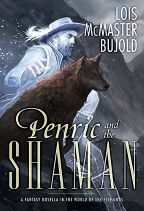
Lois McMaster Bujold, Penric and the Shaman

Four years after making the acquaintance of the demon Desdemona, sorcerer Penric has become a divine in the Bastard’s order. In that capacity, he is asked to participate in the hunt for a runaway shaman who’s responsible for the death of a young nobleman. His partner, the in-world equivalent of a police officer, distrusts all sorcerers and isn’t impressed by Pen’s youth and affability. But as they work together, they come to understand one another better—and realize that the shaman also isn’t quite what he seems. This novella has a lot of world-building that I found a bit hard to follow, even though I’ve read The Hallowed Hunt, which introduced the concept of shamans in this world. There’s also not much conflict; all the major players are well-intentioned and willing to collaborate to solve their problems. But I did enjoy the story and liked seeing Pen impress those who initially underestimated him. I’m excited to continue this series!

Ernest Hemingway, A Moveable Feast

I just got back from my first trip to Paris and thought this would be the perfect book to read while I was there! It’s Hemingway’s fictionalized account of his life in Paris in the 1920s with his first wife, Hadley. He talks about his favorite cafés, his writing process, his affinity for gambling and skiing, and his many friends and acquaintances in the Parisian literary world, such as Gertrude Stein and F. Scott Fitzgerald. I wouldn’t say I’m a huge Hemingway fan, but I do admire his writing style, and there are plenty of wonderfully evocative turns of phrase in this book. I think it’s a bit uneven—which is fair, as it was incomplete when he died and published posthumously—and I’m not sure I’ll ever want to reread it. I think it’s a bit too inside-baseball unless you’re intimately familiar with Hemingway and all the people he describes. Still, it’s reminded me that I would like to read more of Hemingway’s fiction.

Caroline Linden, An Earl Like You

Hugh Deveraux has just inherited an earldom, and with it a mountain of debt that his father had kept secret. With a widowed mother and two sisters to support, he needs money fast. He tries to recover his fortunes at the gaming tables, where he receives an unusual proposal: Rich merchant Edward Cross wants his daughter, Eliza, to marry an aristocrat. If Hugh is willing to be the bridegroom, Cross will pay all his debts and give Eliza a hefty dowry. Hugh is reluctant at first, but when he meets the warm and down-to-earth Eliza, he decides to go through with the marriage. But what will happen when Eliza discovers that her handsome suitor is only after her money? I quite enjoyed this variation on the marriage-of-convenience plot, where only one partner knows it’s a marriage of convenience. Hugh’s deception is appalling, especially because the kind and trusting Eliza thinks it’s a love match, and the book treats this conflict with the gravity it deserves while still making Hugh a likable and redeemable character. I liked this one and may try more from the author.

Mini-Reviews: Miles, Plot, Country

Jenny Colgan, 500 Miles from You

Lissa and Cormac are both home care nurses, she in London and he in the tiny town of Kirrinfief, Scotland. When Lissa is traumatized by an on-the-job tragedy, her boss forces her into a swap: She’ll go to Kirrinfief for three months, where she’ll theoretically have enough peace and quiet to begin healing, and Cormac will take her place in London. At first, both Lissa and Cormac have trouble adjusting to their new surroundings, but gradually they grow and change in unexpected ways. I’ve read a few books by Colgan and found them sweet, uplifting comfort reads. This book definitely has more darkness in it: Lissa’s trauma is described in detail, and many of the patients she and Cormac treat suffer horribly. But the novel retains a gentle feel and warm sense of community, especially in Kirrinfief. Scottish life is a bit too idealized, and the novel seemed to end rather abruptly, but I did enjoy it overall and will continue to read more by Colgan.

Genevieve Cogman, The Lost Plot

In this fourth installment of the Invisible Library series, Irene and Kai are unwillingly roped into political intrigue among the dragons, which puts the Library’s careful neutrality between dragons and Fae in jeopardy. To protect the Library, Irene and Kai travel to an alternate version of Prohibition-era New York City, where they have to evade mobsters and police as well as dragons. This fourth installment of the Invisible Library series is a fun read, consistent with previous books in the series. I enjoyed the new setting with its gangsters and speakeasies, and Irene continues to subtly grow and change as she realizes the Library isn’t always her highest priority. I missed Vale in this book, but it looks like he’ll be more prominent in book 5, which I plan to read next month.

Fiona Hill, The Country Gentleman

Anne Guilfoyle is celebrated as one of the cleverest ladies in London, and she relishes her position and status. But when her fortune is lost due to a bad investment, she’s forced to move to a country manor she’s inherited from a distant relative—and by the terms of the will, she must reside there for 10 months every year. Anne resents the change in her circumstances and views her country neighbors—especially the owner of the closest estate, Henry Highet—as ignorant bumpkins. But as she acclimates to her new life, she grows to appreciate country living, and Highet, more. I’m always on the hunt for well-written, steamless historical romances, and this one definitely fits the bill! Anne is somewhat hard to like at first, as she’s very condescending, but she grows sufficiently throughout the book. I also really liked Anne’s companion and the secondary love story featuring her. Overall, this was a very pleasant surprise, and I’m eager to try more by Fiona Hill.

Review: Speak Easy, Speak Love

speak easy, speak loveMcKelle George, Speak Easy, Speak Love

This debut novel is a YA retelling of Much Ado about Nothing set in the 1920s. Hero Stahr and her father Leo run a speakeasy called Hey Nonny Nonny on Long Island, with the help of Pedro “Prince” Morello. Benedick Scott is an aspiring novelist who chafes under his privileged upbringing and finds a sympathetic home at Hey Nonny Nonny. So does Beatrice Clark, Hero’s cousin, who wants to be a doctor despite her gender and her poverty. Margaret Hughes, the speakeasy’s resident jazz singer, longs for success on a bigger stage — almost as much as she longs for Prince’s standoffish brother, John — but her black skin may stop her from achieving either dream. As these characters fight to keep Hey Nonny Nonny up and running, they must deal with parental pressures, misunderstandings, dangerous bootleggers, and falling in love.

I wasn’t prepared for how much I would love this book. The premise sounded fun, but I thought at best I’d get a lighthearted romp — or, more likely, it would all go horribly wrong. I didn’t expect to care so deeply about these characters, to be so moved by their stories, or to be so invested in their relationships. But I adored this book, and I’m very sure it will be on my “best of 2019” list a year from now! The writing style is sharp and inventive — Beatrice, for example, is described as “a clock-throwing ruin of a girl,” and how could you not love her after that description? I loved the central romance between Beatrice and Benedick, which unfolds with agonizing, delicious slowness. As in Shakespeare’s original, the joy comes from their teasing banter and mutual respect for each other’s intelligence. The book deviates from the play somewhat with the secondary characters, but I thought all the changes made sense and enhanced the story the author was telling. In short, I loved (LOVED) this book and would definitely recommend it to anyone who likes the premise!

Review: City of Jasmine

city of jasmineDeanna Raybourn, City of Jasmine

Famed aviatrix Evangeline Starke is in the midst of a big publicity stunt, flying her plane over the seven seas of antiquity. This trip is motivated by her need for money, her thirst for adventure, and her subconscious desire to move past the death of her husband, Gabriel, which occurred five years before. But when Evie receives a mysterious — and apparently current — photo of Gabriel, she is determined to discover whether he is still alive, and if so, what really happened to him five years ago. Her search takes her to the ancient city of Damascus, where various European countries are carving up the region into strategically advantageous states, and into the heart of the desert itself. What she finds is a priceless relic, ethnic tensions, life-threatening dangers, and possibly a second chance at love.

Something has happened to me in the way I react to Deanna Raybourn’s books. When I first read Silent in the Grave, I remember really loving it and being eager to read the rest of the series. I loved the combination of 19th century historical detail, mystery, and romance, which, as I recall, was fairly unique in my experience at the time. I think the issue is that, as time has passed, I’ve read a lot more books; I’ve become a more sophisticated consumer and have read more widely in the various genres I like. As a result, Raybourn’s brand of historical fiction no longer seems particularly unique or special to me. She has good plots and some funny lines, but her characters are pretty typical for the genre, and I’m not fond of the rugged alpha males she tends to use as heroes. This particular novel is quite entertaining, and I really can’t point to anything wrong with it; it just didn’t really excite me, and I’ve already removed it from my shelves.

Review: The Impersonator

Impersonator, TheMary Miley, The Impersonator

Leah Randall is a talented but impoverished actress who has worked on the vaudeville circuit her whole life. During the course of one performance, she notices a strange man watching her intently. Eventually this man, Oliver Beckett, approaches her with an astonishing proposal. He tells Leah the story of his niece, Jessie Carr, heiress to a substantial fortune, who vanished from her home several years ago without a trace. Leah bears a striking resemblance to Jessie, so Oliver proposes a scheme: Leah will pose as Jessie and return “home” to claim her inheritance, which she will then split with Oliver. At first Leah wants nothing to do with it, but when she is fired from her vaudeville act and can’t get other work, she eventually reconsiders. With Oliver’s help, she assumes Jessie Carr’s identity and travels to the Carrs’ home in Oregon. But the more time she spends with the Carrs, the more she becomes determined to discover what really happened to Jessie all those years ago.

If you read that plot summary and thought, “That sounds an awful lot like Brat Farrar by Josephine Tey,” well, you’d be right. The premise is exactly the same — Miley even acknowledges that Tey’s novel was the main inspiration for her own — but I enjoyed Miley’s novel in its own right. I especially liked the period details about vaudeville, speakeasies, and other highlights of life in the 1920s. There were even references to some Supreme Court cases of the era, which I appreciated as a law school survivor. I also liked Leah’s narrative voice: she’s plain-spoken, independent, and very aware of both her talents and her flaws. The thing is, though, Brat Farrar is still by far the superior book. Miley’s novel is a bit disorganized at times, including several subplots that are more distracting than intriguing. I also hated the romantic aspect of this book; it was unbelievable and underdeveloped. I did enjoy the book overall and found it very readable, but if the premise sounds interesting to you, you should really just read the original instead!

Review: Murder Your Darlings

Murder Your DarlingsJ.J. Murphy, Murder Your Darlings

Dorothy Parker is famous for her elegant quips, biting wit, and copious consumption of alcohol, but this novel also imagines her as an amateur sleuth. When Dorothy shows up at the Algonquin for lunch with her fellow literati, she sees a man’s feet sticking out from under the Round Table. But he’s not dead drunk, as Dorothy first assumes — just dead. Dorothy and her friends soon learn that the corpse is Leland Mayflower, a famous critic with many professional rivals. The police are intent on arresting a shy young Mississippi writer named Billy Faulkner, but Dorothy thinks they’ve got the wrong man. Along with Robert Benchley and the rest of the Algonquin’s “vicious circle,” Dorothy sets out to find the real killer, tossing off jokes and martinis with equal speed along the way.

I don’t know too terribly much about Dorothy Parker, but when I saw the premise of this book, I knew I had to check it out. It’s an extremely fun read, mostly because of the rapid-fire dialogue between Dorothy and her literary friends. I especially loved Robert Benchley’s character, whom I pictured as a slightly more intelligent Bertie Wooster. The mystery itself is definitely secondary to the setting and all of the famous characters, but it’s still well-plotted. My only complaint is that the ending dragged on for too long. After the guilty party’s identity is revealed, there are several more chapters in which Dorothy, the police, and a mob boss all chase the murderer around New York City. It got a bit tedious for me; I don’t enjoy a long denouement once the villain is unmasked. But overall I enjoyed this book a lot, and it’s inspired me to finally read some Dorothy Parker!