Review: Unnatural Death

Unnatural DeathDorothy L. Sayers, Unnatural Death

While dining out one day, Lord Peter Wimsey and his friend Inspector Parker are discussing so-called accidental deaths that might actually be murders. A young doctor overhears them and joins their conversation. He shares the story of a former patient, an elderly woman with cancer who died rather suddenly. She was terminally ill, and no signs of foul play were found on the body, so everyone believed her death was natural; but the doctor was nevertheless suspicious because she had seemed to be improving lately. The woman’s great-niece and presumed heiress was living with her at the time, so she had opportunity, but her motive was questionable because the old lady would die soon enough from natural causes. Lord Peter is intrigued by the case and decides to investigate. He employs Miss Climpson, a chatty but intelligent spinster, to temporarily relocate to the dead woman’s village and do some discreet investigating. Meanwhile, he and Parker search for other suspects, motives, and possible methods of the murder.

After rediscovering Dorothy Sayers earlier this year, I’ve embarked on a project to read all her Lord Peter Wimsey books in publication order. This is book #3 in the series, but if I recall correctly, it can be read as a standalone. I enjoyed this book a lot, but I feel like it’s a very unusual detective story. Despite a high body count, it doesn’t feel very action-packed or plot-driven. The main mystery is not whodunnit, but why and how. One of the biggest clues to the motive is a tiny change in an obscure property statute. Nevertheless, I found the mystery compelling and was eager to solve the complete puzzle of how and why the murder took place. Also, Miss Climpson is delightful; this is her first appearance in the series, but I believe she’ll be a recurring character in future books. She reminds me somewhat of a Jane Austen character — one of the good-hearted chatterboxes, like a more intelligent Miss Bates. I wasn’t completely on board with the characterization of the villain, whose psychology didn’t ring true for me. I doubt this will be my favorite Sayers mystery, but I did enjoy it and look forward to reading the rest of the series.

Review: Dear Enemy

Dear EnemyJean Webster, Dear Enemy

This sequel to Daddy-Long-Legs centers around Judy’s college friend Sallie McBride, a cheerful but frivolous young woman whose wealth has prevented her from ever having to work for a living. So when Judy and her husband encourage Sallie to take over the administration of the orphanage where Judy grew up, Sallie is flabbergasted. At first she outright refuses their proposal, but eventually they convince her to give it a try. Sallie is shocked to discover that she has an aptitude for the work; and what’s more, she enjoys it! Slowly but surely, she begins to reform the orphanage and give a little joy to the orphans in her care. She also clashes immediately with the local doctor, Robin MacRae, whom she frequently addresses as “Dear Enemy.” But the more they are forced to work together, the more they come to recognize each other’s good qualities, until an unexpected tragedy finally forces Sallie to confront her true feelings.

Like Daddy-Long-Legs before it, this book is a charmingly old-fashioned epistolary novel that I absolutely adored! Sallie is an entertaining correspondent, and her letters (mostly to Judy) are light and chatty and lots of fun to read. I enjoyed the romance a lot as well — maybe even more so than in DLL (and those who’ve read DLL will understand why!). The book is also interesting for its exploration of the role of women in the workforce. Sallie encounters a lot of skepticism from the local community about whether she’s capable of being a good administrator, but she joyfully and determinedly proves them all wrong. The book is less progressive in its depiction of mental illness: both Sallie and the doctor make a few comments about “feeble-mindedness” and how people with subnormal mental functioning shouldn’t reproduce. But aside from that jarring reminder of the book’s age (pub date 1915), I really loved this book and would definitely recommend it to fans of older fiction, although I do suggest reading Daddy-Long-Legs first!

Review: Bridge of Spies

Bridge of SpiesGiles Whittell, Bridge of Spies: A True Story of the Cold War

This book tells the story of a Cold War prisoner exchange that, in the author’s view, helped to stave off World War Three. William Fisher, a.k.a. Rudolf Abel, was a Soviet agent (actually British by nationality) who was captured in New York city because of his work spying on the U.S. nuclear program. Francis Gary Powers was an American pilot flying reconnaissance over the Soviet Union to get a look at its nuclear arsenal; he was shot down on one of his missions and imprisoned in Russia. And Frederic Pryor actually had nothing to do with the spy game at all — he was simply an American student in Berlin studying Eastern economics, arrested by the Stasi because he fit their profile of what a spy should look like. Cold War tensions were running high at this time, so the agreement to trade Abel for Powers and Pryor was a vital gesture of good faith between the U.S. and the Soviet Union.

In my American history classes in school, my teachers would always run out of time at the end of the year, so we’d usually only get as far as World War II in the lesson plan. As a result, I know basically nothing about the Cold War and was excited to read this book to learn more. I have to say, I found it slow going at first, as Whittell takes a long time to set up the three prisoners’ backgrounds. He also goes into stupefying detail about the type of plane Powers flew and the various engineering difficulties that its inventors encountered. But once the prisoners’ arrests are described, the book picks up considerably as it focuses on the political machinations needed to accomplish the prisoner exchange. The book also seems to be very well-researched, as Whittell was able to interview many of the people involved firsthand. I’m not sure it’s a particularly groundbreaking work, but I did find it interesting, and I’m now looking forward to seeing the film version with Tom Hanks.

Review: The Other Daughter

Other Daughter, TheLauren Willig, The Other Daughter

Working-class Rachel Woodley is currently employed as a governess in France, but she must return to England in a hurry when she learns that her mother is ill. By the time she gets back to her native village, her mother has died. As a grieving Rachel sorts through her mother’s possessions, she discovers a shocking secret: her father, whom she believed had died many years ago, is actually alive and well. Moreover, he’s an earl with a wife and daughter — his legitimate family. Shocked and angry, Rachel decides she must confront her father somehow. With the help of Simon Montfort, a young gentleman who is part of the earl’s social circle, Rachel assumes a new identity in order to get closer to her father. As she infiltrates the crowd of Bright Young Things in 1920s London, she manages to meet her half-sister and even obtain an invitation to the earl’s home. But the more she gets to know this side of her family, the more Rachel wavers in her desire for revenge.

While I adore Lauren Willig’s Pink Carnation series, her standalone novels have been a bit less successful, in my opinion. They usually lack the humor that makes the Pink Carnation books so much fun, and Willig’s trademark dual narratives (one historical, one contemporary) would split my focus in a way that I found very distracting. Happily, in this book, there is no contemporary framework narrative; the entire book follows Rachel’s journey in the 1920s. Perhaps for this reason, I ended up really liking the novel! I found Rachel’s motivations and feelings very believable, as she tries to deal with the fact that her entire identity has shifted. I also like that her feelings slowly change as she realizes that neither her father nor her half-sister is the pure villain she imagined at first. Of course, there’s a romance in the book as well, which I enjoyed very much — Simon is a delicious hero with a very interesting backstory. Overall, I liked this book a lot and would definitely recommend it to fans of historical fiction!

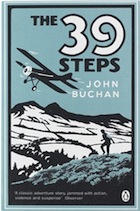
Review: The Thirty-Nine Steps

39 Steps, TheJohn Buchan, The Thirty-Nine Steps

Richard Hannay is fed up. He has just returned to London after several years in South Africa, where he’s led an adventurous life and made a modest fortune. His current life of leisure in England seems incredibly dull by comparison — that is, until his neighbor knocks on his door one day with an amazing story about international conspiracies, assassination plots, and his own very important mission. Hannay isn’t sure what to make of the story at first but agrees to keep his neighbor’s secret. When the man is murdered shortly thereafter, Hannay concludes that his farfetched story must actually be true, and he decides to take over the dead man’s mission to deliver some secret documents to a highly important member of the British government. He immediately finds himself on the run, as the people who murdered his neighbor are now on his trail. Hannay encounters a variety of people on his journey, both friend and foe, and he relies on his instincts to tell him whom he can trust with his story. In some cases these instincts are right, while in others, they are very, very wrong. But somehow, he always manages to stay one step ahead of his pursuers as he searches for the mysterious location with the 39 steps, where the evildoers can all be captured in one fell swoop.

This is one of those books that’s fun to read as a historical artifact, but I feel like it would never be published today. Spy thrillers are so popular in book, TV, and movie formats that audiences have become very sophisticated. The plot of this book may have been cutting-edge when it was published in 1915, but for a modern reader, it’s pretty predictable and really strains credulity at times. Hannay’s actual mission isn’t important; the dramatic tension in the book comes from the fact that he’s being followed, as well as the fact that some pursuers are actually lying in wait for him. There is one pretty suspenseful scene near the end where Hannay is in a room with the suspected evildoers, and he’s suddenly struck with self-doubt: are these people actually the bad guys, or has he been imagining the whole thing? But I did mentally roll my eyes at Hannay several times, as he basically blurts out the entire story to everyone he meets without once stopping to wonder, “Should I actually trust this person?” Still, despite its flaws, I did find the book entertaining and would consider reading more of Hannay’s adventures. I also need to check out the Hitchcock movie now!

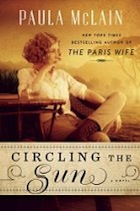
Review: Circling the Sun

Circling the SunPaula McLain, Circling the Sun

Beryl Markham is known to history as one of the pioneers of aviation: she was the first woman to fly solo across the Atlantic from east to west. But this novelized version of her life focuses on her childhood and youth on an African farm in what is now Kenya. Beryl’s family moved to Kenya when she was four years old, but her mother had trouble adapting to African life and soon returned to England. As a result, Beryl’s upbringing was unconventional, and her education was sporadic at best. She grew up with a deep love of the land and creatures surrounding her, and she loved to ride, shoot, and train horses. But as she approached adulthood, her father’s farm fell on hard times, and he eventually decided to sell the property and relocate to Nairobi. Distraught at the thought of leaving her home, and unwilling to be a burden on her father (with whom she was not close), Beryl married a neighboring farmer. But the marriage was not a happy one, and Beryl soon left him to become a horse trainer in her own right. The novel follows Beryl’s attempts to stand on her own against the odds, and it also chronicles her friendship with Karen Blixen — better known as Isak Dinesen, the author of Out of Africa — and her love affair with Denys Finch Hatton, whom the book portrays as the great love of Beryl’s life.

This book initially caught my interest because I find the early days of flight fascinating. It’s amazing to me that traveling by plane is so common now, when back then it was terribly dangerous, and only the most daring adventurers were brave enough to attempt it. Unfortunately, this novel has almost nothing to do with Beryl Markham’s career as an aviatrix; but I still ended up enjoying it a lot for the setting and characters. I don’t know much about Beryl’s life, so I can’t say how accurate the book is in its details, but it certainly paints a vivid and compelling picture of her character and of life in British East Africa at that time. The Beryl of this book was certainly ahead of her time in many ways. She married and divorced multiple times, and she had several extramarital affairs, including one with Prince Henry, Duke of Gloucester. She pursued a career at a time when most women were still relegated to the home. Such characteristics make her a compelling heroine, and I enjoyed reading about her adventures — although this book focuses a lot on her various romances, when I really wanted to know more about her professional life and aspirations. But I did enjoy the novel and would like to learn more about this era. I’ll have to read Out of Africa and Beryl’s own memoir, West with the Night!

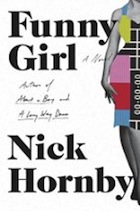
Review: Funny Girl

Funny GirlNick Hornby, Funny Girl

This novel, set in the 1960s, tells the story of Barbara, a girl whose only dream growing up was to go on television and make people laugh. When she wins a local beauty pageant and realizes that she’s about to become stuck in a small-town rut forever, she moves to London to pursue her goal. Her good looks attract the attention of an agent, but all he wants is for her to stand there and look pretty in various insipid commercials. Eventually, however, by sheer luck she teams up with a group of comedy writers who are trying to develop a new show for the BBC. There are Tony Holmes and Bill Gardiner, who have been writing partners for years; there’s Dennis Maxwell Bishop, the meek producer who’s trapped in an unhappy marriage; and there’s Clive Richardson, the handsome, arrogant actor who will be playing the male lead in the show. Against all odds, Barbara — now using her stage name of Sophie Straw — lands the part, and the show becomes an unexpected hit. Throughout its run, Sophie and her colleagues must deal with love affairs, identity crises, divorces, and changing artistic visions; but in the end, they are inextricably linked by the shared bond of creating a show that changed all their lives.

I’m a big fan of Nick Hornby’s books, so I was excited to read this latest release. It’s a bit different from his earlier works — still very funny, but in a subtler way. My favorite parts of the book are when the four main characters are just sitting around, discussing the show and trying to break new stories. It’s a pleasure to watch them all interact and tease each other. It’s obvious that, regardless of the personal issues these characters might have with each other (or in their lives outside of work), they are all genuinely fond of each other. Because of this focus on the characters, there’s not a whole lot of plot in the book; it covers the show from beginning to end, then goes forward in time to explore what happens to Sophie and the other characters. To be honest, I wasn’t a big fan of the time jump; it made the book drag on and minimized the various setbacks and triumphs that occurred during the show’s run. Nevertheless, I enjoyed this book overall and would recommend it to people who like character-driven books, as well as people who are nostalgic for ’60s-era television.

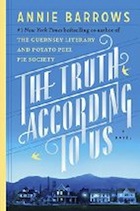
Review: The Truth According to Us

Truth According to Us, TheAnnie Barrows, The Truth According to Us

Though the U.S. in the 1930s is sunk in a depression, senator’s daughter Layla Beck doesn’t have much firsthand experience of deprivation — until she refuses to marry the man her parents have picked out for her, and they cut her off, forcing her to get a job. Her father’s connections get her a position with the Federal Writers’ Project, which gives her the assignment of writing a local history for the town of Macedonia, West Virginia. At first, Layla is extremely resistant to the idea of burying herself in such a tiny town, and she tries to get out of the assignment, but since there’s no other work to be had, she must eventually give in. When she arrives in Macedonia, she stays with the eccentric Romeyn family, which includes the dashing Felix, his strong-minded sister Jottie, and his precocious daughter Willa. Layla can’t help but be drawn to Felix, but the closer she becomes to him, the more she realizes that the Romeyns are hiding a decades-old secret that could shake Macedonia to its core. Meanwhile, 12-year-old Willa is just beginning to observe the strange behavior of the adults around her — and to take the first steps towards growing up herself.

Since Annie Barrows co-authored one of my favorite books, The Guernsey Literary and Potato Peel Pie Society, I had high hopes for this new novel, and I’m happy to say I enjoyed it very much. First of all, I loved the depiction of Macedonia, West Virginia, and its inhabitants. I honestly felt like I was living in this book — I could almost feel the summer heat bearing down on me. I also especially enjoyed the chapters written from Willa’s point of view. I loved her sharp yet childlike observations of the people around her, and how she slowly changes as she begins to realize that the adults in her life have interior lives and secrets of their own. It’s been a long time since I read To Kill a Mockingbird, but her voice made me think of Scout Finch quite a bit. I also loved Jottie, an intelligent, loving woman who has experienced tragedy but hasn’t let it break her. And although Layla is a bit snooty in the beginning of the book, her experiences in Macedonia definitely change her for the better as well. My one complaint is that the book is a little long; I think it probably could have been edited a bit more thoroughly. But overall, I liked this book a lot and would definitely recommend it to fans of historical fiction and/or literature about the South.

Review: Murder Underground

Murder UndergroundMavis Doriel Hay, Murder Underground

Miss Euphemia Pongleton is an unpleasant old woman living in a dreary but respectable London boardinghouse. When she is strangled on the steps of the Belsize Park underground station, her fellow boardinghouse residents are surprised rather than saddened; but they soon move past their shock to speculate on who might have done the deed. The police have arrested one suspect, the boyfriend of a maid in the boardinghouse who had been involved with some petty thievery. But the maid is convinced her man is innocent, and the boarders entertain themselves by coming up with alternate theories of the murder. Naturally, Miss Pongleton’s nephew Basil, who always seems to need money and who depends on inheriting his aunt’s fortune, is a prime suspect. But Basil, despite some highly suspicious behavior on the day of the murder, insists that he is innocent. Are his protests a clever ruse, or could someone else in the boardinghouse have wanted Miss Pongleton dead?

This was a very enjoyable Golden Age mystery, although there’s really nothing that makes it stand out from the genre as a whole. But sometimes formulaic plots are comforting, and that’s why I usually enjoy mysteries from this era. There’s the unpleasant murder victim whom we don’t need to mourn; a variety of suspects with a variety of motives, secrets, and questionable alibis; the secondary love story; and the amateur detectives who solve the crime without the involvement or assistance of the police. The mystery is well plotted, and I didn’t guess who the murderer was (although I suspected almost every character at one point or other). There are also some lovely bits of humor, such as when the boardinghouse residents fight tenaciously — but silently — over who gets to sit in Miss Pongleton’s chair. All in all, I’d recommend this to fans of Golden Age mysteries, but it’s definitely not a stellar example of the genre.

Review: As Chimney Sweepers Come to Dust

As Chimney Sweepers Come to DustAlan Bradley, As Chimney Sweepers Come to Dust

***Warning: SPOILERS for previous books in the series!***

Flavia de Luce’s life has been turned upside-down by the shocking revelation that her mother, Harriet, worked as a spy for England before her death. What’s more, Harriet was groomed for this work at an elite Canadian boarding school, where she belonged to a secret society called the Nide. Now the twelve-year-old Flavia must follow in her mother’s footsteps all the way to Miss Bodycote’s Female Academy, so that she can carry on the family’s legacy of covert service to England. But Flavia is less than thrilled about leaving Buckshaw and all her family and friends behind. Still, Miss Bodycote’s proves more interesting than Flavia expected when a dead body falls down the chimney into her bedroom on her very first night at the school. But whose body is it, and who would have placed the remains there? Was it a fellow student? The science teacher who was once tried for murder? Perhaps even the stern headmistress herself? Once again, Flavia uses her insatiable curiosity and her passion for chemistry to discover how, why, and by whom the victim was murdered. She also struggles to fit in at Miss Bodycote’s and eventually makes an important decision about her future.

This book marks a significant change in the direction of the series, as Flavia is uprooted from Bishop’s Lacey and placed in different surroundings with an entirely new cast of characters. Some people were skeptical about this change, but I was optimistic going in; if series aren’t willing to shake things up sometimes, they risk becoming stale. Unfortunately, I don’t think this particular change was terribly successful. The idea of Flavia trying to fit in at a strict boarding school filled me with glee, but this book doesn’t spend much time on her interactions with the other students, except as necessary for her investigation. And the book really suffers for not having Father, Feely, Daffy, and Dogger to be Flavia’s confidantes, friends, and sometimes enemies. I don’t read this series predominantly for the mysteries; while these are usually fine, the books’ charm lies in Flavia and her unique reactions to the people around her. And sadly, in this book, her social interactions just weren’t as funny, interesting, or poignant as they usually are. The end of this novel promises another change for Flavia, and I hope that the next book will take things in a more satisfying direction.