Review: Late Nights on Air

Late Nights on AirElizabeth Hay, Late Nights on Air

This novel centers around a small group of people working at a radio station in Yellowknife, Northwest Territories, Canada. Harry is a once-promising radio man who has returned to Yellowknife after a disastrous attempt at television. Eleanor, the station’s receptionist, has no life of her own but is keenly observant of the lives of others. Gwen has recently moved to town and is hoping to learn radio production at the station. And newcomer Dido is a natural on-air talent who catalyzes various shifts in the station’s social atmosphere. All these characters have been drawn to Yellowknife for different reasons, but they are united in their fascination and love for the austere beauty of northern Canada. As they develop new friendships, romances, and animosities, they also discuss the history, mythology, and current concerns of the Canadian frontier — especially as a proposed transnational pipeline threatens its very identity.

I picked up this book for its setting, and I think it does a wonderful job of immersing readers in the unique world of the Canadian North. There are lovingly detailed descriptions of weather, scenery, and wildlife; digressive anecdotes about Canadian history, especially the many European explorers who attempted to survive the brutal winters; discussions about the relationship between white settlers and native peoples; and nostalgia for a fading way of life. Hay cleverly uses the debates and hearings surrounding the Mackenzie Valley Pipeline as a framework for her story; the possible destruction of the northern ecosystem parallels the slow destruction of radio as the primary medium for storytelling due to the arrival of television. The novel is somber and contemplative in tone, and the focus is on character and setting much more than on plot. But for anyone interested in books with a unique and vividly described setting, I would definitely recommend this!
Review: The Impersonator

Impersonator, TheMary Miley, The Impersonator

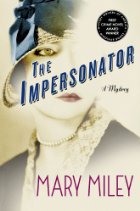
Leah Randall is a talented but impoverished actress who has worked on the vaudeville circuit her whole life. During the course of one performance, she notices a strange man watching her intently. Eventually this man, Oliver Beckett, approaches her with an astonishing proposal. He tells Leah the story of his niece, Jessie Carr, heiress to a substantial fortune, who vanished from her home several years ago without a trace. Leah bears a striking resemblance to Jessie, so Oliver proposes a scheme: Leah will pose as Jessie and return “home” to claim her inheritance, which she will then split with Oliver. At first Leah wants nothing to do with it, but when she is fired from her vaudeville act and can’t get other work, she eventually reconsiders. With Oliver’s help, she assumes Jessie Carr’s identity and travels to the Carrs’ home in Oregon. But the more time she spends with the Carrs, the more she becomes determined to discover what really happened to Jessie all those years ago.

If you read that plot summary and thought, “That sounds an awful lot like Brat Farrar by Josephine Tey,” well, you’d be right. The premise is exactly the same — Miley even acknowledges that Tey’s novel was the main inspiration for her own — but I enjoyed Miley’s novel in its own right. I especially liked the period details about vaudeville, speakeasies, and other highlights of life in the 1920s. There were even references to some Supreme Court cases of the era, which I appreciated as a law school survivor. I also liked Leah’s narrative voice: she’s plain-spoken, independent, and very aware of both her talents and her flaws. The thing is, though, Brat Farrar is still by far the superior book. Miley’s novel is a bit disorganized at times, including several subplots that are more distracting than intriguing. I also hated the romantic aspect of this book; it was unbelievable and underdeveloped. I did enjoy the book overall and found it very readable, but if the premise sounds interesting to you, you should really just read the original instead!

Review: The Case of the Gilded Fly

The Case of the Gilded FlyEdmund Crispin, The Case of the Gilded Fly

In 1940s England, a theater troupe converges upon Oxford to produce a new play by acclaimed playwright Robert Warner. One of the actresses, Yseut Haskell, is a beautiful girl who has attracted many admirers, but her outward appearance masks a cruel and self-absorbed personality. The other people involved with the play are frankly sick of her attitude, especially when she begins to stir up trouble within the company. So it’s not particularly surprising when Yseut is subsequently found murdered — in fact, nearly everyone in the theater company expresses relief that she’s finally gotten what she deserved. In the midst of this tense situation, Oxford don Gervase Fen uses his passion for criminology and his friendship with policeman Sir Richard Freeman to investigate the murder. As he talks to the various suspects and uncovers some unpleasant secrets, he begins to wonder whether exposing the murderer is really the best course of action.

This is a fairly typical Golden Age mystery, and as a fan of that genre, I enjoyed this book. I found Gervase Fen entertaining, although he wasn’t as prominent in the book as I expected he’d be; much of the story is told from the viewpoint of Nigel Blake, a young man who becomes involved with the theater troupe and falls in love with one of the actresses. I can see why Crispin chose that approach, though, because Fen claims to have solved the murder within three minutes of viewing the body! I also found Fen’s qualms about exposing the murderer very interesting. In many mysteries, it’s taken as a matter of course that the murderer should be unmasked and brought to justice; however, in this case the victim is a truly unpleasant person, and many of the characters think that the murderer did them a favor. Finally, I was struck by the fact that this really doesn’t feel like the first book of a series; there are several allusions to Fen’s past cases, and as I mentioned before, his character isn’t particularly fleshed out. Nevertheless, there are a few more Gervase Fen books, and I’ll probably seek them out at some point.

Review: Dreamers of the Day

Dreamers of the DayMary Doria Russell, Dreamers of the Day

This novel, set in the early 20th century, is narrated by Agnes Shanklin, a schoolteacher who has spent her entire life caring for her domineering mother. But when the influenza pandemic of 1918 carries off most of her family, including Mumma, Agnes finds herself unexpectedly inheriting a substantial sum of money. Though she is grieved by the multiple deaths in her family, she is also finally free from Mumma’s influence. Impulsively, she decides to see the world and books a trip to Egypt. There she meets several prominent British officers and diplomats, who are in Cairo to come to an agreement on Middle Eastern policy. Agnes is drawn into their social circle and mingles with the likes of Winston Churchill and Thomas Edward Lawrence, now famously known as “Lawrence of Arabia.” She also meets a German called Karl Weilbacher, who is handsome, kind, and attentive, but may not be all that he seems. Ultimately, the people Agnes meets and events she witnesses in Egypt will have a profound effect on the rest of her life.

After finally reading and loving Doc, I was eager to try another book by Mary Doria Russell. This one was very readable, and the insights into the Cairo Conference of 1921 were fascinating. It’s a historical event that still has obvious ramifications for our world today, covering issues such as a Jewish homeland in Palestine, the territorial boundaries of new nations like Iraq, and the amount of influence Western countries should continue to have in the Middle East. I enjoyed Russell’s depictions of real historical figures in this book, particularly Churchill, wo made me laugh even at his most exasperating. I didn’t like this novel nearly as much as Doc, however, mostly because I found it too preachy. Agnes is an extremely opinionated character, and due to a strange framing device in the novel, she narrates from a quasi-omniscient perspective. Because of this, she judges the events of her time from a 21st-century point of view, which I find very irritating in historical novels. And since Western involvement in the Middle East is still a very complex and controversial issue, I didn’t appreciate Agnes’ more simplistic perspective. But even though this aspect of the book rubbed me the wrong way, I think it’s still worth a read for people interested in the time period or in the creation of the modern Middle East.

Review: They Found Him Dead

They Found Him DeadGeorgette Heyer, They Found Him Dead

This book begins, as so many classic British mysteries do, with an ill-fated party at an English country house. Silas Kane is celebrating his 60th birthday, but many of his guests aren’t in a particularly happy mood. His heir, Clement, is desperate to get his hands on a piece of the older man’s fortune — especially because his beautiful but materialistic wife, Rosemary, is threatening to leave him. Meanwhile, Silas’ neighbor and business partner is eager to interest him in an investment opportunity, but so far he has stubbornly refused to consider the deal. So when Silas is discovered dead the day after the party — having apparently fallen over the cliff where he habitually took a walk every evening — there is no shortage of suspects to consider. And when Clement is shot in the study shortly afterwards, it seems clear that a murderer is at work. Once again, Inspector Hannasyde of Scotland Yard must untangle the various motives in play and discover the identity of a ruthless killer.

I’ve been steadily working my way through Heyer’s mysteries, and this book is a typical example. I always enjoy Heyer’s witty dialogue and hints of romance, although in this book the love story is very peripheral to the main plot. The mystery itself is fine, though there’s nothing particularly surprising for those who read a lot of detective novels. As always, the strength of Heyer’s books is her characters, and there several great ones here, from the self-absorbed Rosemary Kane to the exuberant young Timothy Harte, who is overly eager to assist the police in solving the murder. I should note, however, that while Inspector Hannasyde is a recurring character in Heyer’s mysteries, he is definitely not the protagonist; each individual book tends to revolve around the victim and the suspects much more than around the detective. Anyway, I definitely liked this book overall, but there’s nothing that makes it particularly stand out to me.

Review: Something Wicked This Way Comes

Something Wicked This Way ComesRay Bradbury, Something Wicked This Way Comes

A week before Halloween, Cooger & Dark’s Pandemonium Shadow Show creeps silently into Green Town, Illinois, in the middle of the night. To most of the town’s inhabitants, the show is a carnival like any other, with its sideshows, rides, and circus freaks. But 13-year-old best friends Jim Nightshade and Will Halloway suspect that something more sinister is at work. The carnival seems to lure unwary visitors into its depths, and those who fall under its spell will never be the same again. It’s up to Jim and Will — and Will’s father, an unassuming librarian who worries about his age and his relationship with his son — to uncover the dark secret at the heart of the circus and to prevent it from ensnaring more victims.

I don’t usually read horror novels, but I was interested in this book because of its classic status (and, frankly, because of its Shakespearean title). Unfortunately, this novel really didn’t work for me, but the problem wasn’t the story at all — it was the writing style. The prose is gratingly faux-poetic, overblown, and melodramatic. Words are often used in unconventional ways (nouns being used as verbs and the like), which can be an effective stylistic choice, but in this case I found it incredibly distracting. I also found the dialogue completely unrealistic and stilted. It’s a shame, because I actually do think the basic story is fascinating and could have been very effective in the right hands. I’m definitely not enthusiastic about trying more Bradbury after this — and I’m wondering how well Fahrenheit 451 would stand up to a re-read!

Review: The Roman Hat Mystery

The Roman Hat MysteryEllery Queen, The Roman Hat Mystery

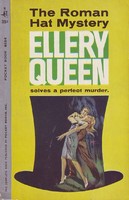
In 1920s New York City, crowds have been thronging to see the latest Broadway hit, a sensationalist gangster play complete with flashing lights and gunfire. But little did the audience members of the Roman theater suspect that a real murder would be committed during the second act! Inspector Richard Queen of the local police is on the scene almost immediately, with his curious son Ellery in tow. In examining the victim’s body, they soon discover an interesting anomaly: despite being dressed in full evening clothes, the dead man wasn’t wearing a top hat. The police scour the Roman theater from top to bottom and search all the audience members as they leave the premises, but the hat is nowhere to be found. While Inspector Queen and his fellow police detectives identify the corpse and discover his involvement in a blackmailing scheme, Ellery applies himself to the mystery of the missing hat — and deduces the identity of the murderer as a result.

I really enjoy classic mysteries from the early 20th century, so I was excited to read this first Ellery Queen novel. Overall, I was very impressed with the mystery plot itself; the solution is tight and hangs together well, although part of the motive is concealed from readers until the very end. (Historical racism is also an aspect of the solution, which can certainly be offputting for contemporary readers.) I also liked the way in which the police were depicted as they investigated the murder: far from being bumbling idiots, they approach their job intelligently and methodically. I was especially tickled by the introduction of the district attorney as a character. Most mystery novels focus solely on catching the killer — never mind if s/he can actually be convicted in a court of law! I wasn’t as impressed with the characterization of the detectives, however. Inspector Queen was more central to this book than Ellery, but he didn’t seem to be consistently depicted, and Ellery was barely fleshed out at all. Presumably, though, more character development occurs in subsequent books, and I’d certainly be willing to read more Ellery Queen novels.

Review: Balzac and the Little Chinese Seamstress

Balzac and the Little Chinese SeamstressDai Sijie, Balzac and the Little Chinese Seamstress (trans. Ina Rilke)

This slight novel tells the story of two young Chinese men who are sent to a remote mountain village to be “re-educated” during the cultural revolution of the 1970s. Both youths are talented individuals; the unnamed narrator plays the violin, and his best friend Luo is a master storyteller. Despite these gifts, however, they soon feel oppressed by the overwhelming boredom of their new lives, where they are forced to perform manual labor from dawn to dusk. But two unexpected events soon occur, changing the course of their lives forever: they discover a hidden cache of Western classics translated into Chinese, and they meet a beautiful young seamstress who steals both their hearts.

This is a very short book, and it honestly felt more like a tableau than a novel to me. The setting is described vividly with meticulous prose, but nothing much happens. I think I was expecting the book to be more overtly political, since the author was himself “re-educated” during this time period and ended up leaving China for France. But while the cultural revolution certainly isn’t praised, the boys’ lives aren’t portrayed in a particularly negative light either. Also, their exposure to Western culture isn’t always a good thing; in fact, their relationship with the seamstress is irrevocably altered by her exposure to European literature. So I was very interested by the ambiguities in the novel, but the plot and characters didn’t particularly grip me. I’d like to read another novel (or nonfiction work) about this time period, which seems like it would be rich in dramatic material.

Review: Million Dollar Baby

Million Dollar BabyAmy Patricia Meade, Million Dollar Baby

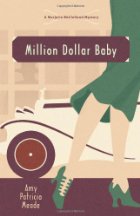
Marjorie McClelland is a mildly successful mystery novelist trying to make ends meet during the Great Depression. Creighton Ashcroft is a wealthy Englishman who has recently purchased the grandest estate in Marjorie’s town. Though they come from two different worlds, Creighton is immediately attracted to the author and offers to help her with her latest book. Marjorie accepts his help, and they soon settle into a daily routine, which is shockingly interrupted by the discovery of a skeleton on Creighton’s property. Creighton and Marjorie call the police immediately, but Creighton regrets this action when the extremely handsome lead detective appears on the scene and competes for Marjorie’s attention. Can this trio of detectives discover what happened to the dead person? And will Creighton be able to win Marjorie’s heart away from his attractive rival?

Being a fan of the classic country house mystery, I was excited to read this book, which is first in a series set in 1930s New England. Unfortunately, I just wasn’t impressed by the writing style. The dialogue was awkward and clumsy, and there was too much “showing” rather than “telling.” I was also annoyed by the rapid shift in Creighton and Marjorie’s relationship; at first, he seems to be merely attracted to her, but about halfway through the book he suddenly feels deep and lasting love. I found the change very abrupt, and I couldn’t figure out why he was so interested in her after a few superficial conversations. I do think the setup of the series is interesting and unique — it’s not every day you have three sleuths embroiled in a love triangle while they attempt to solve crimes! However, the execution just wasn’t good enough for me to continue with the series.

Review: A Whiff of Death

A Whiff of DeathIsaac Asimov, A Whiff of Death

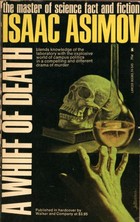
Professor Louis Brade is a middle-aged chemistry professor whose biggest problem is his ongoing struggle for tenure. But his life gets much more complicated when one of his students, Ralph Neufeld, is found dead in the research lab. Outward signs point to an accident; Ralph was preparing an experiment at the time, and he might have accidentally used a poisonous chemical instead of the identical-looking harmless one. But Professor Brade knows that Ralph was a meticulous chemist who would never have made such a mistake. He is reluctant to voice his suspicion that Ralph was murdered, however — especially when it becomes clear that Brade himself is a promising suspect. Can Brade discover the cause of Ralph’s death, clear his name, and avoid becoming the murderer’s next victim?

I was surprised and delighted to discover that Isaac Asimov also wrote detective novels! And I have to say, I was very impressed with this mystery. I enjoyed the academic setting, and although chemistry plays a large role in the story, it’s very easy for non-scientists to follow as well. I also liked Brade as a main character, mostly because of how normal he is compared to other fictional detectives: He’s an intelligent but not brilliant professor, and he has a happy-ish marriage that nevertheless has its fair share of conflict. Finally, I really loved the policeman in this case, whose breezy manner conceals a very sharp mind. The interplay between the policeman and Brade was one of my favorite parts of the book. Overall, I’d definitely recommend this to fans of older mysteries, and I plan to look for more of Asimov’s detective stories.