Review: The Roman Hat Mystery

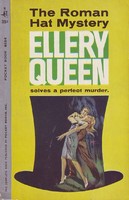
The Roman Hat MysteryEllery Queen, The Roman Hat Mystery

In 1920s New York City, crowds have been thronging to see the latest Broadway hit, a sensationalist gangster play complete with flashing lights and gunfire. But little did the audience members of the Roman theater suspect that a real murder would be committed during the second act! Inspector Richard Queen of the local police is on the scene almost immediately, with his curious son Ellery in tow. In examining the victim’s body, they soon discover an interesting anomaly: despite being dressed in full evening clothes, the dead man wasn’t wearing a top hat. The police scour the Roman theater from top to bottom and search all the audience members as they leave the premises, but the hat is nowhere to be found. While Inspector Queen and his fellow police detectives identify the corpse and discover his involvement in a blackmailing scheme, Ellery applies himself to the mystery of the missing hat — and deduces the identity of the murderer as a result.

I really enjoy classic mysteries from the early 20th century, so I was excited to read this first Ellery Queen novel. Overall, I was very impressed with the mystery plot itself; the solution is tight and hangs together well, although part of the motive is concealed from readers until the very end. (Historical racism is also an aspect of the solution, which can certainly be offputting for contemporary readers.) I also liked the way in which the police were depicted as they investigated the murder: far from being bumbling idiots, they approach their job intelligently and methodically. I was especially tickled by the introduction of the district attorney as a character. Most mystery novels focus solely on catching the killer — never mind if s/he can actually be convicted in a court of law! I wasn’t as impressed with the characterization of the detectives, however. Inspector Queen was more central to this book than Ellery, but he didn’t seem to be consistently depicted, and Ellery was barely fleshed out at all. Presumably, though, more character development occurs in subsequent books, and I’d certainly be willing to read more Ellery Queen novels.

Review: Balzac and the Little Chinese Seamstress

Balzac and the Little Chinese SeamstressDai Sijie, Balzac and the Little Chinese Seamstress (trans. Ina Rilke)

This slight novel tells the story of two young Chinese men who are sent to a remote mountain village to be “re-educated” during the cultural revolution of the 1970s. Both youths are talented individuals; the unnamed narrator plays the violin, and his best friend Luo is a master storyteller. Despite these gifts, however, they soon feel oppressed by the overwhelming boredom of their new lives, where they are forced to perform manual labor from dawn to dusk. But two unexpected events soon occur, changing the course of their lives forever: they discover a hidden cache of Western classics translated into Chinese, and they meet a beautiful young seamstress who steals both their hearts.

This is a very short book, and it honestly felt more like a tableau than a novel to me. The setting is described vividly with meticulous prose, but nothing much happens. I think I was expecting the book to be more overtly political, since the author was himself “re-educated” during this time period and ended up leaving China for France. But while the cultural revolution certainly isn’t praised, the boys’ lives aren’t portrayed in a particularly negative light either. Also, their exposure to Western culture isn’t always a good thing; in fact, their relationship with the seamstress is irrevocably altered by her exposure to European literature. So I was very interested by the ambiguities in the novel, but the plot and characters didn’t particularly grip me. I’d like to read another novel (or nonfiction work) about this time period, which seems like it would be rich in dramatic material.

Review: Million Dollar Baby

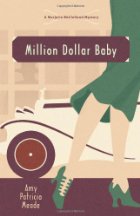
Million Dollar BabyAmy Patricia Meade, Million Dollar Baby

Marjorie McClelland is a mildly successful mystery novelist trying to make ends meet during the Great Depression. Creighton Ashcroft is a wealthy Englishman who has recently purchased the grandest estate in Marjorie’s town. Though they come from two different worlds, Creighton is immediately attracted to the author and offers to help her with her latest book. Marjorie accepts his help, and they soon settle into a daily routine, which is shockingly interrupted by the discovery of a skeleton on Creighton’s property. Creighton and Marjorie call the police immediately, but Creighton regrets this action when the extremely handsome lead detective appears on the scene and competes for Marjorie’s attention. Can this trio of detectives discover what happened to the dead person? And will Creighton be able to win Marjorie’s heart away from his attractive rival?

Being a fan of the classic country house mystery, I was excited to read this book, which is first in a series set in 1930s New England. Unfortunately, I just wasn’t impressed by the writing style. The dialogue was awkward and clumsy, and there was too much “showing” rather than “telling.” I was also annoyed by the rapid shift in Creighton and Marjorie’s relationship; at first, he seems to be merely attracted to her, but about halfway through the book he suddenly feels deep and lasting love. I found the change very abrupt, and I couldn’t figure out why he was so interested in her after a few superficial conversations. I do think the setup of the series is interesting and unique — it’s not every day you have three sleuths embroiled in a love triangle while they attempt to solve crimes! However, the execution just wasn’t good enough for me to continue with the series.

Review: A Whiff of Death

A Whiff of DeathIsaac Asimov, A Whiff of Death

Professor Louis Brade is a middle-aged chemistry professor whose biggest problem is his ongoing struggle for tenure. But his life gets much more complicated when one of his students, Ralph Neufeld, is found dead in the research lab. Outward signs point to an accident; Ralph was preparing an experiment at the time, and he might have accidentally used a poisonous chemical instead of the identical-looking harmless one. But Professor Brade knows that Ralph was a meticulous chemist who would never have made such a mistake. He is reluctant to voice his suspicion that Ralph was murdered, however — especially when it becomes clear that Brade himself is a promising suspect. Can Brade discover the cause of Ralph’s death, clear his name, and avoid becoming the murderer’s next victim?

I was surprised and delighted to discover that Isaac Asimov also wrote detective novels! And I have to say, I was very impressed with this mystery. I enjoyed the academic setting, and although chemistry plays a large role in the story, it’s very easy for non-scientists to follow as well. I also liked Brade as a main character, mostly because of how normal he is compared to other fictional detectives: He’s an intelligent but not brilliant professor, and he has a happy-ish marriage that nevertheless has its fair share of conflict. Finally, I really loved the policeman in this case, whose breezy manner conceals a very sharp mind. The interplay between the policeman and Brade was one of my favorite parts of the book. Overall, I’d definitely recommend this to fans of older mysteries, and I plan to look for more of Asimov’s detective stories.

Review: Royal Blood

Royal BloodRhys Bowen, Royal Blood

Lady Georgiana Rannoch, still both royal and impoverished, is desperately searching for a way to make ends meet — especially when her brother Binky and his odious wife Fig come to London expecting her to feed and house them. So when the queen suggests that Georgie represent the British crown at a royal wedding in Romania, she jumps at the chance for a taste of adventure and temporary freedom from her financial woes. When Georgie arrives at the royal palace — which is inevitably located in Transylvania — she is impressed by its suitably gloomy and gothic atmosphere. But when one of the wedding guests, an unpopular Bulgarian dignitary, is poisoned during the house party, it’s up to Georgie to discover the murderer before the tragedy escalates into an international incident.

I started this series a few years ago but lost track of it somewhere along the way, so I’m glad I finally decided to pick up the next book! I really enjoy the light, breezy tone of this series. Georgie is an extremely likable protagonist, a bit silly sometimes, but also full of spunk. I also love the 1930s setting, which allows for glamorous evening parties but also hints at the international strife that will soon erupt into World War II. The mystery plot itself is very slight, with a solution that basically comes out of nowhere; but since I enjoy the setting and characters, I can forgive a relatively weak plot. I definitely wouldn’t recommend the book as a stand-alone novel, but fans of historical mysteries and cozies should give this series a try!

Review: Behold, Here’s Poison

Behold, Here's PoisonGeorgette Heyer, Behold, Here’s Poison

Gregory Matthews is a domestic tyrant and an all-around unpleasant man, so none of his family members are particularly grieved when he suddenly dies after eating a rich dinner. Everyone, including the local doctor, is ready to accept a verdict of death by heart failure, until the dead man’s overbearing sister insists on a post-mortem. When the autopsy reveals that Matthews was actually poisoned, however, the family is thrown into turmoil. The taint of suspicion touches everyone, from the victim’s sister-in-law, who lives in his house, to his heir, the sophisticated and sarcastic Randall Matthews. Inspector Hannasyde of Scotland Yard is on the case, and he soon finds Randall’s attitude suspicious; meanwhile, Randall claims he is working on his own to discover the murderer. But will he or the police succeed before the guilty party kills again?

I’ve been reading Heyer’s mysteries in publication order, and overall I’ve been enjoying them (though not as much as I love her Regency romances!). Sadly, I think this novel is my least favorite so far. Heyer’s greatest strength isn’t crafting suspenseful mysteries; rather, she excels in creating vivid, likable characters and witty dialogue. In this book, though, I just didn’t find the central characters very likable or interesting. Randall in particular got on my nerves; while Heyer has successfully done similarly urbane, dandified characters in her romances, in this case I found him more irritating than intriguing. The romantic storyline also felt undeveloped and unsatisfying. This book wasn’t a terrible read, by any means, but I’d recommend one of Heyer’s other mysteries instead.

Review: True Grit

True GritCharles Portis, True Grit

In the postwar American West, Mattie Ross is a girl on a mission: her father has been killed by one of his drunken hired hands, and she’s determined to avenge his death. Despite being only 14 years old, Mattie has utter faith in her own ability to achieve her goal. As she arranges her father’s burial rites, she demands to know the name of a U.S. Marshal with “true grit” — someone who will be able to hunt down her father’s killer and exact retribution. Thus Mattie sets out with Rooster Cogburn, who is technically on the side of the law but whose own past is murky at best, and a Texan cowboy named LaBoeuf, who is hunting the same man for a different crime, on a quest for justice and revenge.

Though I don’t normally read Westerns, I’m very impressed with the ones I’ve been reading this year! The best part of this book is Mattie’s voice, which is completely distinctive and very funny, often unintentionally. For example, here’s a tidbit in which Mattie asks the sheriff about the various U.S. Marshals who could help her:

The sheriff thought on it for a minute. He said, “…The meanest one is Rooster Cogburn. He is a pitiless man, double-tough, and fear don’t enter into his thinking. … Now L.T. Quinn, he brings his prisoners in alive. He may let one get by now and then but he believes even the worst of men is entitled to a fair shake.” … I said, “Where can I find this Rooster?”

Another thing I found fascinating about this novel was its exploration of law in the Wild West. Near the beginning of the book, Mattie transcribes the trial of a man whom Rooster Cogburn had caught, complete with lawyers’ arguments and objections. It’s easy to see that, in the world of this novel, the law is largely ineffective and irrelevant to the men whose job is enforcing it. Perhaps that’s why Mattie feels such a strong urge to personally ensure that justice (as she sees it) is done. I’d definitely recommend this book as a quick, adventurous read that raises some thought-provoking questions.

Review: In the Shadow of Gotham

In the Shadow of GothamStefanie Pintoff, In the Shadow of Gotham

After the tragic death of his fiancée, Detective Simon Ziele needs to get out of New York City. He joins the police force of a small town north of the metropolis, hoping that the work will be a respite from the suffering he’s left behind. But when a well-to-do young woman is brutally murdered — in her own house, in broad daylight — Ziele discovers that he can’t fully escape the violence and tragedy of his past. He receives the help of a criminal psychologist at Columbia University who believes that one of his own research subjects may be responsible for crime. Ziele is skeptical about the psychologist’s methods but accepts his help in hunting for the main suspect. But as they search for the man, Ziele is forced to return to New York City and confront some of the memories of his past.

This book had been sitting on my shelf for years, so I’m very glad I finally took the time to read it! I haven’t read many books set in turn-of-the-century America, but it’s certainly a fascinating setting for a murder mystery. This book takes full advantage of the setting, frequently mentioning the Tammany Hall political machine and exploring the gap between rich and poor. The mystery itself was fine but not particularly surprising; I didn’t guess “whodunit,” but I came up with a solution that, frankly, I would have enjoyed more than the actual answer! Nonetheless, I liked Simon Ziele and plan to continue with the series. I would definitely recommend this book to fans of historical mysteries.

Review: This Burns My Heart

This Burns My HeartSamuel Park, This Burns My Heart

This novel, set in 1960s South Korea, tells the story of Soo-ja, the daughter of a wealthy factory owner who has never had to work for a living. She longs to become one of South Korea’s first female diplomats, but her family wants her to uphold tradition by making an advantageous marriage. When Soo-ja meets the handsome Min Lee, she’s convinced she’ll have the best of both worlds: She will be married to an attractive young man, and she’ll be able to move to Seoul and pursue her dreams. But when she marries Min, she learns that she is expected to stay in the house and be a servant for her new in-laws. As Soo-ja comes to terms with her new life, she remembers the young medical student who once urged her to marry him instead of Min, and she wonders how different her life could have been if she’d made a different choice.

I found this book very readable at the time, but the more I think about it, the fewer good things I can find to say about it. I just didn’t really feel like I got to know any of the characters…something about the tone of the novel kept me at a distance. The book was (as far as I know) originally written in English, but it feels like a translation, if that makes sense. The language was too simplistic, maybe? I also thought that the character portrayals were too black-and-white — Soo-ja’s in-laws are basically portrayed as monsters, while it seems like Soo-ja is supposed to be always right. Personally, I didn’t find her very sympathetic, so maybe that’s why the book didn’t work for me. I don’t mean to sound harsh; I don’t think this is a bad book, by any means. It just wasn’t the right book for me, and I don’t plan to seek out more by this author.

Review: Operation Mincemeat

Operation MincemeatBen Macintyre, Operation Mincemeat: How a Dead Man and a Bizarre Plan Fooled the Nazis and Assured an Allied Victory

This book about a World War II intelligence operation proves once again that truth is stranger than fiction. In the spring of 1943, the Allies hoped to invade a Europe that was firmly in control of the Nazis. The obvious target for an invasion was Sicily, but unfortunately, the Germans knew this all too well. So a few creative members of British intelligence came up with a daring plan, codenamed “Operation Mincemeat”: They would float a dead body wearing a British uniform onto a Spanish beach. This corpse would be carrying top-secret — and totally false — documents stating that the Allies were planning to launch a two-pronged attack against Greece and Sardinia; Sicily would only be a “decoy” target. Since neutral Spain had pro-German sympathies, it was hoped that the Spaniards would turn over these documents to the Germans and thus convince the Axis to rearrange their defensive forces. This book tells the story of this extraordinary plan and its even more extraordinary success.

I’m not normally a big reader of nonfiction, but the premise of this book caught my attention right away, and I’m really glad it did! This is an extremely readable and entertaining account of a plan so farfetched, it couldn’t possibly be true — except it is. The book covers every aspect of Operation Mincemeat with meticulous attention to detail, describing everything from the difficulties of acquiring an appropriate body to the creation of a fictitious identity for the corpse to the various personalities who contributed to the formation of the plan. To me, one of the most astonishing things about the operation was how easily everything could have gone wrong. What if the Spanish authorities had returned the documents to the British immediately (as, indeed, some of them tried to do)? What if the Germans had been skeptical of this intelligence instead of eagerly grasping at a welcome piece of news? In short, this is a well-written account of an absolutely fascinating subject. I definitely plan to read more by Ben Macintrye — Double Cross: The True Story of the D-Day Spies is already on my wishlist!