Review: The Dead in Their Vaulted Arches

Dead in Their Vaulted Arches, TheAlan Bradley, The Dead in Their Vaulted Arches

***Warning: MAJOR SPOILERS for previous books in this series!***

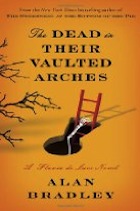
At the end of Speaking from Among the Bones, Flavia and her family received the shocking news that her mother, who disappeared many years ago somewhere in Tibet, had been found. This book begins with the de Luce family waiting at the train station for Harriet’s body to come home. Though Flavia is shocked and grieving, she can’t help wondering why Winston Churchill himself has come to pay his respects. Then there’s the man on the platform who whispers a mysterious message into Flavia’s ear and falls to his death on the tracks minutes later. Or was he pushed? As Flavia tries to sort out her feelings about her mother’s death, she can’t help but dig into the secrets of her family’s past — which, of course, turn out to be much bigger and more important than she ever imagined. Not only does she eventually solve the case of the man who died at the train station, but she discovers shocking information about Harriet’s death — and about her own future destiny.

I’ve enjoyed the Flavia de Luce series from the start, but this book is definitely my new favorite. The mystery plot is only so-so; the backstory of Flavia’s mother is rather predictable, and the villain of the book doesn’t have a terribly coherent motivation for some of the events that take place. Still, there is definitely more to be learned about the de Luce family’s past, and I’m sure additional solutions will be revealed in future books! I also think some of the secondary characters got short shrift in this installment; I wanted more of the vicar, the inspector, Adam Sowerby, and the other denizens of Bishop’s Lacey. But despite these nitpicks, I think this book got the most important thing exactly right: the reactions of Flavia and her father and sisters to Harriet’s death. This novel is a story of bereavement and grief much more than a mystery story, and in that light I think it’s fantastic. If you’re a fan of this series, you definitely won’t want to miss this installment! I can’t wait to see what’s next for Flavia and the rest of the de Luces.

Review: The Letters of Nancy Mitford and Evelyn Waugh

Letters of Nancy Mitford and Evelyn Waugh, TheCharlotte Mosley, ed., The Letters of Nancy Mitford and Evelyn Waugh

“I want to write a sad story of a man who gave up drink and hated all his chums. It is me.” — Evelyn Waugh, 12 November 1944.

Nancy Mitford and Evelyn Waugh were two of the most popular and respected authors of the early and mid-20th century; they were also lifelong friends who kept up a correspondence lasting more than two decades. This book is a collection of their letters to each other, which are full of jokes, literary allusions, and most of all gossip. They each had a very pointed, satirical sense of humor that was frequently directed at members of their own social set — and quite often at each other. In many ways they couldn’t be more different: Waugh was very conservative, old-fashioned, and staunchly Roman Catholic, while Mitford was a spiritually indifferent socialist living as an expatriate in Paris. But their correspondence reveals that they understood one another and shared a deep, affectionate friendship. Through their discussions of current events, important people, and of course books (both their own and other people’s), Mitford and Waugh’s letters provide a unique window into their age.

It’s taken me a long time to write this review, because how can one “review” a collection of letters that weren’t (necessarily) meant to be public? All I can say is that I enjoyed reading them. I’ve read a few books by each of these authors — Mitford’s The Pursuit of Love and Love in a Cold Climate, Waugh’s Brideshead Revisited and A Handful of Dust — but otherwise I didn’t know much about either of them. I do think some level of familiarity with their work is helpful, but you definitely don’t have to be an expert in order to enjoy these letters. They’re often hilarious (how I shrieked, as Nancy would say) and also have some interesting discussions about literature. I want to read more of their books now! Of course, their chatter about mutual friends and acquaintances was hard to follow, although the editor did a fairly good job of identifying people in footnotes; but I still enjoyed this collection overall. If you’re interested in early- and mid-20th-century literature, this might be a good book to seek out.

Review: The Two Mrs. Abbotts

Two Mrs. Abbotts, TheD.E. Stevenson, The Two Mrs. Abbotts

Warning: SPOILERS for Miss Buncle’s Book and Miss Buncle Married.

This third book in the “Miss Buncle” series jumps forward in time to explore life in an English village during World War II. Barbara Abbott, née Buncle, now lives in Wandlebury with her husband and two adorable children. The war apparently has little effect on her life, except that there is less food available at the market. But Barbara’s niece by marriage, Jerry Abbott, is dealing with the fact that her husband Sam is fighting somewhere in Africa; in the meantime, she has opened her home to soldiers and evacuees. But despite the privations and worries of wartime, there are still plenty of opportunities for gossip and romance! Sullen Lancreste Marvell has fallen in love with an unsuitable woman; famous authoress Janetta Walters is coming to Wandlebury to speak at the village bazaar; and Jerry’s brother Archie finally seems to be ready for marriage. Finding herself in the midst of these entanglements, will Barbara be able to engineer a happy ending?

I’m so happy that Sourcebooks is re-releasing D.E. Stevenson’s books! I really loved the first two “Miss Buncle” books, and this one is also quite fun and charming, though it definitely suffers by comparison. The problem with this book is that it lacks cohesion; there are several little plots going on, but they are largely independent of one another. Some plots also seem to peter out with no resolution; for example, in the beginning of the book, an old friend of Barbara’s comes to visit, and it seems as though she is going to be a big part of the story, but then she vanishes about halfway through the book. Ultimately the biggest story is about Archie’s courtship, which is quite sweet, but it’s not really developed in much depth. I did like reading a World War II novel that isn’t really about the war, but nevertheless the war affects many aspects of the characters’ lives. The happy, wholesome picture of village life in this book was most likely vanishing at the time Stevenson wrote the novel. Overall, I’d recommend this book to people who liked the other “Miss Buncle” books and are looking for a nice comfort read.

Review: Fer-de-Lance

Fer-de-LanceRex Stout, Fer-de-Lance

This novel introduces the famous detective team of Nero Wolfe, an eccentric genius whose skill in detection is rivaled only by his fondness for orchids, and Archie Goodwin, his streetwise secretary. Although they live in comparative luxury, Wolfe and Archie have not been immune to the effects of the Great Depression, and they certainly won’t turn down any opportunity of making some hard cash. So when a worried Italian woman comes to their doorstep asking them to track down her missing brother, they are eager to take the case. Due to Wolfe’s obese build and strange fears of the outside world, he refuses to leave his home; so it’s up to Archie to investigate the man’s disappearance. He soon discovers, however, that the missing Italian man is just one piece of a much larger puzzle involving the sudden death of a prominent university professor. While Archie collects evidence, Wolfe applies his considerable talents to solving the mystery.

This is my first encounter with Nero Wolfe and Archie Goodwin, but it certainly won’t be my last! I loved Archie as the narrator; his wry, amusing voice reminds me of the fast-talking banter of the great screwball comedies of the 1930s. It was great fun to see the investigation through his eyes, as he applies his own special brand of persuasion to the various suspects and interested parties. Nero Wolfe, by contrast, is significantly less interesting, since the inner workings of his mind remain largely mysterious. He did have some funny moments, though, and I liked his extremely formal patterns of speech. He and Archie make a nice contrast in that regard, since Archie is full of contemporary slang and has an almost aggressively casual tone. As for the mystery itself, it is quite well-plotted, even if the solution isn’t very surprising. The only thing I disliked was that the book keeps going after the culprit’s identity is revealed. For me, the fun of reading a mystery is trying to solve it; once the solution is discovered, I don’t want to read a long denouement about how the guilty party was finally caught. So I thought the end dragged a bit; but other than that, I enjoyed this mystery and look forward to reading more in the series.

Review: Late Nights on Air

Late Nights on AirElizabeth Hay, Late Nights on Air

This novel centers around a small group of people working at a radio station in Yellowknife, Northwest Territories, Canada. Harry is a once-promising radio man who has returned to Yellowknife after a disastrous attempt at television. Eleanor, the station’s receptionist, has no life of her own but is keenly observant of the lives of others. Gwen has recently moved to town and is hoping to learn radio production at the station. And newcomer Dido is a natural on-air talent who catalyzes various shifts in the station’s social atmosphere. All these characters have been drawn to Yellowknife for different reasons, but they are united in their fascination and love for the austere beauty of northern Canada. As they develop new friendships, romances, and animosities, they also discuss the history, mythology, and current concerns of the Canadian frontier — especially as a proposed transnational pipeline threatens its very identity.

I picked up this book for its setting, and I think it does a wonderful job of immersing readers in the unique world of the Canadian North. There are lovingly detailed descriptions of weather, scenery, and wildlife; digressive anecdotes about Canadian history, especially the many European explorers who attempted to survive the brutal winters; discussions about the relationship between white settlers and native peoples; and nostalgia for a fading way of life. Hay cleverly uses the debates and hearings surrounding the Mackenzie Valley Pipeline as a framework for her story; the possible destruction of the northern ecosystem parallels the slow destruction of radio as the primary medium for storytelling due to the arrival of television. The novel is somber and contemplative in tone, and the focus is on character and setting much more than on plot. But for anyone interested in books with a unique and vividly described setting, I would definitely recommend this!

Review: The Impersonator

Impersonator, TheMary Miley, The Impersonator

Leah Randall is a talented but impoverished actress who has worked on the vaudeville circuit her whole life. During the course of one performance, she notices a strange man watching her intently. Eventually this man, Oliver Beckett, approaches her with an astonishing proposal. He tells Leah the story of his niece, Jessie Carr, heiress to a substantial fortune, who vanished from her home several years ago without a trace. Leah bears a striking resemblance to Jessie, so Oliver proposes a scheme: Leah will pose as Jessie and return “home” to claim her inheritance, which she will then split with Oliver. At first Leah wants nothing to do with it, but when she is fired from her vaudeville act and can’t get other work, she eventually reconsiders. With Oliver’s help, she assumes Jessie Carr’s identity and travels to the Carrs’ home in Oregon. But the more time she spends with the Carrs, the more she becomes determined to discover what really happened to Jessie all those years ago.

If you read that plot summary and thought, “That sounds an awful lot like Brat Farrar by Josephine Tey,” well, you’d be right. The premise is exactly the same — Miley even acknowledges that Tey’s novel was the main inspiration for her own — but I enjoyed Miley’s novel in its own right. I especially liked the period details about vaudeville, speakeasies, and other highlights of life in the 1920s. There were even references to some Supreme Court cases of the era, which I appreciated as a law school survivor. I also liked Leah’s narrative voice: she’s plain-spoken, independent, and very aware of both her talents and her flaws. The thing is, though, Brat Farrar is still by far the superior book. Miley’s novel is a bit disorganized at times, including several subplots that are more distracting than intriguing. I also hated the romantic aspect of this book; it was unbelievable and underdeveloped. I did enjoy the book overall and found it very readable, but if the premise sounds interesting to you, you should really just read the original instead!

Review: The Case of the Gilded Fly

The Case of the Gilded FlyEdmund Crispin, The Case of the Gilded Fly

In 1940s England, a theater troupe converges upon Oxford to produce a new play by acclaimed playwright Robert Warner. One of the actresses, Yseut Haskell, is a beautiful girl who has attracted many admirers, but her outward appearance masks a cruel and self-absorbed personality. The other people involved with the play are frankly sick of her attitude, especially when she begins to stir up trouble within the company. So it’s not particularly surprising when Yseut is subsequently found murdered — in fact, nearly everyone in the theater company expresses relief that she’s finally gotten what she deserved. In the midst of this tense situation, Oxford don Gervase Fen uses his passion for criminology and his friendship with policeman Sir Richard Freeman to investigate the murder. As he talks to the various suspects and uncovers some unpleasant secrets, he begins to wonder whether exposing the murderer is really the best course of action.

This is a fairly typical Golden Age mystery, and as a fan of that genre, I enjoyed this book. I found Gervase Fen entertaining, although he wasn’t as prominent in the book as I expected he’d be; much of the story is told from the viewpoint of Nigel Blake, a young man who becomes involved with the theater troupe and falls in love with one of the actresses. I can see why Crispin chose that approach, though, because Fen claims to have solved the murder within three minutes of viewing the body! I also found Fen’s qualms about exposing the murderer very interesting. In many mysteries, it’s taken as a matter of course that the murderer should be unmasked and brought to justice; however, in this case the victim is a truly unpleasant person, and many of the characters think that the murderer did them a favor. Finally, I was struck by the fact that this really doesn’t feel like the first book of a series; there are several allusions to Fen’s past cases, and as I mentioned before, his character isn’t particularly fleshed out. Nevertheless, there are a few more Gervase Fen books, and I’ll probably seek them out at some point.

Review: Dreamers of the Day

Dreamers of the DayMary Doria Russell, Dreamers of the Day

This novel, set in the early 20th century, is narrated by Agnes Shanklin, a schoolteacher who has spent her entire life caring for her domineering mother. But when the influenza pandemic of 1918 carries off most of her family, including Mumma, Agnes finds herself unexpectedly inheriting a substantial sum of money. Though she is grieved by the multiple deaths in her family, she is also finally free from Mumma’s influence. Impulsively, she decides to see the world and books a trip to Egypt. There she meets several prominent British officers and diplomats, who are in Cairo to come to an agreement on Middle Eastern policy. Agnes is drawn into their social circle and mingles with the likes of Winston Churchill and Thomas Edward Lawrence, now famously known as “Lawrence of Arabia.” She also meets a German called Karl Weilbacher, who is handsome, kind, and attentive, but may not be all that he seems. Ultimately, the people Agnes meets and events she witnesses in Egypt will have a profound effect on the rest of her life.

After finally reading and loving Doc, I was eager to try another book by Mary Doria Russell. This one was very readable, and the insights into the Cairo Conference of 1921 were fascinating. It’s a historical event that still has obvious ramifications for our world today, covering issues such as a Jewish homeland in Palestine, the territorial boundaries of new nations like Iraq, and the amount of influence Western countries should continue to have in the Middle East. I enjoyed Russell’s depictions of real historical figures in this book, particularly Churchill, wo made me laugh even at his most exasperating. I didn’t like this novel nearly as much as Doc, however, mostly because I found it too preachy. Agnes is an extremely opinionated character, and due to a strange framing device in the novel, she narrates from a quasi-omniscient perspective. Because of this, she judges the events of her time from a 21st-century point of view, which I find very irritating in historical novels. And since Western involvement in the Middle East is still a very complex and controversial issue, I didn’t appreciate Agnes’ more simplistic perspective. But even though this aspect of the book rubbed me the wrong way, I think it’s still worth a read for people interested in the time period or in the creation of the modern Middle East.

Review: They Found Him Dead

They Found Him DeadGeorgette Heyer, They Found Him Dead

This book begins, as so many classic British mysteries do, with an ill-fated party at an English country house. Silas Kane is celebrating his 60th birthday, but many of his guests aren’t in a particularly happy mood. His heir, Clement, is desperate to get his hands on a piece of the older man’s fortune — especially because his beautiful but materialistic wife, Rosemary, is threatening to leave him. Meanwhile, Silas’ neighbor and business partner is eager to interest him in an investment opportunity, but so far he has stubbornly refused to consider the deal. So when Silas is discovered dead the day after the party — having apparently fallen over the cliff where he habitually took a walk every evening — there is no shortage of suspects to consider. And when Clement is shot in the study shortly afterwards, it seems clear that a murderer is at work. Once again, Inspector Hannasyde of Scotland Yard must untangle the various motives in play and discover the identity of a ruthless killer.

I’ve been steadily working my way through Heyer’s mysteries, and this book is a typical example. I always enjoy Heyer’s witty dialogue and hints of romance, although in this book the love story is very peripheral to the main plot. The mystery itself is fine, though there’s nothing particularly surprising for those who read a lot of detective novels. As always, the strength of Heyer’s books is her characters, and there several great ones here, from the self-absorbed Rosemary Kane to the exuberant young Timothy Harte, who is overly eager to assist the police in solving the murder. I should note, however, that while Inspector Hannasyde is a recurring character in Heyer’s mysteries, he is definitely not the protagonist; each individual book tends to revolve around the victim and the suspects much more than around the detective. Anyway, I definitely liked this book overall, but there’s nothing that makes it particularly stand out to me.

Review: Something Wicked This Way Comes

Something Wicked This Way ComesRay Bradbury, Something Wicked This Way Comes

A week before Halloween, Cooger & Dark’s Pandemonium Shadow Show creeps silently into Green Town, Illinois, in the middle of the night. To most of the town’s inhabitants, the show is a carnival like any other, with its sideshows, rides, and circus freaks. But 13-year-old best friends Jim Nightshade and Will Halloway suspect that something more sinister is at work. The carnival seems to lure unwary visitors into its depths, and those who fall under its spell will never be the same again. It’s up to Jim and Will — and Will’s father, an unassuming librarian who worries about his age and his relationship with his son — to uncover the dark secret at the heart of the circus and to prevent it from ensnaring more victims.

I don’t usually read horror novels, but I was interested in this book because of its classic status (and, frankly, because of its Shakespearean title). Unfortunately, this novel really didn’t work for me, but the problem wasn’t the story at all — it was the writing style. The prose is gratingly faux-poetic, overblown, and melodramatic. Words are often used in unconventional ways (nouns being used as verbs and the like), which can be an effective stylistic choice, but in this case I found it incredibly distracting. I also found the dialogue completely unrealistic and stilted. It’s a shame, because I actually do think the basic story is fascinating and could have been very effective in the right hands. I’m definitely not enthusiastic about trying more Bradbury after this — and I’m wondering how well Fahrenheit 451 would stand up to a re-read!