Review: Death in the Stocks

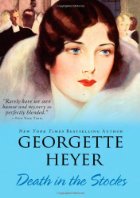
Death in the StocksGeorgette Heyer, Death in the Stocks

When a dead man wearing evening dress is found locked in the stocks on the village green, the local police are only too happy to turn the case over to Scotland Yard. The corpse is Arnold Vereker, a universally despised man who kept a tight hold on the family purse strings. When Superintendent Hannasyde questions Vereker’s young relatives, they all declare themselves extremely happy that their unpleasant half-brother is dead at last. Hannasyde doesn’t know what to make of Antonia, Kenneth, and their various love interests, but he suspects that there are secrets hidden beneath their lighthearted jokes. He sifts through the muddle of motives and alibis with help from Giles Carrington, the Vereker family’s solicitor, who has his own reasons for wanting to uncover the murderer.

I’m a longtime fan of Georgette Heyer’s romances, but I’m quickly coming to love her mysteries as well! As someone who loves a good period piece, I found this an extremely fun book to read. The mystery is perfectly fine, with some interesting little twists and red herrings; I figured out some pieces of the puzzle but didn’t ultimately guess whodunit. However, the real pleasure of this book is the characters, their witty conversations and their blossoming romantic attachments. While the Verekers and their friends take center stage, though, Superintendent Hannasyde is also an intriguing sleuth, and I look forward to reading about more of his cases in subsequent Heyer novels.

Review: Eleanor & Park

Eleanor & ParkRainbow Rowell, Eleanor & Park

Eleanor is a chubby new girl with out-of-control red hair and weird clothes. Park is a quiet half-Korean boy who clings to his position at the edge of the cool group. In the normal course of things, they would have no reason to speak to each other. But the first day that Eleanor gets on the bus, she is immediately taunted and ostracized by the other students — and Park surprises himself by letting her sit next to him. Tentatively, Eleanor and Park begin to build a friendship, which gradually deepens into an intense love. But the odds are stacked against them: Park’s parents don’t warm to the prickly Eleanor, and Eleanor’s family life is such a disaster that Park can’t even come to her house. Plus, they’re both smart people and know that high school relationships rarely last forever. Will their relationship be able to survive these obstacles, or will love ultimately tear them apart?

After loving Rowell’s debut novel, Attachments, I naturally had to check out this book too…and happily, it is equally awesome! Both Eleanor and Park are wonderful, likable characters, and it was lovely to see each of them through the other’s eyes. I completely believed in their passionate love for each other, which is unusual for me with teen romance. I tend to scoff at happily-ever-after endings in YA, because very few high school relationships actually work out over the long term. But this book swept me away with its giddy intensity, and I found myself happily rooting for Eleanor and Park to make it. I also really enjoyed the pop culture references that are sprinkled throughout the book; it’s set in the 1980s, so there are many mentions of New Wave and cassette tapes and feathered bangs. I would definitely recommend this book to fans of romance or chick lit, even those who don’t normally read YA.

Review: Luckiest Man

Luckiest ManJonathan Eig, Luckiest Man: The Life and Death of Lou Gehrig

This well-researched biography of Lou Gehrig follows his life and baseball career in vivid detail, from his humble beginnings playing high school ball to his stellar performance as first baseman and power hitter for the New York Yankees. Along the way, Eig discusses some of the broader social developments in America in the 1920s and ’30s, but the focus remains on baseball and how it evolved throughout the early 20th century. The book uses a wealth of primary sources, particularly the many newspaper stories that covered Gehrig’s remarkable career. Most importantly, though, this biography illuminates Gehrig’s personality — humble, modest, conscientious, hardworking, and determined to do his best in life both on and off the field.

I don’t particularly follow baseball (or any other sport, frankly), but for some reason I’ve always been interested in Lou Gehrig — probably because he was left-handed, like me, and because he died tragically young. So I decided to check out this biography, and I’m glad I did because it is fantastic. I felt like I really got a sense of Lou Gehrig as a person, and it was a pleasure to read about someone so admirable. I also loved learning more about the other legendary players of that era: Babe Ruth figures prominently in the book, and there are plentiful references to other greats like Ty Cobb and Joe DiMaggio. Eig discusses Gehrig’s baseball career in great detail, sometimes describing almost every play of a game. I suppose this might be boring for some, but I really appreciated all the information since I knew basically nothing coming in. Overall, I would highly recommend this book to anyone, although it will probably be most appealing to baseball fans.

Review: Lessons in French

Lessons in FrenchHilary Reyl, Lessons in French

In 1989, Kate is a fresh-faced college graduate who dreams of becoming an artist someday. So she’s overjoyed when she is hired as an assistant to Lydia Schell, a famous American photographer currently living in Paris. Kate is excited to make the most of this opportunity, but she soon discovers that Lydia is an extremely demanding boss. For example, Kate not only coordinates Lydia’s schedule and runs her errands, but she is also expected to help Lydia’s husband Clarence with the book he is writing about 19th-century French fashion. The longer Kate stays with the Schells, the more she realizes that their seemingly successful family is fraught with dysfunction. As Kate tries to please all parties, she is pulled in so many conflicting directions that she begins to lose her own identity in the process.

I liked the basic idea of this book — naive American girl moves to Paris and learns about herself and the world — but overall it fell far short of my expectations. My biggest problem was that every single character, including the heroine, is absolutely insufferable. Kate is a total doormat, doing every single thing the Schells tell her to do regardless of how demeaning (and how unrelated to her job description). She’s also too stupid to see some really obvious things about the Schells that are going on right under her nose. I spent the whole book wishing she’d grow a spine, and while she sort of does at the end, it’s definitely too little, too late. As for the Schells, they’re pretentious pseudo-intellectual snobs with no redeeming qualities whatsoever. I did like the 1989 setting, with the Berlin Wall coming down and the Gulf War about to begin, but it didn’t play a very big part in the novel. Basically this book made me feel angry and frustrated, and only the somewhat competent writing style kept me reading until the end.

Review: Dead Men Don’t Ski

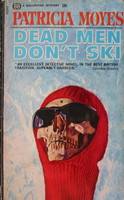
Dead Men Don't SkiPatricia Moyes, Dead Men Don’t Ski

Inspector Henry Tibbett and his wife Emmy are looking forward to a relaxing ski holiday in the Alpine town of Santa Chiara, Italy. However, Henry has also been asked to keep his eyes peeled for information relating to an international smuggling ring that might be headquartered in the area. Though reluctant to spoil his holiday with work, Henry can’t help but notice that several of his fellow vacationers have secrets to hide. Then one of the other guests at his hotel, Fritz Hauser, is found murdered on the ski lift. As Henry helps the local police to investigate, he soon learns that Hauser was involved in the smuggling ring — and that several of the hotel guests had good reasons for wanting him dead.

I think this book could best be described as a “traveling” English country house mystery. All the key elements are there — unlikable murder victim, plenty of suspects, an unusual crime scene which demands very precise alibis from everyone — but it happens to take place in a ski villa rather than an English country house. Since I love the genre, I found a lot to enjoy in this book. I especially enjoyed the subtle deviations from the standard mystery formula: for example, two of the characters are a hearty English colonel and his domineering wife, yet there’s more to both of them that meets the eye. Also, the “foreigners” in classic mystery novels always seem to be there as mere background, but here they were truly fleshed-out characters with actual relevance to the plot. I believe this is the first book in a series featuring Tibbett, and I’d gladly read more. Definitely recommended for classic mystery fans!

Review: The Night Circus

The Night Circus by Erin MorgensternErin Morgenstern, The Night Circus

The action of this novel centers around a beautiful, mysterious circus known as Le Cirque des Rêves. It is open only at night, and it contains unimaginable wonders — not only acrobats, contortionists, and exotic animals, but also gardens made entirely of ice and carousels with animals so lifelike that they breathe. In this magical environment, Celia and Marco meet and fall in love. However, unbeknownst to them, they are also rivals: both of them are magicians whose tutors are engaged in a deadly game. As Celia and Marco outdo themselves with feats of magical prowess, they must also find a way to end the “game” without paying an unthinkable price.

I find myself a little conflicted about this book, since I absolutely loved certain aspects of it but found other parts underwhelming. By far the strongest part of the novel is its setting: the Night Circus is described in such specific, evocative, loving detail that I absolutely believed in its magic. I’ve rarely read a book with such lush, awe-inspiring descriptions. By comparison, the plot of the star-crossed dueling magicians, while a wonderful idea in theory, is a bit flimsy in execution. I didn’t particularly connect with any of the characters. Even Celia and Marco are extremely flat, with no particular defining characteristics except for their mutual infatuation. The circus is the heart of the book, but the events and people surrounding it seem almost like afterthoughts. That said, I did enjoy reading the book overall and would definitely read more by Morgenstern. Also, I hope this book is made into a movie and that Baz Luhrmann directs it — it would be gorgeous.

Review: The Glass Menagerie

The Glass Menagerie by Tennessee WilliamsTennessee Williams, The Glass Menagerie

This classic American play centers around the Wingfields, a lower-middle-class family living in the Midwest. The mother, Amanda, is a former Southern belle who is desperate to prevent the family from sinking into poverty. The daughter, Laura, is a fragile young woman with a slight physical deformity that has made her morbidly self-conscious and shy. The son, Tom, works in a warehouse but dreams of being a poet and living a life of adventure. When a “gentleman caller” comes to dinner, Amanda pressures Laura to make a good impression on him, but the evening doesn’t go according to plan.

I haven’t had much prior experience of Tennessee Williams, but I quite liked this play and can see why it’s considered a classic. I was definitely invested in the story and felt particularly sympathetic toward Laura. Amanda, on the other hand, drove me crazy; she reminded me of Mrs. Bennet in her pushy eagerness for Laura to attract an eligible husband. And Tom was actually the least interesting character for me, because it seemed like he was nothing more than a spokesman for the author. Though he’s fairly artistic about it, Williams definitely uses this play to express his views on the flaws in his society. I would be interested in seeing the work performed, as there are a lot of very specific stage directions, but it also “reads” well. Overall, I’d say it’s worth reading, even if it’s not destined to become one of my favorite plays.

Review: Are Women Human?

Are Women Human? by Dorothy L. SayersDorothy L. Sayers, Are Women Human?

Dorothy Sayers is best known for her mystery series featuring Lord Peter Wimsey, but she wrote on a lot of other topics too. This short volume contains two of her essays in which she explicitly talks about the role of women in society and the feminist movement as she perceived it in the early 20th century. Sayers’ central point in these essays is that people should spend less time thinking about “women” as a class and more about each particular woman as an individual. She notes that opinions, beliefs, intellect, and abilities vary among women just as they do among men. She also champions a woman’s right to work outside the home if she wants to; both women and men should be able to do work that they enjoy and at which they excel.

I really enjoyed both of these thoughtful, witty essays. Even though they were written many decades ago and the world has changed a lot since then, I think Sayers’ observations remain relevant and interesting. I especially liked what she says about the idea that a woman’s place is in the home. She points out that in the Middle Ages, a lot of the most interesting and important jobs were done in the home — weaving, dyeing, food production, brewing, estate management, etc. These all used to be women’s jobs, and they didn’t become men’s jobs until after the Industrial Revolution, when they moved into factories. I don’t tend to read a lot of feminist theory, but I’d recommend this book to anyone interested in the history of the feminist movement — or anyone looking for a quick, humorous, and thought-provoking read!

Review: A Handful of Dust

Evelyn Waugh, A Handful of Dust

This novel, set mainly among the leisured class of 1930s England, follows a small group of social acquaintances and sheds light on their shallow approach to life. Brenda Last is married to Tony, a traditional English gentleman who is devoted to preserving his estate. Bored and lonely in the country, Brenda decides to spend more time in London. She soon enters into an affair with John Beaver, an idle young man with no job and not much money, whose greatest talent is lunching at other people’s expense. Tony is oblivious to what’s going on until a shocking tragedy forces his failing marriage into the limelight. As the Lasts try to cope with the fallout from Brenda’s infidelity, they both hope that striking out on their own will bring them happiness, but their efforts are ultimately doomed to failure.

I’m the kind of person who tends to enjoy books with happy endings and likable protagonists. I figure, why read a book that’s just going to depress you? But this book is the antithesis of the qualities I just mentioned, and I still thought it was excellent. Most of the main characters are horrible, odious people, but they’re like a train wreck that I couldn’t look away from. I did sympathize with Tony quite a bit, especially because of one truly heinous thing that Brenda said (don’t want to spoil, so unfortunately I can’t be specific). The whole time, I was hoping that things would somehow work out in the end, even though I knew it was extremely unlikely. I’m also a fan of Waugh’s writing style: he mocks his characters mercilessly, but you can’t really fault him for it because they truly deserve it! So I would definitely recommend this book to fans of classic literature, even those who prefer more lighthearted literature.

Review: The Man in the Queue

The Man in the Queue by Josephine TeyJosephine Tey, The Man in the Queue

When an unidentified man is stabbed to death while waiting in line outside a theater, the crime becomes an immediate sensation in London. Inspector Alan Grant of Scotland Yard is assigned to the case, which at first seems impossible. The people standing closest to the dead man noticed nothing, and the murderer seems to have left no trace behind. However, eventually one witness mentions that he saw the dead man arguing with someone in the queue — someone who afterwards left in a hurry. With the help of this statement, Grant is soon on the trail of the man who argued with the victim. However, the more evidence Grant obtains, the more complicated the case seems to grow.

My experience so far with Josephine Tey has been very hit-or-miss: I was disappointed by The Daughter of Time, I really liked Brat Farrar, and now I find myself underwhelmed by this book. I read in the introduction that Tey didn’t like to use the standard conventions of the mystery genre, and that’s certainly evident in this novel. A lot of the book takes place inside Grant’s head, as he immediately begins to theorize about what sort of man might have committed this crime. Thus, much of the novel is Grant jumping to conclusions and then being proved wrong as more evidence is uncovered — which may be true to life but isn’t a lot of fun to read about. The mystery is also technically not “fair,” as the solution comes out of nowhere with no clues given in advance. So I wasn’t a huge fan of this book, but I think I will try some more Josephine Tey in hopes of finding something better.