Review: The River of No Return

River of No Return, TheBee Ridgway, The River of No Return

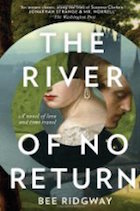
Nicholas Falcott, Marquess of Blackdown, is about to die on the battlefield at Salamanca. But instead of being trampled by a French cavalry horse, he suddenly disappears in a blaze of light and reappears in the 21st century. There, Nicholas finds himself under the protection of the Guild, a secret society of individuals with the ability to jump forward in time. The Guild provides Nick with a new identity, plenty of money, and enough information about the modern world for him to survive in the present. Nick believes it’s impossible to go back to his original time — until one day, out of the blue, the Guild leaders order him to do just that. They tell him about a rival group of time travelers whose attempts to change history will result in widespread disaster, unless Nick can go back to 1815 and stop them. But when he jumps back to his own time, he learns that the Guild is keeping secrets from him. He also reconnects with Julia Percy, his beautiful young neighbor who is somehow connected to this feud between time travelers.

This is a book I should have loved: it’s got Regency England, romance, intrigue, and time travel! But sadly, the novel’s underwhelming execution didn’t live up to its great premise. One of the biggest problems for me was the pacing. It took forever to set up the world and introduce Nick and Julia as characters. Once Nick jumps back to 1815 (about 1/4 of the way into the book), things pick up a little, but the pacing still drags. Nothing really important occurs until the last 50 pages or so, when the characters suddenly learn a whole lot of new information at breakneck speed. My other big problem with this novel is that NOTHING IS RESOLVED IN THE END. Nick eventually learns more about the future catastrophe that the time travelers are trying to prevent, but he doesn’t actually do anything about it. So basically, this book is one long setup for a payoff that isn’t going to happen until the sequel — and I don’t think it’s actually been published yet, so it could be a long wait! I’ll admit that I am a bit curious to know how things turn out, but it may not be worth the aggravation this book caused me.

Review: Act Like It

Act Like ItLucy Parker, Act Like It

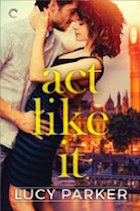
Actress Lainie Graham is the sweetheart of the London stage, and her wholesome public persona is now especially sympathetic because she’s recently been dumped. In contrast, her co-star Richard Troy is the quintessential bad boy. His Byronic good looks and considerable talent have counterbalanced some of his negative behavior, but the public is no longer willing to overlook his violent temper. Desperate to get public opinion back on their side, the theater manager and Richard’s agent concoct a plan: Richard and Lainie will pretend to be in a relationship so that her positive image will rehabilitate Richard’s negative one. At first, Lainie objects to the plan — she can’t stand Richard’s obnoxious behavior and inflated ego — but she is eventually convinced to play along. As she spends more time with Richard, however, she learns that there’s much more to him than meets the eye. Meanwhile, Richard is surprised to discover that Lainie is intelligent, kind, and more than willing to match him quip for quip. But how can these two actors be confident that their so-called fake relationship has evolved into something real?

After a streak of books that weren’t grabbing my attention, I was delighted to discover this sweet romance! I always enjoy the “fake relationship becomes real” trope, so I was predisposed to like the book anyway. But the adorable banter between Lainie and Richard is what really sealed the deal for me. Their sarcastic jabs at one another soon become playful teasing, and these interactions really made their chemistry believable. I appreciated how their careers as actors added another layer of complexity to the relationship; I especially enjoyed watching Richard seethe as Lainie had to pretend to be in love with her ex, another actor in the same play. The book does contain some of the romance genre’s more annoying clichés, such as a physically perfect hero with piercing blue eyes and a Big Misunderstanding that needlessly threatens the relationship. But overall, this book was a lovely surprise that came along at just the right time for me. Definitely recommended for fans of romantic comedies!

Review: Read Bottom Up

Read Bottom UpNeel Shah and Skye Chatham, Read Bottom Up

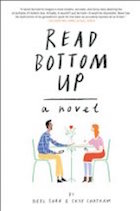
This epistolary novel tells the story of a 21st-century romance solely through emails and texts. Elliot and Madeline meet at a restaurant opening in New York City and slowly begin to communicate through emails, texting, and finally in-person interactions. But they’re not only communicating with each other; they’re also in simultaneous conversations with their best friends, David and Emily respectively, as they frantically over-analyze each interaction down to the very last comma. Elliot and Madeline tentatively embark upon a relationship while navigating modern dating pitfalls such as how to wait the appropriate amount of time before responding to a text, or how to tell the difference between a date and a group hang. But beyond all the angst and analysis, are they actually right for each other?

I picked up this book from the library on a whim and found it a quick, pleasant read. I love a good epistolary novel, and I’m especially interested in modern-day versions that utilize technology like emails and texting. Moreover, the epistolary format emphasizes the paradox that despite all the modes of communication available to Elliot and Madeline, they are actually pretty bad at communicating honestly with each other. This drives the conflict in the book, as well as most of its humor. I have to say, I wasn’t particularly enamored of Elliot or Madeline, especially the former; I’m not quite sure why Madeline is so interested in such a bland guy. The best friends, David and Emily, are actually more interesting characters, but that’s probably because they’re offering genuine opinions, not censoring themselves to please a potential love interest. Overall, I think this novel is a pretty accurate representation of modern dating, and it’s a pleasant way to spend an evening, but there’s nothing particularly deep or emotionally resonant about it.

Review: Things I Can’t Explain

Things I Can't ExplainMitchell Kriegman, Things I Can’t Explain

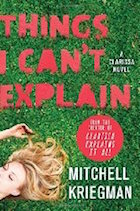
Those who grew up in the ‘90s will likely remember Clarissa Darling, the witty, offbeat heroine of the Nickelodeon sitcom “Clarissa Explains It All.” This novel, written by the creator of the show, follows a grown-up Clarissa trying to navigate life in her late 20s. Although she achieved her childhood goal of becoming a journalist, she’s now unemployed because the newspaper she worked for has gone under. Her family is also in a state of upheaval, as her overachieving mother and impractical father are separating. And most confusing of all is her love life, as she wavers between an old romance and a chance at something new. Clarissa may have been a know-it-all as a teen, but now she’ll have to confront, and maybe even embrace, the fact that she still has a lot to learn.

When I was a kid, “Clarissa Explains It All” was one of my favorite shows, but I definitely overestimated my level of nostalgia for it! First of all, I actually remembered much less about the show than I thought I did. I had no memory of Clarissa’s lists and wacky superstitions, and I didn’t remember her female friends at all. In fact, I think all I really wanted to know was what happened between Clarissa and her best friend Sam. The show kept them platonic throughout, but honestly, my sappy romantic soul wanted them to end up together! And — spoiler alert — they don’t. In fact, Sam is never actually “on page”; Clarissa reminisces about him quite frequently, but we never get his side of the story. That bugged me so much that maybe I’m not being fair about the rest of the book. But overall, I thought it was pretty mediocre chick lit, not really worth reading unless you’re a diehard Clarissa fan.

Review: Love in Lowercase

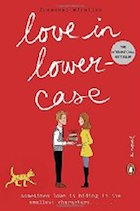
Love in LowercaseFrancesc Miralles, Love in Lowercase (trans. Julie Wark)

Samuel is a thirty-something professor of German living in Barcelona, ringing in the New Year alone with no sense of joy or optimism for the year ahead. But his life suddenly becomes much less lonely with the arrival of a stray cat who immediately demands his attention and affection. The cat leads Samuel to his upstairs neighbor Titus, who is compiling a collection of inspirational stories. Samuel eventually agrees to help the elderly and ailing Titus with his book, which opens up Samuel to a host of new people and experiences. He befriends Valdemar, a possibly homeless conspiracy theorist who philosophizes with him late into the night. He mildly flirts with the veterinarian who comes to give the cat its shots. And by sheer happenstance, he runs into Gabriela, the girl he fell madly in love with as a child but whom he hasn’t seen in decades. But will Samuel be able to transcend his solitary habits and actually act on his feelings?

I should say up front that I didn’t particularly enjoy this book, but I don’t think it’s necessarily the book’s fault. Based on the title and cover, I was expecting a romantic comedy. The cover art looks similar to that on Rainbow Rowell’s books, so I think that made me subconsciously expect a Rowell-esque story. But this book is very different; in fact, the romance is quite weak, which disappointed and sometimes even aggravated me. It’s not that I always need a strong romantic plot in my books, although I admit it’s usually a plus! But if there’s going to be a romance, I’d like for it to be emotionally satisfying…and for me, this one wasn’t. Gabriela is barely a character at all; she’s merely an idealized romantic fantasy for Samuel to moon over. And in fact, the romance isn’t even the main plot. The book mostly just follows Samuel around Barcelona as he philosophizes (in a not particularly deep manner) about life and love. So I wasn’t a fan of this book, but maybe I would have liked it more if I’d gone into it with different expectations.

Review: Anything for You

Anything for YouKristan Higgins, Anything for You

Connor O’Rourke thinks it’s the perfect time to propose to his on-again, off-again girlfriend, Jessica Dunn. His restaurant is thriving, his new house is big enough for a family, and he’s even thinking of opening his own brewery. But when he gets down on one knee, Jessica gives him a kind but firm “no.” Her life has always been complicated: unlike Connor, she grew up in poverty with alcoholic parents and an intellectually disabled younger brother. She finally has a good job and a stable living situation, and she doesn’t want anything to change. But Connor is left reeling by her refusal and says that he can’t be with Jessica anymore if she’s not willing to move forward with him. The problem is, no matter how many women his well-meaning sister sets him up with, he can’t get Jessica out of his mind. And Jessica, despite her independent facade, begins to realize that she misses Connor a lot more than she thought she would.

When I need a light, quick, palate-cleansing read, I almost always pick up a Kristan Higgins novel. This one was enjoyable, as always…I liked that the conflict between Connor and Jessica feels realistic, given Jessica’s difficult past. It was also fun to spend more time in the world of the Blue Heron series, of which I think this is the last installment. All the characters and couples from earlier books make an appearance, and they’ve all pretty much achieved their happily-ever-afters. In fact, if I had one complaint, the sheer amount of happiness in this book — literally everyone is getting together, getting married, and/or having babies — is pretty saccharine and unrealistic. But then again, I’m not reading fluffy romance novels for the realism. 🙂 If you’re looking for a sweet, fun romance you can read in a day, I’d definitely recommend this book, although you might be a little confused about the secondary characters if you haven’t read the rest of the series.

Review: 2 A.M. at The Cat’s Pajamas

2 a.m. at The Cat's PajamasMarie-Helene Bertino, 2 A.M. at The Cat’s Pajamas

Madeleine Altimari is a smart-mouthed, rebellious nine-year-old who also happens to be an aspiring jazz singer. Still mourning the recent death of her mother, and caring for her grief-stricken father, she doesn’t realize that on the eve of Christmas Eve she is about to have the most extraordinary day—and night—of her life. After bravely facing down mean-spirited classmates and rejection at school, Madeleine doggedly searches for Philadelphia’s legendary jazz club The Cat’s Pajamas, where she’s determined to make her on-stage debut. On the same day, her fifth grade teacher Sarina Greene, who’s just moved back to Philly after a divorce, is nervously looking forward to a dinner party that will reunite her with an old high school crush, afraid to hope that sparks might fly again. And across town at The Cat’s Pajamas, club owner Lorca discovers that his beloved haunt may have to close forever, unless someone can find a way to quickly raise the $30,000 that would save it.

As these three lost souls search for love, music and hope on the snow-covered streets of Philadelphia, together they will discover life’s endless possibilities over the course of one magical night. (Summary from Amazon.com.)

I think I was hoping to love this book more than I did, but I still found it pretty enjoyable. I don’t really like when a book jumps around between too many characters, because it splits my focus, and I end up not being very invested in any of the storylines. But in this case, I was immediately drawn to Lorca and the other denizens of The Cat’s Pajamas. I’m an amateur musician myself, and I always love reading about music and musicians. So I sympathized with Lorca, whose beloved jazz club is slowly dying, and the literal band of misfits he’s collected. But I wasn’t as invested in the other stories until the end, where all the characters converge on the club. I did get a kick out of Madeleine, whose goal of becoming a jazz singer is so precocious and bizarre, and I warmed up to Sarina as her story unfolded. The book also has a great sense of atmosphere and paints a vivid picture of contemporary Philadelphia. Some people may find the novel too whimsical, but I liked it overall, even though it didn’t completely grab me.

Review: Neanderthal Seeks Human

Neanderthal Seeks HumanPenny Reid, Neanderthal Seeks Human

There are three things you need to know about Janie Morris: 1) She is incapable of engaging in a conversation without volunteering TMTI (Too Much Trivial Information), especially when she is unnerved, 2) No one unnerves her more than Quinn Sullivan, and 3) She doesn’t know how to knit.

After losing her boyfriend, apartment, and job in the same day, Janie Morris can’t help wondering what new torment fate has in store. To her utter mortification, Quinn Sullivan- aka Sir McHotpants- witnesses it all then keeps turning up like a pair of shoes you lust after but can’t afford. The last thing she expects is for Quinn- the focus of her slightly, albeit harmless, stalkerish tendencies- to make her an offer she can’t refuse. (Summary from Amazon.com.)

I downloaded this e-book for free, and honestly, that’s the only good thing I can say about it. I don’t think I’ve ever encountered a heroine whom I’ve despised more than Janie Morris. The novel would have you believe that Janie is very book-smart, although her nerves get the best of her in social situations. In fact, however, there is absolutely no evidence of her alleged intelligence, and her “nervousness” is so over-the-top as to be completely ridiculous. She literally cannot form complete sentences when speaking to a man she finds attractive. She also somehow fails to notice that her crush Quinn, whom she believes is a lowly security guard, is actually the owner of the company where she works. The reader, of course, has noticed it by approximately chapter two. The book’s writing style is fairly awful as well, complete with one of the most cringe-inducing sex scenes I’ve ever encountered. I can’t even remember the main conflict of the book, to be honest…all my attention was given to my utter hatred of Janie. Like I said, the book was free, but I still wish I could get those hours of my life back.

Review: First Impressions

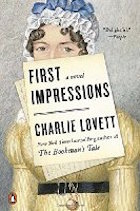
First ImpressionsCharlie Lovett, First Impressions

Book lover and Austen enthusiast Sophie Collingwood has recently taken a job at an antiquarian bookshop in London when two different customers request a copy of the same obscure book: the second edition of A Little Book of Allegories by Richard Mansfield. Their queries draw Sophie into a mystery that will cast doubt on the true authorship of Pride and Prejudice—and ultimately threaten Sophie’s life.

In a dual narrative that alternates between Sophie’s quest to uncover the truth—while choosing between two suitors—and a young Jane Austen’s touching friendship with the aging cleric Richard Mansfield, Lovett weaves a romantic, suspenseful, and utterly compelling novel about love in all its forms and the joys of a life lived in books. (Summary from Amazon.com.)

I should have known better than to pick this one up. My love of Jane Austen means that I’ve read a lot of the retellings, re-imaginings, and spinoffs of her novels, and most of them have ranged from “meh” to truly awful. So I should have known that I’d dislike this book, and indeed, the writing style had turned me off by the end of the first chapter. The author unwisely makes Jane Austen a character and tries to imitate her voice, with disastrous results.

Further, the entire “past” storyline had essentially no stakes, being nothing more than an account of the friendship between Austen and an elderly clergyman. In the “present” storyline, book lover Sophie Collingwood comes across said clergyman’s name in connection with Austen and investigates a possible plagiarism scandal. Because of course Austen lovers want to read books suggesting that she didn’t actually create her own work!

Anyway, Sophie is an utter ninny caught between a Darcy and a Wickham, although they’re pretty equally insufferable! The Wickham (whose name I can’t actually remember) is supposed to be skeevy, of course, but the Darcy also exhibits some major stalker vibes. Therefore, I didn’t buy the love triangle or enjoy the romance. So for me, the book failed on basically every front. Maybe I’m being too harsh; I’d read some positive reviews of the novel, and possibly my expectations were too high. But unfortunately, this book is in my “bottom 10” for the year.

Review: Carry On

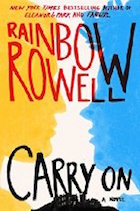
Carry OnRainbow Rowell, Carry On

Simon Snow is the worst Chosen One who’s ever been chosen.

That’s what his roommate, Baz, says. And Baz might be evil and a vampire and a complete git, but he’s probably right.

Half the time, Simon can’t even make his wand work, and the other half, he starts something on fire. His mentor’s avoiding him, his girlfriend broke up with him, and there’s a magic-eating monster running around, wearing Simon’s face. Baz would be having a field day with all this, if he were here–it’s their last year at the Watford School of Magicks, and Simon’s infuriating nemesis didn’t even bother to show up. (Summary from Amazon.com.)

As you can see, I had A LOT of feelings about this book! So if you just want the short version, skip to the last paragraph!*

Fellow lovers of Rainbow Rowell will remember her novel Fangirl, in which protagonist Cath is obsessed with the Simon Snow series and is writing fanfiction about two of its principal characters, Simon and Baz. While I really liked Fangirl overall, I noted that the “excerpts” from the Simon Snow books and from Cath’s fanfic were my least favorite parts of that novel. So, I was less than enthused when I learned that Carry On would be Rowell’s own version of the Simon/Baz romance.

I had other issues with the concept of Carry On as well. In Fangirl, it’s obvious that Simon Snow is meant to be a stand-in for Harry Potter (which makes the single HP reference in Fangirl extremely jarring!), so Carry On is, in a sense, HP fanfic. That made me feel apprehensive and a little icky, like Rowell was essentially ripping off J.K. Rowling and taking advantage of the devotion of the HP fandom. I don’t attribute any malicious motives to Rowell — I’m sure she would view Carry On as more of an homage than a copy — but the world of Simon Snow is uncomfortably similar to the world of HP.

Then there’s my own stance on fanfiction, which is that I don’t really get it. Not to take away from anyone else’s pleasure in reading or writing it, but I’ve never personally been that interested in it. I do understand the desire to remain in a beloved world and explore it further, especially if the original author left certain stories hanging and you need some closure for them. But I tend to believe the author wrote the stories s/he intended to write, and it’s not my job as a reader to “fix” storylines that didn’t turn out the way I wanted them to. So, to take the most relevant example, I know there’s a lot of Harry/Draco fanfic out there. But in the actual HP series, it’s obvious that Harry is heterosexual, and (spoilers) he eventually marries and procreates with Ginny. So I honestly don’t understand the impulse to pair Harry and Draco in fanfiction. I don’t mean to insult anyone who enjoys fanfic or who ships Harry/Draco, but I would not personally be interested in reading a slash fanfic about those characters — which is essentially the plot of Carry On, just with different character names.

AND YET.

I actually ended up liking Carry On a lot more than I expected to! Yes, the setting and principal characters are all very reminiscent of HP, and that still does bother me. I also wasn’t particularly invested in the monster plot and all the backstory about where the monster came from and all of that. It was predictable and rather generic for a fantasy novel. But one of Jenny’s (of Reading the End) comments really resonated with me: “I think Rainbow Rowell maybe just is not that good at plot.” YES. This is true of all her novels, which generally don’t have much plot to speak of. Where Rowell shines is her characters, who are flawed and struggling but also hopeful and determined to find a happy ending. I sympathized with Simon, who feels crushed by the weight of his “chosen” status and his inability to live up to everyone’s expectations. Penelope was a great friend, practical and loyal, even though she was a bit too Hermione-ish. And I adored Baz, as I always adore disdainful, elitist, painfully elegant antagonists who turn out to be not-so-secret heroes.

*The short version: I was nervous about Carry On, and if anyone other than Rainbow Rowell had written it, I definitely wouldn’t have read it. But I decided to trust Rowell, and I’m glad I did. For me, the positives (great characters and dialogue) outweighed the negatives (most notably, the extensive similarities to HP). If you’re on the fence about this book, I would encourage you to give it a try! And I’ll note that you definitely do NOT have to read Fangirl first, although you should read it anyway because it’s really good. 🙂