Review: Making Up

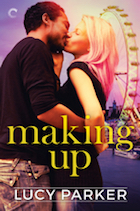
making upLucy Parker, Making Up

Trix Lane is a confident, talented circus performer whose daring aerial acrobatics have won her a major role in a popular and long-running London show. But some of her spark has dimmed lately, in the wake of an emotionally abusive relationship that shook her confidence. Now she has the opportunity to get an even bigger role in the show, but she’s not quite sure she can do it. And her anxiety isn’t helped when she learns that Leo Magasiva has just been hired to do makeup for the show. Leo and Trix have a fraught past, and whenever they meet, they can’t seem to help antagonizing each other. But beneath their sarcastic banter is an undeniable attraction, and when they begin to explore their true feelings for one another, Trix is surprised to discover how compatible they really are. But will their fledgling relationship be able to survive new misunderstandings and competing career goals?

I adore Lucy Parker’s contemporary romances, and this one is no exception. I love the enemies-to-lovers trope when it’s done well, which it definitely is here; I especially loved the nods to Much Ado about Nothing (my favorite Shakespeare play, not surprisingly!). I have to admit, though, I didn’t adore this book quite as much as I did Act Like It and Pretty Face. I think it’s because the overall tone is a little more somber, and there isn’t quite as much witty banter. (That’s understandable, of course, given that Trix is recovering from her ex’s abusive treatment.) I also find that I can’t remember very many incidents in the book. Both Leo and Trix do change throughout the novel, but their development is largely internal, not necessarily tied to specific plot events. Don’t get me wrong — I still really liked this book! It’s just a bit quieter than Parker’s previous novels. But I still love her and can’t wait until her next book, The Austen Playbook, comes out!

Review: Home by Nightfall

home by nightfallCharles Finch, Home by Nightfall

***Warning: Slight spoilers for previous books in this series.***

In this ninth installment of the Charles Lenox series, the Victorian gentleman-sleuth is happy that his fledgling detective agency is beginning to thrive. He is especially excited about the recent disappearance of a famous German pianist who had been performing in London. Hoping to be hired to assist the police, Charles eagerly reads the newspaper reports and spins theories to explain the disappearance. But his attention is split between this mystery and his brother Edward, who is grieving the recent death of his wife Mary. Charles offers to keep Edward company at his country estate, only to run into more strange occurrences: a break-in, several thefts, and an unsettlingly cryptic drawing. Now Charles must work to solve two mysteries, and he soon realizes that in both cases, nothing is as it seems.

I quite enjoy this series, so I’m not sure why I waited three and a half years to read this book after reading the previous installment! It was nice to revisit these characters and immerse myself in this world after spending some time away. And I think this might be one of the strongest books in the series. I was able to guess some elements of the countryside mystery, but it still held my interest, and I found the resolution to be very thought-provoking and poignant. I also enjoyed the diversion to the village setting — most of the plot takes place there, although Charles does dash up to London every so often to work on the case of the disappearing pianist. In fact, my main complaint is that the dual mystery plots split the reader’s focus; I would have preferred to stay in the country and follow that case, perhaps leaving the pianist for another book. Still, this is a very good installment of an enjoyable series — well worth reading for fans of historical mysteries!

Review: Death in the Tunnel

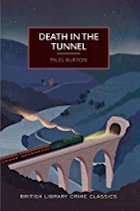
Death in the TunnelMiles Burton, Death in the Tunnel

When prominent businessman Sir Wilfred Saxonby is found dead in a first-class train compartment, the local police assume that he must have committed suicide. After all, they found the murder weapon, monogrammed with Sir Wilfred’s initials, in the train compartment, and the train employees swear that no one entered or left the compartment except Sir Wilfred himself. But because of the man’s high social status—and the apparent lack of a motive—Scotland Yard is called in. Inspector Arnold is not quite satisfied with the suicide theory, so he in turn asks for the help of his friend Desmond Merrion, an amateur expert in criminology. Together, Arnold and Merrion consider the possibility that Sir Wilfred was murdered and try to discover how it could be done.

This is one of those Golden Age mystery novels that’s all plot and absolutely no character development. The two principal characters are Arnold and Merrion, and all we ever learn about them is that Merrion is more “imaginative” than Arnold, but both are good detectives. They have literally no other character traits — though I believe there are several other books featuring Merrion, so he may be better defined elsewhere. Sir Wilfred is only fleshed out enough to hint at a possible motive for murder, and the three or four suspects are only vaguely differentiated from each other. That said, the plot is actually very ingenious — one of the best mysteries I’ve read in a while from a pure “puzzle” standpoint! Merrion and Arnold piece together their solution in a very logical way, demonstrating how the seemingly impossible crime could have been accomplished. So in the end, the excellent plot made up for the lackluster characterization, for me; your mileage may vary.

Review: The Jane Austen Project

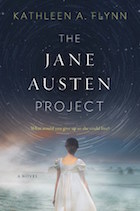
Jane Austen ProjectKathleen A. Flynn, The Jane Austen Project

Rachel Katzman and Liam Finucane live in a near-future world where time travel is well established as a scientific research tool. Their first mission is to travel to 1815, where they will retrieve Jane Austen’s personal letters (many of which were destroyed after her death) and her manuscript of “The Watsons,” which, according to a recent discovery, she actually did complete. To achieve this goal, Rachel and Liam will pose as members of the gentry and try to become part of the Austens’ social circle. But the more they get to know Jane and her family, the more Rachel and Liam begin to have scruples about their actions. Additionally, they start to worry about the possibility of changing history and the even scarier possibility that they may not be able to leave 1815. And of course, the deepening of their relationship to each other may have far-reaching consequences in both 1815 and their own time.

I enjoyed this book overall, but I definitely think some parts were more successful than others. The premise is certainly an interesting one if you love Jane Austen, and overall I think the portrayal of Jane and her family was very well done. The book evokes the 1815 setting very well; it feels like the reader is also a time traveler, being immersed into this bygone era for the first time. I was particularly tickled by one scene where Jane catches Rachel looking through her private papers and accuses her of being a French spy! That said, the novel gives short shrift to the time travel element; it doesn’t explain how it works or what the “rules” are, and the future consequences of Rachel and Liam’s actions in 1815 are wrapped up very quickly. Finally, I wasn’t particularly invested in the romance. While Rachel and Liam are both pleasant enough, I never really got a sense of what made them tick. Ultimately, I did like the book, but I don’t think it’s one I’ll ever need to reread.

Review: The English Wife

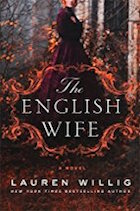
English WifeLauren Willig, The English Wife

In the winter of 1899, Bayard van Duyvil and his highborn English wife, Annabelle, are at the pinnacle of New York high society. Wealthy and attractive, with two young children and a brand-new estate, they seem to be the perfect couple — that is, until their Twelfth Night ball, when Bayard is found murdered and Annabelle goes missing. Rumors abound that Annabelle killed her husband, but Bayard’s sister Janie is not convinced. With the help of dashing journalist James Burke, Janie is determined to discover what really happened to Bay and Annabelle. But she soon learns that their relationship was much more complicated than it appeared.

I always enjoy Lauren Willig’s books, but I find that I definitely prefer her light and fluffy Pink Carnation series to her more serious historical novels. I enjoyed the setting of this one, and I liked Janie a lot — I’m always a fan of characters who have to grow into their strength. The romance between Janie and James was also satisfying, albeit quite predictable. However, I wasn’t a huge fan of the secondary narrative, which takes place five years earlier and is told from the point of view of Georgie, an actress who meets Bayard while he’s visiting London. I liked Georgie but disliked Bayard more and more as the story went on. I also found Janie’s story more interesting, so I was annoyed when the book’s focus shifted away from her. Overall, I found this an enjoyable read, but it’s not a keeper for me.

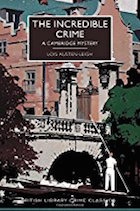
Review: The Incredible Crime

Incredible CrimeLois Austen-Leigh, The Incredible Crime

Prudence Pinsent enjoys her position as the daughter of the Master of Prince College, Cambridge. She socializes with the various professors, Fellows, and their wives, and she loves a good rugby match. One day she travels into the countryside to visit her cousin, Lord Wellende, and to enjoy a few days’ hunting on his estate. En route, she encounters an old acquaintance who happens to be a coast guard inspector. He reveals that a nasty new drug is being smuggled into England, and the central distributor is operating out of Cambridge. Moreover, he suspects that Lord Wellende, whose estate is on the coast, may also be involved. He asks Prudence to keep her eyes and ears open while she visits her cousin, but she insists that Wellende couldn’t possibly be involved in drug smuggling. However, the longer she stays at Wellende’s estate, the more she is forced to admit that something fishy is going on. Meanwhile, she finds romance in an unlikely place.

I enjoyed this book for its bright, lively voice, but I must say that the plot is very scattered! Cambridge actually isn’t a huge part of the story, but the scenes set there feel more like a satire of academia than anything else. The drug smuggling is the main plot, but it’s not a traditional mystery in the sense of fair cluing, multiple suspects, alibis, and the like. There is a suspicious death in the book, but it happens almost at the end of the novel and is resolved fairly quickly. Then there’s the romantic element, which I (somewhat surprisingly) was not a fan of and which felt very tacked on. My overall impression is that the book isn’t sure what it’s trying to be. I think it’s best to approach the novel as a period piece — the style is enjoyable, there are some lovely descriptions of the countryside, and some of the minor characters are great fun. But it’s not particularly satisfying as a mystery, and I’m not sure whether I’ll end up keeping my copy.

Review: The Grave’s a Fine and Private Place

Grave's a Fine and Private PlaceAlan Bradley, The Grave’s a Fine and Private Place

***Warning: SPOILERS for previous books in the series!***

In this latest installment of the Flavia de Luce series, Buckshaw is in mourning after the death of Haviland. To cheer up Flavia and her sisters, Dogger suggests a holiday to the nearby village of Volesthorpe. But what should be a peaceful boating excursion inevitably turns into another mystery when Flavia dangles her hand in the water and inadvertently catches a corpse. The dead man is Orlando Whitbread, the son of Canon Whitbread, who was convicted of murdering three of his parishioners by poisoning the communion chalice. Naturally, Flavia is on the case, and she soon discovers that the people of Volesthorpe are hiding many secrets, including what really happened in the case of the poisoned chalice.

After reading Thrice the Brinded Cat Hath Mew’d, I honestly wasn’t sure whether I wanted to continue with this series. Flavia’s continuing lack of friends, her adversarial relationship wth her sisters, and of course Haviland’s death made me feel very sad for Flavia, and I was more depressed than entertained. But I’m happy to say that this book was a lot more fun; it feels like the old irrepressible Flavia is back! I loved her interactions with Dogger in this novel, and it was interesting to learn a little more about his backstory. I was also pleased to see her getting along with her sisters a bit better, especially Daffy, whose love of poetry ends up giving Flavia a key clue. There’s even a hint of a suspicion that Flavia might be growing up, although I’m kind of torn on whether or not I want that to happen…. Nevertheless, I’m looking forward to the next book now, and I’m happy that the series seems to be back on track!

Review: A Man Lay Dead

Man Lay DeadNgaio Marsh, A Man Lay Dead

This first book in the Inspector Alleyn series is pretty much the quintessential English country house murder. A group of acquaintances is invited to Frantock, the stately home of Sir Hubert Handesley, who is famous for his house parties. Everything seems to be going swimmingly, although first-time guest Nigel Bathgate notices some tension in the air. Sir Hubert suggests a game of Murders, in which one guest is secretly designated the “murderer” and must “kill” another member of the party without being caught. Of course, the game becomes all too serious when one of the houseguests is really killed. Inspector Alleyn is on the case, and he soon uncovers several motives for murder — but it seems as though none of the suspects would have been able to complete the dastardly deed in time.

I’m almost positive that I’ve read this book before, but it’s been so long that I hardly remembered anything about it. Maybe I didn’t like it the first time, because I don’t remember reading any other books by Ngaio Marsh; but I definitely enjoyed it this time around! I liked the writing style, the book has good pacing, and the clues are well planted and spread around. The solution to the mystery is bizarre but satisfying, and there’s even a nice little romance on the sidelines. The characterization is rather flat, even for Alleyn; Nigel Bathgate is the only one with a bit of depth. And a fair bit of the plot is spent on a Russian secret society that (spoiler alert) has nothing to do with the murder and is just there to create trouble. (I mean, that’s not even really a spoiler, because it is literally never the Russians.) Still, I’m definitely interested in continuing with this series, and I’m sure the characterization — at least of Alleyn himself — will improve in later books!

Mini-reviews: Three, Congress, Twisted, Piccadilly

Case for Three DetectivesCongress of Secrets

Leo Bruce, Case for Three Detectives — This parody of Golden Age detective fiction is an absolute must-read for fans of the real thing! It has all the traditional elements: an ill-fated house party, an impossible murder, a brilliant amateur detective (or three), and a bumbling local policeman. In this case, the three detectives — who bear striking resemblances to Lord Peter Wimsey, Hercule Poirot, and Father Brown, respectively — use their unique methods to arrive at three different solutions to the crime, while Sergeant Beef reiterates in the background, “But I know who done it!” The humor in this book is quite specific: if you’re unfamiliar with any of the three detectives being parodied, you’re missing out on some of the fun, but Leo Bruce really does get the voices of these three fictional detectives exactly right! Also, I was impressed by the fact that he had to come up with four different plausible solutions to the mystery. I’ll definitely read more by this author, and I wholeheartedly recommend this book to fans of Lord Peter, Poirot, and Father Brown!

Stephanie Burgis, Congress of Secrets — This book checks off so many of my personal boxes, it’s ridiculous: The book is set in the 19th century, specifically at the Congress of Vienna that concluded the Napoleonic wars. Magic exists in the world but is being used by powerful men for very dark purposes. And one of the main characters is a con man! And there’s a romance! So, obviously I was predisposed to like this book, and it did not disappoint. I’ve already acquired more books by Burgis, and I’m excited to have discovered a new-to-me author!

Twisted Sword, ThePiccadilly Jim

Winston Graham, The Twisted Sword — Oof, lots of changes for the Poldarks and Warleggans in this book, and most of them are tragic. I won’t go into specifics for fear of spoilers, but in my opinion this is probably the saddest book in the series. It’s still a very absorbing and enjoyable read, though — after 11 books, I’ve really grown invested in the Poldarks, the Warleggans, and all their friends and neighbors in Cornwall and beyond. What I love is that Graham paints such a complete picture of life at the time, weaving the wider political, social, and economic landscape into his tale of these country families.

P.G. Wodehouse, Piccadilly Jim — I loved this book, which is pure farce of the silliest, most delightful kind! Wodehouse actually spent some time in America writing screenplays and musicals (!), and I could definitely see this book as an old-fashioned screwball comedy! It contains so many tropes of that era — mistaken identities, love aboard a transatlantic vessel, a boxer with a heart of gold — not to mention classic Wodehousian touches like a pair of disapproving aunts and a ludicrous kidnapping scheme. Highly recommended!

Mini-reviews: Inevitable, Ready, Loving, Duke

That Inevitable Victorian ThingReady Player One

E.K. Johnston, That Inevitable Victorian Thing — This alt-historical novel is set in a version of the Victorian era in which technology has greatly advanced, leading to innovations such as a computer that predicts a person’s optimal spouse based on his or her genetic code. In this world, heir to the throne Margaret travels to Canada, posing as a commoner to have one last hurrah before she must submit to a computer-arranged marriage. There she meets Helena and August, who have been unofficially promised to each other for years but who both harbor shocking secrets.

I have mixed feelings about this book. I think it succeeds best when it focuses on the changing relationships among the three main characters (if you’re wondering whether there’s a queer love triangle, the answer is yes). On the other hand, I found myself in a situation where I actually wanted more world-building! The book contains some fascinating ideas about how the world might have been different if things had gone differently in the actual Victorian era, but I wish those ideas had been developed more. Also, I think there’s one significant plot weakness: about halfway through the novel, a big secret is revealed about Helena, but the implications of that secret are never really addressed. Not a bad book, by any means, but I didn’t like it nearly as much as I wanted to.

Ernest Cline, Ready Player One — I have to say, I did not enjoy this book at all! I know it’s very popular, and I can see how it would appeal to lovers of ’80s geek culture, but it is emphatically not the book for me. The protagonist, Wade, is a smug know-it-all who thinks he’s better than everyone else because of his dedication to memorizing the minutia of ’80s movies, music, and video games. He’s the kind of guy who will judge you for not knowing some obscure piece of trivia and claim that you’re not a “true fan” of whatever thing. I honestly can’t remember the last book I read whose protagonist annoyed me so much! That said, the overall concept — sort of The Matrix meets The Westing Game — is fun; it just doesn’t make up for the insufferable “hero,” in my opinion.

Loving Cup, TheDuke and I, The

Winston Graham, The Loving Cup — In the 10th Poldark book, Clowance makes a decision about her future; Jeremy struggles with his obsessive, unrequited love for Cuby; and tensions between Valentine and George finally come to a head. I’m so behind on reviews that I’ve actually finished the series now, so I can’t quite remember which events happened in this book versus others. I do remember Jeremy’s ultimate decision regarding Cuby, which was based on TERRIBLE advice from Ross! I also didn’t love the continued presence of Stephen Carrington, who starts to rehabilitate himself only to fall even more spectacularly. Still, I really enjoyed the series overall, and this installment did some important place-setting for the final two books.

Julia Quinn, The Duke and I — I’d read one Julia Quinn book previously (Just Like Heaven) and enjoyed it, so I decided to try this first book in her famous Bridgerton series. It’s a fun, quick read, but for me it never rose above somewhat mindless entertainment. For one thing, I’m not a huge fan of the “notorious rake is reformed by the love of a good woman” plotline. For another, I didn’t quite know what to make of the hero’s personal history, which basically amounts to serious verbal and emotional abuse from his father. Clearly this backstory is meant to make the hero more interesting and to create an obstacle in the plot; but the book generally has such a lighthearted tone that the backstory seems incongruous and almost inappropriate. All that said, I do enjoy some nice Regency fluff every now and then, so I’ll probably read more by this author…but maybe I’ll try one of her other series!