Review: The Last Dragonslayer

Last Dragonslayer, TheJasper Fforde, The Last Dragonslayer

In the Ununited Kingdoms, magic is a part of everyday life, but it’s only used for the most mundane of tasks, like rewiring a house’s electricity or removing all the moles from the garden (or your face). But lately, the magic levels seem to be rising in the Kingdom of Hereford, and nobody quite knows why. Moreover, the local pre-cogs have begun to prophesy the death of the world’s last remaining dragon — an event of great importance, not only because dragons seem to be inextricably tied to magic, but also because once a dragon dies, its lands are up for grabs. Thus, the premonition inevitably results in a huge influx of people and corporations hoping to claim the Dragonlands for themselves. In the midst of all this, Jennifer Strange, a seemingly ordinary 15-year-old girl, learns that she has a surprising destiny: she is the Last Dragonslayer, the one fated to kill the dragon. The problem is, Jennifer isn’t quite sure she wants to do it….

As a big Fforde ffan, I’m glad I finally got around to reading this book, his first YA novel and the first book in a trilogy. Overall, I found it pretty enjoyable and quite reminiscent of the Thursday Next books in some ways. Like Thursday, Jennifer is a strong and intelligent heroine who’s willing to fight for her principles. She also has a quirky pet, although it’s not a dodo but a Quarkbeast, a visually terrifying creature with the personality of a dog. And just as Thursday often gets into trouble with the all-powerful Goliath corporation, Jennifer runs into similar problems with Consolidated Useful Stuff. In fact, maybe that’s the reason I didn’t like this book as much as Fforde’s other work — it’s a bit too similar to the Thursday Next series, except without all the fun literary references and time travel. I’d say it’s still worth reading if you enjoy Fforde’s particular brand of schtick, but it’s not the best entry point into his work.

Review: Quick Curtain

Quick CurtainAlan Melville, Quick Curtain

Crowds flock to the London premiere of Douglas B. Douglas’ sensational new musical comedy, hoping to catch a glimpse of stage idols Brandon Baker and Gwen Astle. But they get even more sensation than they bargained for when leading man Baker is shot dead in the middle of Act 2. Fortunately, Inspector Wilson of Scotland Yard is in the audience, along with his son Derek, an enterprising young journalist. When another cast member is found hanged in his dressing room, the obvious conclusion is that he murdered Baker, then committed suicide. But Inspector Wilson isn’t convinced, especially when he finds a bullet hole in a place that would be impossible under that theory of the crime. He and Derek jointly investigate the mystery, which leads them to a remote village, several salacious secrets, and an altogether unexpected solution to the mystery.

I absolutely love Golden Age mysteries, and this one was a very enjoyable read, unique in its lighthearted tone and somewhat breezy attitude to police procedure. (For instance, does Inspector Wilson even have jurisdiction over the case? In this book, it doesn’t matter: he’s first on the scene, so he simply commandeers the investigation.) I loved the humorous running commentary on show business of the era; apparently the author himself had a long career in the industry. And I laughed out loud at various silly jokes, particularly an exchange where the play’s director is impatiently waiting for the doctor to examine the corpse. Finally fed up, the director asks, “Well?” “Not at all; in fact, he’s dead,” the doctor replies. The mystery plot isn’t particularly original, and a twist in the last chapter may irritate readers who want their mystery authors to play fair. But I really enjoyed the book’s tongue-in-cheek style and would definitely recommend it to fans of the genre!

Review: No Wind of Blame

No Wind of BlameGeorgette Heyer, No Wind of Blame

Plenty of people wanted to murder the shiftless, good-for-nothing Wally Carter. His rich wife, Ermyntrude, was tired of giving him money that he only drank or gambled away. Ermyntrude’s daughter, Vicky, thought her mother would be happier with another man. The slick “Prince” Alexis Varasashvili, had his eye on Ermyntrude’s fortune. And several other characters had equally strong movies for wanting Wally out of the way. But when he actually is shot, it seems that no one could possibly have fired the gun without being immediately discovered. As suspicion rests on each of the characters in turn, it’s up to Scotland Yard’s Inspector Hemingway to discover the truth. Along the way, a sordid scandal comes to light, a crooked business deal is unearthed, and romances end and begin.

I’m glad I chose this book to kick off my 2016 reading, since it contains both an ingenious mystery plot and a wonderful assortment of classic Heyer characters. I loved the histrionic Ermyntrude, who is certainly vulgar but also extremely kind-hearted. And Vicky, who delights in playing a variety of different roles (such as Sports Girl and Dutiful Daughter), annoyed me at first, but eventually I began to enjoy her antics in spite of myself. The main characters are so well-drawn that the mystery is a bit sidelined, but I do think the solution is very clever. I guessed the murderer but not the “how” or the “why,” although Heyer plants a few clues throughout the novel. The romances are a bit undercooked, especially the one involving Wally’s ward, Mary Cliffe. I don’t know whether I’d consider it one of my favorite Heyer mysteries, but it was still a fun read and a great start to the year!

Review: An English Murder

English Murder, AnCyril Hare, An English Murder

The setting of An English Murder seems, at first, to be a very conventional one. A group of family and friends come together for Christmas at a country house, Warbeck Hall. The house is owned by Lord Warbeck, a dying and impoverished peer who wants to be among loved ones for what he thinks will be his last Christmas. The holiday decorations are up and snow is falling fast outside. The guests range from the Lord’s difficult son to a visiting Czech historian. There is, of course, a faithful butler and his ambitious daughter. But when the murders begin, there is nothing at all conventional about them – or the manner of their detection. This ingenious detective story gleefully plays with all of our expectations about what an ‘English murder’ might be and offers enough twists and turns to keep us reading into the night. (Summary from Amazon.com.)

This was my first Cyril Hare mystery, but hopefully it won’t be my last! This is a quintessential English country house mystery, and I really enjoyed it. Most of the characters aren’t particularly likable, but the amateur sleuth, Dr. Wenceslaus Bottwink, makes up for all the others. Not only does he have a great name, but his somewhat detached “observer” status allows him to see the situation clearly and even find some humor in the various nasty interactions among other characters. The book is also interesting as a historical artifact: it was published just after World War II (1951, I believe) and contains characters whose views span the whole political spectrum, from socialism to fascism. The solution to the mystery, which also explains the book’s title, is one of the most delightful resolutions to a murder mystery that I’ve read in a while. Definitely recommended for vintage mystery lovers!

Review: Newt’s Emerald

Newt's EmeraldGarth Nix, Newt’s Emerald

After Lady Truthful’s magical Newington Emerald is stolen from her she devises a simple plan: go to London to recover the missing jewel. She quickly learns, however, that a woman cannot wander the city streets alone without damaging her reputation, and she disguises herself as a mustache-wearing man. During Truthful’s dangerous journey she discovers a crook, an unsuspecting ally, and an evil sorceress—but will she find the Emerald? (Summary from Amazon.com.)

A Regency romance with fantasy elements…of course I was going to like this book! 🙂 It’s actually the first thing I’ve read by Garth Nix, and I believe it’s somewhat atypical for him, but I’m still interested in reading more of his backlist now. I think my favorite thing about this book is the light, bright tone throughout. Even though the novel’s stakes are fairly high — the missing emerald is an ancient and powerful jewel capable of causing significant havoc — the plentiful humor and Regency elements make the book a very light, pleasant read. I also enjoyed Truthful’s adventures as a man, especially because they allowed her and her love interest truly to get to know each other, beyond the superficial interactions between ladies and gentlemen in Regency society. The actual romance wasn’t totally satisfying for me; it starts off with a nice slow build, but the resolution is extremely abrupt and comes very late in the book. But overall, I really enjoyed this novel, and so should any fan of the genre!

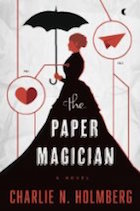
Review: The Paper Magician

Paper Magician, TheCharlie N. Holmberg, The Paper Magician

Ceony Twill arrives at the cottage of Magician Emery Thane with a broken heart. Having graduated at the top of her class from the Tagis Praff School for the Magically Inclined, Ceony is assigned an apprenticeship in paper magic despite her dreams of bespelling metal. And once she’s bonded to paper, that will be her only magic…forever.

Yet the spells Ceony learns under the strange yet kind Thane turn out to be more marvelous than she could have ever imagined—animating paper creatures, bringing stories to life via ghostly images, even reading fortunes. But as she discovers these wonders, Ceony also learns of the extraordinary dangers of forbidden magic.

An Excisioner—a practitioner of dark, flesh magic—invades the cottage and rips Thane’s heart from his chest. To save her teacher’s life, Ceony must face the evil magician and embark on an unbelievable adventure that will take her into the chambers of Thane’s still-beating heart—and reveal the very soul of the man. (Summary from Amazon.com.)

This was a pleasant read on the younger end of the YA spectrum, which is to say that I enjoyed it in the moment, but it wasn’t particularly complex or compelling. I think I was expecting more of a steampunk adventure, whereas the book is actually rather placid. Yes, there’s a dark sorceress who tears Emery Thane’s heart out of his chest, and Ceony has to stop her. But she basically fulfills this mission by entering Emery’s heart and thus becoming privy to his memories and emotions. I actually liked this conceptualization of the heart, especially as Ceony accesses both the good and evil parts of Emery’s psyche. But the character development is a bit simplistic, and the action doesn’t really pick up until the end. All in all, a decent read, but I’m on the fence about whether I want to continue with the series.

Review: The Unpleasantness at the Bellona Club

Unpleasantness at the Bellona Club, TheDorothy L. Sayers, The Unpleasantness at the Bellona Club

On November 11, ninety-year-old General Fentiman is found dead in an armchair at the Bellona Club. No one knows exactly when his death occurred—information essential in determining the recipient of a substantial inheritance. But that is only one of the mysteries vexing Lord Peter Wimsey. The aristocratic sleuth needs every bit of his amazing skills to discover why the proud officer’s lapel was missing the requisite red poppy on Armistice Day, how the Bellona Club’s telephone was fixed without a repairman, and, most puzzling of all, why the great man’s knee swung freely when the rest of him was stiff with rigor mortis. (Summary from Amazon.com.)

I think this is my favorite Lord Peter Wimsey book so far. The mystery plot is ingenious and provides an intellectually satisfying solution. I also appreciate how character-driven Sayers’ mysteries are in comparison to, say, Agatha Christie’s. (Not to bash Dame Agatha, but I think her books are far more plot-driven, with the characters rarely being very three-dimensional.) I was especially fascinated by Ann Dorland, one of the potential heirs to the general’s fortune. Her behavior is suspicious throughout the novel, but is she guilty? And if not, why does she act the way she does? The one jarring note to this mystery is the ending, where Lord Peter unmasks the killer and essentially suggests that, instead of going through the humiliation of an arrest and trial, the person should just commit suicide. I guess this attitude makes sense for the time, when people set more store by their honor than they do today…and of course, a convicted murderer would face the death penalty anyway…but I was still taken aback by Lord Peter’s suggestion! Still, I enjoyed the book and look forward to continuing with the series.

Review: Coventry

CoventryHelen Humphreys, Coventry

On the evening of November 14, 1940, Harriet Marsh stands on the roof of the historic Coventry cathedral and marvels at the frost glittering beneath a full moon. But it is a bomber’s moon, and the Luftwaffe is coming to unleash destruction on the city. For Harriet; for the young fire watcher, Jeremy, standing beside her; and for his artist mother, Maeve, hiding in a cellar, this single night of horror will resonate for the rest of their lives. Coventry is a testament to the power of the human spirit, an honest and ultimately uplifting account of heartache transformed into compassion and love. (Summary from Amazon.com.)

Many World War II novels are sprawling epics that reflect the enormity of the tragedy, death, and suffering caused by the war. By contrast, this is a lovely little book that focuses on one specific event, the bombing of Coventry in 1940, and on three people whom the bombing affects in various ways. Harriet is the most fleshed-out (and therefore most sympathetic) character, but I was interested in all three stories and how they intersect. The novel is very understated in its description of the fear and pain the characters experience, which makes these emotions seem all the more vivid and raw. I was reminded of a quote by a musician I like: “Sometimes a sketch says more than a mural” (Grant-Lee Phillips on his album Ladies’ Love Oracle). This book is a sketch, but an effective one. I’d definitely recommend it to fans of World War II novels or historical fiction in general.

Review: First Impressions

First ImpressionsCharlie Lovett, First Impressions

Book lover and Austen enthusiast Sophie Collingwood has recently taken a job at an antiquarian bookshop in London when two different customers request a copy of the same obscure book: the second edition of A Little Book of Allegories by Richard Mansfield. Their queries draw Sophie into a mystery that will cast doubt on the true authorship of Pride and Prejudice—and ultimately threaten Sophie’s life.

In a dual narrative that alternates between Sophie’s quest to uncover the truth—while choosing between two suitors—and a young Jane Austen’s touching friendship with the aging cleric Richard Mansfield, Lovett weaves a romantic, suspenseful, and utterly compelling novel about love in all its forms and the joys of a life lived in books. (Summary from Amazon.com.)

I should have known better than to pick this one up. My love of Jane Austen means that I’ve read a lot of the retellings, re-imaginings, and spinoffs of her novels, and most of them have ranged from “meh” to truly awful. So I should have known that I’d dislike this book, and indeed, the writing style had turned me off by the end of the first chapter. The author unwisely makes Jane Austen a character and tries to imitate her voice, with disastrous results.

Further, the entire “past” storyline had essentially no stakes, being nothing more than an account of the friendship between Austen and an elderly clergyman. In the “present” storyline, book lover Sophie Collingwood comes across said clergyman’s name in connection with Austen and investigates a possible plagiarism scandal. Because of course Austen lovers want to read books suggesting that she didn’t actually create her own work!

Anyway, Sophie is an utter ninny caught between a Darcy and a Wickham, although they’re pretty equally insufferable! The Wickham (whose name I can’t actually remember) is supposed to be skeevy, of course, but the Darcy also exhibits some major stalker vibes. Therefore, I didn’t buy the love triangle or enjoy the romance. So for me, the book failed on basically every front. Maybe I’m being too harsh; I’d read some positive reviews of the novel, and possibly my expectations were too high. But unfortunately, this book is in my “bottom 10” for the year.

Review: Sorcerer to the Crown

Sorcerer to the CrownZen Cho, Sorcerer to the Crown

The Royal Society of Unnatural Philosophers, one of the most respected organizations throughout all of England, has long been tasked with maintaining magic within His Majesty’s lands. But lately, the once proper institute has fallen into disgrace, naming an altogether unsuitable gentleman—a freed slave who doesn’t even have a familiar—as their Sorcerer Royal, and allowing England’s once profuse stores of magic to slowly bleed dry. At least they haven’t stooped so low as to allow women to practice what is obviously a man’s profession…

At his wit’s end, Zacharias Wythe, Sorcerer Royal of the Unnatural Philosophers and eminently proficient magician, ventures to the border of Fairyland to discover why England’s magical stocks are drying up. But when his adventure brings him in contact with a most unusual comrade, a woman with immense power and an unfathomable gift, he sets on a path which will alter the nature of sorcery in all of Britain—and the world at large… (Summary from Amazon.com.)

This book ticks so many of my boxes — Regency England! Magic! Georgette Heyer comparisons! — that I knew it would be right up my alley. And my high expectations were completely justified: this is definitely one of my favorite books of the year! Zacharias is an immediately sympathetic character, his African descent automatically making him an outsider despite his theoretical position of authority. The other protagonist, Prunella, is equally appealing. She is headstrong and warmhearted, while Zacharias can be cold and reserved, so they make an excellent team. My gold standard for historical fantasy novels is Sorcery and Cecelia by Patricia C. Wrede and Caroline Stevermer, and Sorcerer to the Crown is very much in that tradition. I must say that the marketing for this book is terrible; the cover design implies a very different sort of novel, and the quote comparing it to “a cross between Georgette Heyer and Susanna Clarke” is completely inaccurate. It’s much more Heyer than Clarke, so if you’re expecting something similar to Jonathan Strange and Mr. Norrell, you’ll be disappointed. But I loved the book and am thrilled that there will be at least one sequel!