Review: Life of Johnson

Life of JohnsonJames Boswell, Life of Johnson

James Boswell and Samuel Johnson were unlikely friends: Boswell was a young Scottish nobleman with a penchant for drinking and whoring, while Johnson was poorer, much more devout (in theory, at least), and a good 30 years older. Yet throughout the course of this monumental work, Boswell describes his reverence for Johnson’s intelligence, morality, and literary talents — a reverence so extreme that Boswell took notes on almost every conversation he ever had with the older man. As a result, this biography is stuffed full of Boswell’s personal anecdotes, letters both to and from Johnson, and first-person accounts of other contemporaries who knew him. Near the end of the book, Boswell states: “The character of Samuel Johnson has, I trust, been so developed in the course of this work, that they who have honoured it with a perusal, may be considered as well acquainted with him.” And indeed, anyone who reads this book will come away with an extremely vivid picture of a remarkable man.

This book is so huge and deals with so many things that I don’t quite know what to say about it. At first I was very intimidated, both by its length and by Boswell’s flowery 18th-century prose. But even though it’s not a quick read, this book contains a wealth of fascinating details about Johnson and the age in which he lived. I was struck by how literary the 18th century was, in the sense that seemingly anyone with a claim to intelligence was churning out books and pamphlets. In that way, Johnson’s time is very similar to our own, where everybody can (and does) publish blogs, tweets, and other forms of instantaneous literature. I was also fascinated by Johnson’s unique character; though intelligent, he was often pompous, narrow-minded, and abrasive. I frequently found myself underlining various Johnsonian sayings that were wise, or funny, or both — but I would have hated to be forced to converse with him! Overall, I would recommend this book to anyone interested in the time period or who enjoys very thorough biographies!

Review: Whom the Gods Love

Whom the Gods LoveKate Ross, Whom the Gods Love

Alexander Falkland, one of the darlings of English society, has just been murdered — bashed over the head with a poker in the middle of a party at his own house. The Bow Street Runners are at a loss to discover the killer; after all, who would want to murder a man who was universally liked? When the official investigation goes nowhere, Alexander’s father enlists the help of Regency dandy/sleuth Julian Kestrel. As a man of Alexander’s own social class, Julian has unique access to his friends and associates that the Bow Street Runners could never obtain. Julian agrees to take the case, but he warns Alexander’s father that unpleasant truths might emerge. And indeed, the further Julian digs into Alexander’s life, the more shocking secrets he uncovers, including several motives for murder.

I absolutely loved the first two books in the Julian Kestrel series, and I’m thrilled to be able to say that I loved this one as well! The strength of most mystery series depends on the protagonist, and Julian Kestrel is a wonderful sleuth: intelligent, intuitive, willing to cooperate with the police (a rare trait!), and always impeccably dressed. I also think this book is very well-plotted. Obviously there is more to Alexander Falkland than meets the eye, but the various twists and turns of the plot kept me in suspense until almost the very end of the book. My only problem with the book is that I really liked one particular character who ended up doing a horrible thing in the course of the plot. Because of this, the resolution of the mystery wasn’t completely satisfying for me; but I suppose that’s a testament to the author for making me care so much about that character! In short, I’d definitely recommend this book (and the entire series) to anyone who enjoys mysteries or historical fiction!

Review: Un Lun Dun

Un Lun DunChina Miéville, Un Lun Dun

Zanna and Deeba, two seemingly ordinarly pre-teen girls, are suddenly thrust into an unfamiliar world when they follow an umbrella into a dark London basement and emerge in Un Lun Dun. Un Lun Dun is an “abcity,” part of a universe that parallels our own but has many significant differences. (For example, giraffes aren’t exactly harmless herbivores in Un Lun Dun….) At first, Zanna and Deeba only want to go home; but they soon learn that Un Lun Dun is under attack by the evil Smog, and Zanna is supposed to be the “Schwazzy,” or chosen one, who will fulfill an ancient prophecy and defeat it. The girls are willing enough to help, but when their first encounter with the Smog goes terribly wrong, it’s up to Deeba, rather than the chosen Zanna, to save the day.

This was my first encounter with Miéville, and I’m thinking it won’t be my last. If you enjoy detailed world-building and clever puns, this is definitely a book for you! The world of Un Lun Dun is wildly inventive, from the trash-can warriors known as “binjas” to the flying buses to the “extreme librarians” who populate the abcity. You may think the book sounds a lot like Gaiman’s Neverwhere, what with the alternate London setting, but I was actually reminded a lot more of Jasper Fforde. The plot itself is rather predictable, but it’s still a fun ride to follow Deeba as she figures out who her real allies and her real enemies are. Some may find the book a bit preachy on the issue of environmentalism — the villain is literally called Smog, after all — but since this book is aimed toward younger readers, I suppose the message shouldn’t be too subtle! All in all, I found this book very entertaining, and I’m interested to try some of Miéville’s adult novels now.

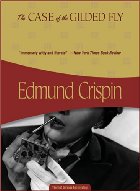
Review: The Case of the Gilded Fly

The Case of the Gilded FlyEdmund Crispin, The Case of the Gilded Fly

In 1940s England, a theater troupe converges upon Oxford to produce a new play by acclaimed playwright Robert Warner. One of the actresses, Yseut Haskell, is a beautiful girl who has attracted many admirers, but her outward appearance masks a cruel and self-absorbed personality. The other people involved with the play are frankly sick of her attitude, especially when she begins to stir up trouble within the company. So it’s not particularly surprising when Yseut is subsequently found murdered — in fact, nearly everyone in the theater company expresses relief that she’s finally gotten what she deserved. In the midst of this tense situation, Oxford don Gervase Fen uses his passion for criminology and his friendship with policeman Sir Richard Freeman to investigate the murder. As he talks to the various suspects and uncovers some unpleasant secrets, he begins to wonder whether exposing the murderer is really the best course of action.

This is a fairly typical Golden Age mystery, and as a fan of that genre, I enjoyed this book. I found Gervase Fen entertaining, although he wasn’t as prominent in the book as I expected he’d be; much of the story is told from the viewpoint of Nigel Blake, a young man who becomes involved with the theater troupe and falls in love with one of the actresses. I can see why Crispin chose that approach, though, because Fen claims to have solved the murder within three minutes of viewing the body! I also found Fen’s qualms about exposing the murderer very interesting. In many mysteries, it’s taken as a matter of course that the murderer should be unmasked and brought to justice; however, in this case the victim is a truly unpleasant person, and many of the characters think that the murderer did them a favor. Finally, I was struck by the fact that this really doesn’t feel like the first book of a series; there are several allusions to Fen’s past cases, and as I mentioned before, his character isn’t particularly fleshed out. Nevertheless, there are a few more Gervase Fen books, and I’ll probably seek them out at some point.

Review: An Old Betrayal

An Old BetrayalCharles Finch, An Old Betrayal

***Warning: SPOILERS for previous books in the series!***

Charles Lenox, Victorian gentleman and Member of Parliament, thinks he has left his former life as a detective behind. But when his aristocratic protégé, John Dallington, asks him for help with a prospective client, Charles is eager to lend a hand, leaving his work in the House of Commons behind. Since Dallington is laid up with a bad cold, Charles agrees to meet the prospective client in his place; but before Charles can make contact with the client, a young woman named Grace Ammons, she is scared away by a mysterious man. Eventually Charles learns that Grace has connections to Buckingham Palace, and he suspects a possible plot to steal the priceless items within it. But when the man who frightened Grace Ammons is later found murdered, Charles realizes that the plot against the palace is more shocking and deadly than he ever imagined.

This is the seventh Lenox mystery, and in my opinion, the series is still going strong. One of my biggest complaints about the last couple installments has been the neglect of the secondary characters, but this book gives them a lot more attention. There is a significant subplot involving Charles’ medical friend, Thomas McConnell, and Dallington (my favorite character!) is also prominently featured. I also largely enjoyed how the mystery plot unfolded in this book; unsurprisingly, the murder and the threat to Buckingham Palace turn out to be connected, and there are many clever twists and turns along the way. But I think my favorite aspect of this novel is how it ends: there are a lot of big changes for Lenox and his friends in this book, and in my opinon, they’re changes for the better. I’m really looking forward to seeing where the series goes from here!

Review: An Excellent Mystery

An Excellent MysteryEllis Peters, An Excellent Mystery

In the summer of A.D. 1141, two Benedictine brothers seek refuge at the Abbey of Saints Peter and Paul in Shrewsbury. They have fled the city of Winchester, where their former abbey has gone up in flames, a casualty of the civil war between King Stephen and Empress Maud that still rages on. The older of the two refugees, Brother Humilis, is obviously a nobleman — and just as obviously dying from a mortal wound sustained many years ago in the Crusades. The younger man, Brother Fidelis, is mute, but he tends his fellow traveler with astonishing devotion. Brother Cadfael, due to his knowledge of herbs and their healing properties, spends a lot of time with these two brothers and eventually discovers that there is more to their story than meets the eye. Meanwhile, Cadfael also investigates the disappearance of a beautiful young woman who intended to become a nun but never arrived at her convent.

This book is the eleventh installment of the Cadfael series, but I think it can largely function as a stand-alone; newcomers to the series wouldn’t get lost if they jumped in here, though I still recommend starting with A Morbid Taste for Bones. These books are always comfort reads for me. I love the historical setting of a medieval monastery, and I enjoy seeing how Cadfael’s small world is affected by larger historical events. I also like the fact that these mysteries are firmly on the “cozy” end of the spectrum; there is often murder, but it’s never grisly, and there’s also romance and humor and a lot of lovely descriptions of monastic life. As for this book in particular, I definitely enjoyed it, but I’m pretty sure I read something about the solution to the mystery ahead of time, because it definitely didn’t surprise me. In fact, I think the resolution is fairly predictable even if you haven’t been spoiled. However, I still liked this book a lot and look forward to the next installment of the Cadfael series!

Review: Curtsies & Conspiracies

Curtsies and ConspiraciesGail Carriger, Curtsies & Conspiracies

After the events of Etiquette & Espionage, Miss Sophronia Temminick is back at Mademoiselle Geraldine’s finishing school, where young ladies learn to finish…anyone or anything. Sophronia learns that she has received top marks in her espionage classes, which causes resentment among the other students, even her close friends. Meanwhile, she discovers more information about the crystalline valve prototype that caused so much trouble in the previous book. While she tries to learn more about the valve’s purpose, it quickly becomes evident that she’s not the only interested party — and that her best friend Dimity might be in danger because of it. While Sophronia attempts to put her clandestine skills to good use, she must also cope with the arrival of boys from a rival academy — including one who flirts with her most scandalously! Will Sophronia be able to protect her friend and solve the mystery, all while trying to listen to her confused heart?

This second book in Carriger’s Finishing School series is another fun Victorian romp with steampunk trappings. The world of these books is fascinating and very entertaining, with its steam-powered “mechanimals” and rules of supernatural etiquette. This book even furnishes a few specific alternate-universe facts, such as that the telegraph was introduced a few years ago but failed dismally. These tidbits help to anchor the novel’s plot a bit more in reality, which is important because most of it is so entirely silly! If you’re not familiar with Carriger’s schtick, be prepared for a lot of riduculous names and pseudo-British witticisms. I personally enjoy the silliness, but your mileage may vary. I also quite like Sophronia, a delightfully practical, self-assured heroine who doesn’t let little things like rules or restrictions prevent her from satisfying her curiosity. My only complaint is that I’m still very confused about the valve and the various parties involved. No one’s motives are clear yet, which makes it hard to know whether Sophronia is doing a good job or not. But I’m still definitely planning to continue with the series to find out!

Review: The Last Enchantment

The Last EnchantmentMary Stewart, The Last Enchantment

This third book in Stewart’s Merlin saga picks up right where The Hollow Hills left off: Arthur has just been crowned High King of Britain, and now he must confront the various threats to his kingdom. He immediately engages in battle with the Saxons and attains victory after victory, but the more serious dangers to Arthur’s kingship come from within. First, Morgause has managed to hide away Mordred, the son she conceived during her incestuous liaison with Arthur, who will ultimately be Arthur’s doom. There’s also the necessity of ensuring the succession, which means Arthur must find a bride. And finally, some of the northern kings are chafing under Arthur’s rule, so he faces internal rebellions as well as external threats. Through all of this, Merlin remains by Arthur’s side to give him advice, friendship, and the occasional prophecy.

My biggest feeling on finishing this book is one of relief — I’m finally done with this trilogy! (Yes, there is a fourth book, The Wicked Day, but I don’t own that one and have no intention of reading it.) It’s not badly written at all, but it moves so slowly that I couldn’t wait to be done! I think the pitfall of telling Arthur’s story from Merlin’s point of view is that (at least in this version of events) Merlin likes to go off by himself to read or tend his garden or visit foreign lands, so he’s not by Arthur’s side during all the interesting parts. There’s almost nothing in this book about Arthur’s knights, or his relationship with Guinevere, or most of the famous legends of Camelot. In short, I found this book — and the series as a whole — pretty boring, although maybe Arthur enthusiasts would enjoy it more. Personally, it’s not something I ever need to read again.

Review: They Found Him Dead

They Found Him DeadGeorgette Heyer, They Found Him Dead

This book begins, as so many classic British mysteries do, with an ill-fated party at an English country house. Silas Kane is celebrating his 60th birthday, but many of his guests aren’t in a particularly happy mood. His heir, Clement, is desperate to get his hands on a piece of the older man’s fortune — especially because his beautiful but materialistic wife, Rosemary, is threatening to leave him. Meanwhile, Silas’ neighbor and business partner is eager to interest him in an investment opportunity, but so far he has stubbornly refused to consider the deal. So when Silas is discovered dead the day after the party — having apparently fallen over the cliff where he habitually took a walk every evening — there is no shortage of suspects to consider. And when Clement is shot in the study shortly afterwards, it seems clear that a murderer is at work. Once again, Inspector Hannasyde of Scotland Yard must untangle the various motives in play and discover the identity of a ruthless killer.

I’ve been steadily working my way through Heyer’s mysteries, and this book is a typical example. I always enjoy Heyer’s witty dialogue and hints of romance, although in this book the love story is very peripheral to the main plot. The mystery itself is fine, though there’s nothing particularly surprising for those who read a lot of detective novels. As always, the strength of Heyer’s books is her characters, and there several great ones here, from the self-absorbed Rosemary Kane to the exuberant young Timothy Harte, who is overly eager to assist the police in solving the murder. I should note, however, that while Inspector Hannasyde is a recurring character in Heyer’s mysteries, he is definitely not the protagonist; each individual book tends to revolve around the victim and the suspects much more than around the detective. Anyway, I definitely liked this book overall, but there’s nothing that makes it particularly stand out to me.

Review: The Hollow Hills

The Hollow HillsMary Stewart, The Hollow Hills

Picking up right after The Crystal Cave left off, this book follows Merlin from the day Arthur was conceived to the day he became high king of Britain. Although Merlin helped Uther Pendragon to marry Ygraine, he is currently out of favor with the king. Yet when Uther needs advice about what to do with his unborn child, Merlin is still the first person he consults. If the child is a boy, Uther must recognize him as the king’s son, just in case he is unable to produce a legitimate heir. At the same time, however, he must keep the boy far away from his court, both to protect him and to get him out of the way in case there should be another son with a better claim to the throne. Merlin suggests sending the child to one of Uther’s loyal knights, where he will be raised as a foster child ignorant of his true parentage. Meanwhile, Merlin becomes Arthur’s friend and protector, teaching him all he needs to know in order eventually to take his rightful place as the king’s heir.

I wasn’t terribly impressed with the first book in this series, The Crystal Cave, but I actually liked this book more. It starts off slowly, but once Arthur is born, the book picks up and gets significantly more interesting. Unsurprisingly, I enjoyed the political machinations aspect of the book more than the mystical aspect; I found Merlin’s visions and prophecies a little boring! I did like watching the relationship between Merlin and Arthur unfold, though, and I look forward to seeing how it continues in the next book. Overall, I’m glad I decided not to give up after The Crystal Cave, and I’m a little more excited about The Last Enchantment than I was before.