Review: Royal Blood

Royal BloodRhys Bowen, Royal Blood

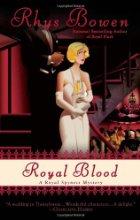
Lady Georgiana Rannoch, still both royal and impoverished, is desperately searching for a way to make ends meet — especially when her brother Binky and his odious wife Fig come to London expecting her to feed and house them. So when the queen suggests that Georgie represent the British crown at a royal wedding in Romania, she jumps at the chance for a taste of adventure and temporary freedom from her financial woes. When Georgie arrives at the royal palace — which is inevitably located in Transylvania — she is impressed by its suitably gloomy and gothic atmosphere. But when one of the wedding guests, an unpopular Bulgarian dignitary, is poisoned during the house party, it’s up to Georgie to discover the murderer before the tragedy escalates into an international incident.

I started this series a few years ago but lost track of it somewhere along the way, so I’m glad I finally decided to pick up the next book! I really enjoy the light, breezy tone of this series. Georgie is an extremely likable protagonist, a bit silly sometimes, but also full of spunk. I also love the 1930s setting, which allows for glamorous evening parties but also hints at the international strife that will soon erupt into World War II. The mystery plot itself is very slight, with a solution that basically comes out of nowhere; but since I enjoy the setting and characters, I can forgive a relatively weak plot. I definitely wouldn’t recommend the book as a stand-alone novel, but fans of historical mysteries and cozies should give this series a try!

Review: Behold, Here’s Poison

Behold, Here's PoisonGeorgette Heyer, Behold, Here’s Poison

Gregory Matthews is a domestic tyrant and an all-around unpleasant man, so none of his family members are particularly grieved when he suddenly dies after eating a rich dinner. Everyone, including the local doctor, is ready to accept a verdict of death by heart failure, until the dead man’s overbearing sister insists on a post-mortem. When the autopsy reveals that Matthews was actually poisoned, however, the family is thrown into turmoil. The taint of suspicion touches everyone, from the victim’s sister-in-law, who lives in his house, to his heir, the sophisticated and sarcastic Randall Matthews. Inspector Hannasyde of Scotland Yard is on the case, and he soon finds Randall’s attitude suspicious; meanwhile, Randall claims he is working on his own to discover the murderer. But will he or the police succeed before the guilty party kills again?

I’ve been reading Heyer’s mysteries in publication order, and overall I’ve been enjoying them (though not as much as I love her Regency romances!). Sadly, I think this novel is my least favorite so far. Heyer’s greatest strength isn’t crafting suspenseful mysteries; rather, she excels in creating vivid, likable characters and witty dialogue. In this book, though, I just didn’t find the central characters very likable or interesting. Randall in particular got on my nerves; while Heyer has successfully done similarly urbane, dandified characters in her romances, in this case I found him more irritating than intriguing. The romantic storyline also felt undeveloped and unsatisfying. This book wasn’t a terrible read, by any means, but I’d recommend one of Heyer’s other mysteries instead.

Review: Devil’s Brood

Devil's BroodSharon Kay Penman, Devil’s Brood

Henry II, with the help of his wife, Eleanor of Aquitaine, has created one of the vastest empires known to Europe, and the time has come to parcel it out among his sons. As the oldest, Hal will succeed his father as king of England and will also rule over the French duchies of Normandy and Anjou. Richard, Eleanor’s favorite son, will inherit her lands as Duke of Aquitaine. Geoffrey will become Duke of Brittany through marriage to a prominent heiress. But even though all three boys have grown up, Henry still holds onto the reins of power, convinced that none of them are truly ready to rule in their own right. His sons’ lack of independence soon breeds resentment, and Henry is shocked by its consequence: with the help of their mother, they openly rebel against him. This novel is the story of the conflict between Henry and his sons, between Henry and Eleanor, and between the boys themselves, as their struggle for power leads to almost constant warfare throughout Europe.

I’ve been enjoying Penman’s Plantagenet series, and I think this is my favorite installment so far. It’s hard to believe that the major events in this novel actually happened…there’s just so much drama! I also found the portrayal of Henry and Eleanor’s (adult) sons to be fascinating. Geoffrey was my favorite, which will probably surprise any fans of “The Lion in Winter”; but based on Penman’s depiction, I think he would have made the best king. Sure, he was self-serving and manipulative, but so was everyone else in the book! At least he had a good strategic mind with an ability to make long-term plans, and he managed to win over the Breton nobles so that he could rule Brittany competently. The overarching conflict between Henry and his sons was both sad and frustrating. It seemed to come down to a total lack of communication skills and an inability to see the other side’s point of view. (Hmm, sounds familiar….) I’m glad I finally read this book, and I look forward to reading Lionheart in the future.

Review: The Passion of the Purple Plumeria

The Passion of the Purple PlumeriaLauren Willig, The Passion of the Purple Plumeria

In the eyes of the world, Miss Gwendolyn Meadows is the fiercely protective chaperone of Miss Jane Wooliston, who is currently one of the belles of Parisian society. But since Jane is also the elite British spy known as the Pink Carnation, Miss Gwen’s duties also include strategy, swordsmanship, and a taste for the dangerous work of espionage. Miss Gwen thrives upon the excitement of her double life, but she is forced to return to England when Jane’s younger sister goes missing from her prestigious boarding school. A second girl has also disappeared: the youngest daughter of Colonel William Reid, an officer of the British East India Company who has recently returned to England to reunite with his daughters. Now Miss Gwen and Colonel Reid must work together to find the missing girls — and fight their increasing attraction to one another, because Miss Gwen is all too aware that her clandestine activities are the probable reason for the girls’ disappearance.

This is the 10th book in Lauren Willig’s Pink Carnation series, and as I expected, it was a fun Regency romp complete with legendary Indian treasure, a meeting of the Hellfire Club, and a sinister French master spy. I like the fact that Willig chose a more mature hero and heroine for this installment of the series; it lent a bit of substance to the story, although the book still retains the series’ trademark light and fluffy tone. Miss Gwen is in her 40s and has long despaired of ever finding romance, so the relationship between her and Colonel Reid is particularly sweet and satisfying. I also liked how Willig is starting to gather the loose threads from some of her earlier books; for example, Colonel Reid is the father of Alex Reid from The Betrayal of the Blood Lily, and some of the events of that novel are relevant to this story. I am really hoping that Jack Reid, the black sheep of the family, is a hero in one of the future Pink Carnation books! All in all, I’m still enjoying this series and will continue to read more by Willig.

Review: A Midsummer Tempest

A Midsummer Tempest

Poul Anderson, A Midsummer Tempest

Set during an alternate version of the English Civil War, this novel follows Prince Rupert of Bohemia, one of King Charles’ most valiant allies. Unfortunately, Charles is losing his war against the Puritans, and after a particularly brutal battle, Rupert is captured by a Puritan nobleman and placed under house arrest. He immediately begins plotting his escape, but fate steps in when he meets his captor’s beautiful niece, Jennifer. The two of them end up fleeing the Puritan’s house together and receiving help from an unlikely source: Oberon and Titania, the king and queen of Faerie. They encourage Rupert to find the lost treasure of Prospero, whose magical artifacts will help the king’s cause; but Rupert must brave many dangers before he can fulfill his quest.

There are so many clever, ingenious concepts at work in this book that it’s almost too hard to list them all. First there is the obvious debt to Shakespeare: in this world, he is not merely a playwright but also the Great Historian, so everything he wrote is factually true. (Bohemia even has a sea coast!) Thus, this book is full of all the wonderful Shakespearean plot devices — faeries, star-crossed lovers, uncouth jesters, shipwrecks, and a very unusual tavern, to name a few. My favorite thing was realizing that several of the characters actually talk in iambic pentameter. Sure, it makes the style a bit choppy and stilted, but the characters talk in iambic pentameter! Add in a discussion of parallel universes, some trains, and angry Puritans getting their comeuppance, and I’m sold! I’d definitely recommend this one if you’re interested in the premise.

Review: The Three Musketeers

The Three MusketeersAlexandre Dumas, The Three Musketeers (trans. Richard Pevear)

This classic novel, whose title is somewhat misleading, follows a young solider named D’Artagnan who travels from his native Gascony to Paris in order to join the musketeers, an elite military force that serves the king. D’Artagnan naively believes that he will swiftly realize his dream and make his fortune, but his simple goal soon becomes much more complicated. Through a series of accidents he befriends the three most prestigious musketeers, Athos, Porthos, and Aramis. He also becomes involved in the struggle between King Louis XIII and Cardinal Richelieu, the two most powerful men in France. As a would-be musketeer, D’Artagnan is the king’s man, but his loyalty wavers when he meets the beautiful Milady, one of the cardinal’s most influential spies. With the help of his three friends, D’Artagnan must foil Milady’s sinister plot while fighting his own attraction for her.

I actually read this book when I was 12 or so, but I’m very glad I read it again now that I have at least some knowledge of the historical context! I find it very interesting that Dumas, who was writing in the 19th century (shortly after the Napoleonic era), chose to set this story during the 17th-century wars of religion, a similarly tumultuous time for France. But even without the bigger picture, this book is quite simply a rollicking good read! It’s a long book, but the story is gripping and seems to fly by. The strength of the book is definitely its plot; by contrast, the characters aren’t developed very well. It’s fun to watch D’Artagnan and the musketeers interact with each other, but they’re essentially stock characters (Athos is the noble one, Porthos is the buffoon, etc.). And Milady is an extremely flat villain who is Pure Evil ™ through and through. In my opinion, the scheming cardinal is by far the most interesting character! Regardless, I really enjoyed this book and would love to read the rest of the series…one of these years!

Review: A Death in the Small Hours

A Death in the Small HoursCharles Finch, A Death in the Small Hours

Victorian gentleman and amateur detective Charles Lenox has largely given up sleuthing in the pursuit of other interests. A rising member of Parliament, he’s just been asked to give the opening speech for the next session — a very great honor that fills him with both pride and anxiety. But when his uncle, a well-to-do country squire, writes him a letter describing some recent acts of vandalism, Charles is tempted to return to his previous life of detection. He eventually accepts his uncle’s invitation, reasoning that a little time away from London will give him the peace and quiet necessary to work on his speech. When petty vandalism escalates to murder, however, Charles must use all his former skills to uncover the sinister secrets lurking within his uncle’s village.

I always enjoy the Charles Lenox mysteries, but I think this one is a bit of a weak link. My biggest complaint is that the mystery is very perfunctory and almost uninteresting. Although the solution was creative, with the appropriate number of red herrings and so forth, I just didn’t seem to care about it very much! To be fair, the main purpose of the book seems to be Charles’ internal development rather than the external mystery: he is beginning to learn that being a member of Parliament isn’t the dream career he thought it would be. I do love Charles’ character and am interested to see what will happen to him next; I was also very glad to see more of Dallington and would love to see him take a central role in upcoming books! Overall, I definitely plan to continue the series, but this is not one of the strongest installments.

Review: Operation Mincemeat

Operation MincemeatBen Macintyre, Operation Mincemeat: How a Dead Man and a Bizarre Plan Fooled the Nazis and Assured an Allied Victory

This book about a World War II intelligence operation proves once again that truth is stranger than fiction. In the spring of 1943, the Allies hoped to invade a Europe that was firmly in control of the Nazis. The obvious target for an invasion was Sicily, but unfortunately, the Germans knew this all too well. So a few creative members of British intelligence came up with a daring plan, codenamed “Operation Mincemeat”: They would float a dead body wearing a British uniform onto a Spanish beach. This corpse would be carrying top-secret — and totally false — documents stating that the Allies were planning to launch a two-pronged attack against Greece and Sardinia; Sicily would only be a “decoy” target. Since neutral Spain had pro-German sympathies, it was hoped that the Spaniards would turn over these documents to the Germans and thus convince the Axis to rearrange their defensive forces. This book tells the story of this extraordinary plan and its even more extraordinary success.

I’m not normally a big reader of nonfiction, but the premise of this book caught my attention right away, and I’m really glad it did! This is an extremely readable and entertaining account of a plan so farfetched, it couldn’t possibly be true — except it is. The book covers every aspect of Operation Mincemeat with meticulous attention to detail, describing everything from the difficulties of acquiring an appropriate body to the creation of a fictitious identity for the corpse to the various personalities who contributed to the formation of the plan. To me, one of the most astonishing things about the operation was how easily everything could have gone wrong. What if the Spanish authorities had returned the documents to the British immediately (as, indeed, some of them tried to do)? What if the Germans had been skeptical of this intelligence instead of eagerly grasping at a welcome piece of news? In short, this is a well-written account of an absolutely fascinating subject. I definitely plan to read more by Ben Macintrye — Double Cross: The True Story of the D-Day Spies is already on my wishlist!

Review: Hamlet, Revenge!

Hamlet, Revenge!Michael Innes, Hamlet, Revenge!

Something is rotten at Scamnum Court. The noble English estate is hosting a large house party in order to produce an amateur performance of Hamlet, but things go wrong almost immediately when cryptic threats — some of them taken from the text of Hamlet itself — are delivered to various houseguests. Then Lord Auldearn, a guest who also happens to be the Lord Chancellor of England, is murdered onstage during opening night. The sheer audacity of the murder makes it particularly hard to solve; although the scene of the crime was packed with actors and spectators, it appears that no one saw a thing. Also, there is no shortage of suspects or possible reasons for the crime. Was Lord Auldearn murdered for the confidential state papers in his possession, or was the motive more personal? Inspector Appleby of Scotland Yard must unravel this complex case and discover a diabolically clever murderer.

I have to confess that I spent most of this book being completely bewildered. There were so many characters to keep track of, and I wasn’t sure who would turn out to be important to the plot, so I exhausted myself trying to keep tabs on everyone! This is also a very cerebral mystery; most of the “action” is conversations between Inspector Appleby and his friend Giles Gott. However, I definitely enjoyed the book more as I got further into it, and the ultimate solution was both ingenious and unexpected. I would definitely recommend having read Hamlet, or at least being familiar with the plot, before reading this book; otherwise many of the allusions and plot twists will be very obscure. Overall, I’m not sure this is quite “my kind” of book, but I did enjoy it and would consider reading more by Innes. There’s a whole series featuring Inspector Appleby, and this book is #2, but I was able to follow everything without having read the first book.

Review: The Ashford Affair

The Ashford AffairLauren Willig, The Ashford Affair

In this book, Willig takes a break from her Pink Carnation series and visits a different setting, the 1920s in England and Kenya. Addie Gillecote is a poor relation living with her aunt and uncle at Ashford Park. Her deceased parents were bohemian artists, so Addie finds it hard to adjust to her new life, which is bound by etiquette and propriety. Her only solace is the friendship of her cousin Bea, who is outgoing and confident where Addie is quiet and modest. The two girls grow up the best of friends, but when they become marriageable young ladies, their relationship changes forever. Bea marries a handsome young earl but soon finds herself unable to control her husband’s wandering eye. Desperately unhappy, she rushes into an affair of her own — with the man Addie loves. Addie and Bea’s story is framed by the contemporary trials of Clemmie Evans, Addie’s granddaughter, who accidentally uncovers a scandalous secret in her family’s history.

I really enjoy Willig’s Pink Carnation books; they’re a bit silly sometimes, but I love their exuberant treatment of romance and espionage during the Napoleonic Wars. This book has a much more serious tone, which is an interesting departure from Willig’s usual style. Also, where the Pink Carnation books primarily focus on romance, this book is really about the relationship between Addie and Bea. In fact, I think that Bea is the true main character in this novel. She is catty and manipulative and such an unconventional protagonist that the novel felt unique and original to me. The modern-day sections of the book were quite boring by comparison; I didn’t care about Clemmie or her job or her romantic problems at all. It’s understandable that Willig would want to stick with her tried-and-true formula, but I’d like to see her attempt a book without the contemporary framing story. Overall, though, I was very impressed with this book, and I hope Willig continues to write books outside the Pink Carnation universe!