Review: The Birth of Blue Satan

The Birth of Blue SatanPatricia Wynn, The Birth of Blue Satan

Set in England during the reign of George I, this book follows the turbulent fortunes of Gideon St. Mars. Gideon is a handsome and rich aristocrat who hopes to marry Isabella Mayfield, the most sought-after beauty in London. His father, however, disapproves of the match, so Gideon visits him in hopes of persuading him to change his mind. Unfortunately, they have a violent quarrel, which becomes a damning piece of evidence against Gideon when his father is murdered later that day. Although Gideon is innocent, his so-called friends in London society immediately begin to suspect and shun him, including Isabella. Only Isabella’s companion, Hester Kean, believes in Gideon’s innocence; with her help, Gideon must hide from the law until he can bring his father’s real murderer to justice.

This is one of those books whose plot seems custom-made for me: a murder mystery, a wrongly accused hero, an interesting period setting, and a slowly developing romance. So perhaps it’s needless to say that I really enjoyed it! The early 18th century is a period I don’t know much about, but it seems fascinating and ripe for dramatic conflict. George I, the first Hanoverian monarch, is on the throne of England, but there are plenty of dissenters who would like to restore the Stuart line to power. This larger conflict is woven into Gideon’s story, and I’m interested to see how events will unfold in future installments of the series. The only jarring aspect of this book, for me, was that all the women were addressed as “Mrs.” regardless of their marital status. An author’s note explains that this was apparently the custom at that time, but it definitely confused me at first! Otherwise, though, I liked this book a lot and will definitely seek out the sequels.

Review: A Girl Like You

A Girl Like YouGemma Burgess, A Girl Like You

Abigail Wood has just had a terrible realization: she doesn’t know how to be single. She’s been with the same man since college but is recently on the market again, and now she’s trying to navigate the London dating scene…with no clue what she’s doing. Her sister Sophie and best friend Plum shower her with well-meaning (and often contradictory) advice, but Abigail still seems to end up dating — and getting dumped by — the wrong men. Desperate, she seeks help from her flatmate Robert, a smooth-talking man who can seemingly get any woman he wants. Abigail decides to try Robert’s tips, and she’s shocked (and pleased) to discover that they actually work! Abigail becomes more confident in her career as well as her love life, and she’s never been happier. But when she meets a guy she really, really wants to impress, she’s suddenly not sure that she can keep following Robert’s advice.

I really loved Gemma Burgess’ first book, The Dating Detox, so when I found out she’d written another one, I put it on my wishlist immediately. I’m happy to say that it didn’t disappoint! If you like chick lit, I can’t recommend this author highly enough. Abigail is a fun heroine with a sassy, tongue-in-cheek style, and I think that she’s a very relatable character — sort of a much-less-obnoxious Carrie Bradshaw. I certainly can’t imagine myself doing some of the things that Abigail does, but it was fun to escape into her world for a while! I also loved Abigail’s friends, who have their own lives apart from her drama but who still manage to be there and support her. The overall plot of which man Abigail will end up with is fairly transparent, but it was still fun watching her realize it. I’m disappointed that I don’t have any more Gemma Burgess books to read…hopefully she’ll write another one soon!

Review: Time and Chance

Time and ChanceSharon Kay Penman, Time and Chance

This novel, the sequel to When Christ and His Saints Slept, continues the story of Henry II after his accession to the throne of England. Henry and his new wife, Eleanor of Aquitaine, seemingly have a charmed life, with all the power and riches they could desire. But their great ambitions come with great costs: Henry is constantly on the battlefield defending his holdings in France and skirmishing for power in Wales, while Eleanor is forced to the sidelines and must undergo the rigors of repeated childbirth. The book tells the story of their tempestuous marriage but also examines another important relationship in Henry’s life — his friendship with his chancellor (and later Archbishop of Canterbury), Thomas Becket.

I read When Christ and His Saints Slept a few years ago, but this book contains enough reminders of past events that I was able to follow along without a problem. Overall I enjoyed this novelization of the birth of the Plantagenet dynasty; it’s what I would term an intelligent romp. Penman does her research, but she also manages to write page-turners that are filled with action, scandal, and intrigue. The parts that focused on Henry’s deteriorating relationship with Thomas Becket were both interesting and frustrating to me. Even though I knew how their argument would end, I found myself hoping against hope that they’d be able to communicate with each other and work things out! As for Henry and Eleanor, I think their story in this book will pale in comparison to the events of the sequel, when their children are all grown up. I will be reading Devil’s Brood this summer, and I’m looking forward to it!

Review: The Poisoned Chocolates Case

The Poisoned Chocolates CaseAnthony Berkeley, The Poisoned Chocolates Case

Roger Sheringham is the president of an amateur criminology club. The club has six members, almost all of whom are famous in their respective fields of law, drama, and literature. Since Roger and the other club members are fascinated by crime, they are delighted when a unique opportunity comes their way: a Scotland Yard inspector invites them to try their hands at solving a prominent murder case that has stumped the police. The club members, confident in their abilities, decide that that they will each formulate a possible solution to the mystery and present it to the club as a whole. If all the members agree on the murderer’s identity, they will inform Scotland Yard of their conclusion. As the members take turns presenting their solutions, however, it becomes clear that the case is much more complicated than they originally thought.

This is one of the most unique and interesting mysteries I have ever read. The format is unlike most other mysteries because it doesn’t focus on practical detective work like discovering clues and interviewing suspects. Rather, almost all the evidence is presented to the club members at the beginning of the novel, and the book spends most of its time exploring the characters’ different theories of the crime. I really liked how the book pokes fun at various detective-novel conventions, particularly the idea that facts necessarily lead to one and only one conclusion. Here, all the club members have access to the same facts, but they all argue convincingly for different solutions. I didn’t guess the ultimate answer to the puzzle (although I did have the same theory as one of the club members), but the answer really isn’t the point. Instead, this book is all about the philosophy of the detective novel, and as such, I would definitely recommend it to mystery fans!

Review: The Crystal Cave

The Crystal CaveMary Stewart, The Crystal Cave

This novel, the first installment of Stewart’s Arthurian saga, reimagines the story of Merlin, legendary wizard and mentor to King Arthur. Merlin is the illegitimate son of the king of South Wales, a status that brings both privileges and dangers. He never goes hungry and is able to study with tutors, but he is also a target for anyone who might wish to succeed the king or seize power. When the king dies, the ensuing struggle for the throne puts Merlin in grave danger, and he decides to flee the kingdom. At age 12, with no name, no friends, and no particular skill with a sword, Merlin must learn to survive in a hostile world. He also begins to learn that he possesses unusual abilities — powers that enable him to see into the future and foretell the coming of Arthur, who will eventually become king of a united Britain.

I really enjoy Mary Stewart’s novels of romantic suspense, so I was excited to acquire her first three Arthurian books at a library sale a few years ago. But I have to admit, I was a little disappointed by this book. It’s well-written, and the historical insights into Roman Britain are fascinating…it just moves so slowly! It seems like the first hundred pages of a not-very-long novel are just about Merlin as a child in the king’s home, where nothing much happens to him, and he spends all day hiding in the ruins of the underground plumbing system. Once he leaves South Wales, the story picks up, and I quite enjoyed the descriptions of battles and political maneuverings among the various claimants to the British throne. I’ll read the remaining books because I already bought them, but I wasn’t as excited by this book as I’d hoped.

Review: A Little Folly

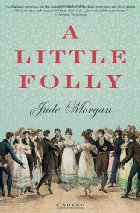
A Little FollyJude Morgan, A Little Folly

Louisa Carnell and her brother Valentine have grown up in the shadow of their tyrannical father, who devoted his energy to controlling their lives and repressing their spirits. So when he finally dies, the Carnell siblings are ready to come out of their shells and experience life. They re-establish contact with some distant cousins (who had been estranged from the family when their father was alive) and eventually go off to visit them in London. However, their ignorance of the world soon leads them into some fairly big trouble: Valentine becomes attached to a married woman, and Louisa has to navigate her way among various suitors who might hope to win her fortune rather than her love.

Despite — or perhaps because of — my fanatical devotion to Jane Austen and Georgette Heyer, I’m almost always disappointed by books that attempt to mimic their plots and style. The copies are almost never as good as the originals, and why read something inferior when you could have the real thing? But Jude Morgan is a writer of Regency-era historical fiction whose books I truly enjoy, and this book is no exception. I loved Louisa as a heroine because she is both romantic and level-headed. It was also nice to read a book that featured a close sibling relationship. I enjoyed the compelling storyline, witty dialogue, and satisfying romance. In short, definitely recommended to fans of fiction set in this time period!

Review: Death in the Stocks

Death in the StocksGeorgette Heyer, Death in the Stocks

When a dead man wearing evening dress is found locked in the stocks on the village green, the local police are only too happy to turn the case over to Scotland Yard. The corpse is Arnold Vereker, a universally despised man who kept a tight hold on the family purse strings. When Superintendent Hannasyde questions Vereker’s young relatives, they all declare themselves extremely happy that their unpleasant half-brother is dead at last. Hannasyde doesn’t know what to make of Antonia, Kenneth, and their various love interests, but he suspects that there are secrets hidden beneath their lighthearted jokes. He sifts through the muddle of motives and alibis with help from Giles Carrington, the Vereker family’s solicitor, who has his own reasons for wanting to uncover the murderer.

I’m a longtime fan of Georgette Heyer’s romances, but I’m quickly coming to love her mysteries as well! As someone who loves a good period piece, I found this an extremely fun book to read. The mystery is perfectly fine, with some interesting little twists and red herrings; I figured out some pieces of the puzzle but didn’t ultimately guess whodunit. However, the real pleasure of this book is the characters, their witty conversations and their blossoming romantic attachments. While the Verekers and their friends take center stage, though, Superintendent Hannasyde is also an intriguing sleuth, and I look forward to reading about more of his cases in subsequent Heyer novels.

Review: Adorkable

AdorkableSarra Manning, Adorkable

Jeane Smith has never been what you’d call a normal teenager. She dyes her hair weird colors (it’s currently gray, like an old lady’s), buys her clothes at jumble sales, and has a blog on youth culture that’s turned into a full-fledged brand. Jeane has no patience for the boring, vapid teenagers who go to her school, so she’s shocked when all-around golden boy Michael Lee approaches her and informs her that his girlfriend and Jeane’s boyfriend appear to have a thing for each other. At first Jeane is angry and suspicious, which causes her to turn her wrath on Michael. In turn, Michael is extremely put off by Jeane’s in-your-face attitude. But when one of their arguments inexplicably turns into a makeout session, Jeane and Michael begin spending more time together and growing closer to each other in the process.

I really liked Manning’s novel You Don’t Have to Say You Love Me, so I was excited to read this one when it came out. I ended up devouring it in a single day — it may not be great literature, but it sucked me in! What I really like about these characters is that they’re not too good to be true. They have real flaws, to the extent that they’re downright unlikeable at times: Jeane is obnoxious, Michael is cocky, and they’re both extremely self-centered. But the beauty of the story is that it lets you see that they are both lovable despite their faults. I also liked that Jeane and Michael’s relationship is not the perfect, magical love that so often seems to appear in romance novels (both YA and adult). For example, Michael still has a deep attachment to his first love, and his relationship with Jeane doesn’t make that previous relationship any less significant. So I would definitely recommend this book to fans of YA romance.

Review: Etiquette & Espionage

Etiquette & EspionageGail Carriger, Etiquette & Espionage

Fourteen-year-old Sophronia Temminnick is the despair of her mother due to her disheveled appearance and unladylike fascination with mechanical objects. In desperation, her mother decides to send her to finishing school — a prospect that fills Sophronia with dismay. But she soon discovers that Mademoiselle Geraldine’s Finishing School is much more than meets the eye. For one thing, it’s located on a giant dirigible; for another, lessons include weaponry and poisoning as well as dancing and the proper way to drink tea. Sophronia is delighted with her unexpected education, which proves to be useful when the school is attacked by foes who are looking for a valuable prototype. Along with her newfound friends both above- and belowdecks, Sophronia decides to learn more about the prototype and its significance, but her investigation may endanger her family as well as herself.

I very much enjoyed Gail Carriger’s Parasol Protectorate series, so I was eager to read this new book that is set in the same universe, but a few decades earlier. I’m happy to say that I liked it even more than the Parasol Protectorate books! The concept of a finishing school that teaches young ladies how to be dangerous secret agents is absolutely fascinating, and I was absorbed by the world of the novel. I really enjoyed the combination of Victoriana, steampunk, and humor that Carriger does so well; I especially loved the occasional bits of pure silliness, such as the existence of “flywaymen” (highwaymen that travel by hot air balloon) and a villainous society of Picklemen whose leader is known as the Great Chutney. There are also some wonderful secondary characters and a few potential love interests for Sophronia, so I definitely look forward to reading more books in this series!

Review: The Passing Bells

The Passing BellsPhillip Rock, The Passing Bells

In the summer of 1914, the aristocratic Grevilles of Abingdon Pryory are relatively carefree, except for the usual problems of their class: son and heir Charles is in love with an unsuitable woman, daughter Alexandra is about to begin her first London Season, and brash American cousin Martin Rilke is visiting from Chicago. So when a duke in faraway Austria is assassinated by a Serbian revolutionary, neither the Grevilles nor their friends believe that the event will have any effect on them. Yet as the conflict escalates into a full-scale war, the Grevilles’ lives are changed forever as Charles joins the army and Alexandra volunteers as a nurse. This novel follows several characters, from Lord Greville down to housemaid Ivy Thaxton, as they experience the shock and horror of World War I.

“Downton Abbey” fan that I am, I couldn’t resist this historical novel about WWI. I was very impressed by the way historical information was embedded into the narrative; while there are a few infodumps, they’re largely unobtrusive. For example, the American cousin is a newspaper man trying to do a story about the war, but his fellow journalists have to explain the background of the European conflict to him. I also liked that the book follows a variety of characters with different perspectives on the war. The young people are enthusiastic and overflowing with patriotism at first, but most of them are quickly disillusioned. Senior military officers berate the stupidity that lost so many lives needlessly at the Somme. The women experience the pain of losing their loved ones, but they also find new and useful work that gives their lives a new direction. All that said, I never became fully gripped by the story; because the novel is so focused on the war, it somewhat neglects character development and relationships. Overall, this is a solid historical fiction novel, and I’d recommend it to fans of the period, but I didn’t love it.