Review: Something Wicked This Way Comes

Something Wicked This Way ComesRay Bradbury, Something Wicked This Way Comes

A week before Halloween, Cooger & Dark’s Pandemonium Shadow Show creeps silently into Green Town, Illinois, in the middle of the night. To most of the town’s inhabitants, the show is a carnival like any other, with its sideshows, rides, and circus freaks. But 13-year-old best friends Jim Nightshade and Will Halloway suspect that something more sinister is at work. The carnival seems to lure unwary visitors into its depths, and those who fall under its spell will never be the same again. It’s up to Jim and Will — and Will’s father, an unassuming librarian who worries about his age and his relationship with his son — to uncover the dark secret at the heart of the circus and to prevent it from ensnaring more victims.

I don’t usually read horror novels, but I was interested in this book because of its classic status (and, frankly, because of its Shakespearean title). Unfortunately, this novel really didn’t work for me, but the problem wasn’t the story at all — it was the writing style. The prose is gratingly faux-poetic, overblown, and melodramatic. Words are often used in unconventional ways (nouns being used as verbs and the like), which can be an effective stylistic choice, but in this case I found it incredibly distracting. I also found the dialogue completely unrealistic and stilted. It’s a shame, because I actually do think the basic story is fascinating and could have been very effective in the right hands. I’m definitely not enthusiastic about trying more Bradbury after this — and I’m wondering how well Fahrenheit 451 would stand up to a re-read!
Review: Shadows

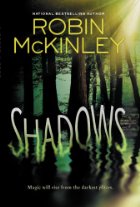
ShadowsRobin McKinley, Shadows

At first glance, Maggie seems to be an ordinary teenage girl: she loves animals, hates algebra, and thinks there’s something wrong with her new stepfather, Val. But it’s not just Val’s funny Oldworld accent or terrible taste in shirts that worries Maggie. It’s the fact that he’s always surrounded by shadows that don’t make sense; they’re the wrong shapes, and there are far too many of them to be natural. To make matters worse, Maggie has started to notice some troubling things about her hometown in Newworld — unexplained phenomena that almost look like breaks in reality. Eventually Maggie confronts Val and learns some unpleasant truths about Newworld and its way of dealing with unnatural occurrences.

I’ve been a huge fan of Robin McKinley’s since the first time I read The Hero and the Crown in elementary school, so I was ecstatic to learn that she’d written a new book, even if it wasn’t the long-awaited continuation of Pegasus. However, I’m sorry to say that I was very disappointed in this book. It does contain many of the classic McKinley touches, such as a wonderful canine companion, a no-nonsense heroine with plenty of gumption, and (less happily) a magical system that is never fully explained. But overall, I felt let down by this story; there were a lot of very interesting threads running throughout the novel, but they were never gathered together in the end. I’m not sure whether a sequel is planned or not, but some further resolution of the story definitely seems necessary. I can’t help but wonder if McKinley was attempting to write her version of the dyptopian YA novel that is so popular nowadays. All I can say is, I vastly prefer her older books!

Review: The Dream Thieves

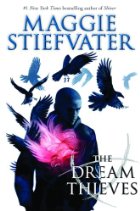
The Dream ThievesMaggie Stiefvater, The Dream Thieves

***Warning: SPOILERS for The Raven Boys!***

Ronan Lynch has the unusual ability to steal objects from his dreams. This doesn’t seem very strange to his group of friends, but then, they’re not exactly normal either. Gansey is obsessed with finding the medieval Welsh king Owen Glendower, Adam has made a strange bargain with a magical forest, Noah is a ghost, and Blue lives in a house full of psychics. Although they’re all working together on the Glendower quest, Ronan is more preoccupied with his own talent and how it might be linked to his family’s past. He’s also being drawn into the orbit of another Raven Boy with a bad reputation and a reckless thirst for danger. But the greatest threat of all seems to come from the sinister Grey Man, who is hunting for something — or someone — that can bridge the gap between dreams and reality. Only Ronan’s friends stand between him and the darkness that awaits…who will prevail?

While I enjoyed The Raven Boys when I first read it, I wasn’t completely sure that I cared enough about the story or characters to continue with the series. This book, however, sold me; I’m now committed to reading the entire series as it comes out. Stiefvater is an excellent writer, with a sparse yet poetic way of describing things that I really admire. Also, since this is book #2 in the series, the characters and world have already been established, so there’s an opportunity to dig deeper into Ronan’s and his friends’ backstories. It doesn’t hurt that this book features Ronan heavily; he’s definitely my favorite of the Raven Boys, and his story arc in this book is compelling. I can’t wait to see what happens to him and the other characters as the series continues!

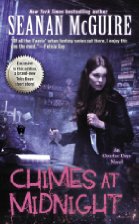
Review: Chimes at Midnight

Chimes at MidnightSeanan McGuire, Chimes at Midnight

October Daye, faerie knight and private detective, is making it her mission to get goblin fruit off the streets of San Francisco. More potent than any human drug, goblin fruit will cause a human or changeling to become addicted with just one taste; its victims will become swallowed up in their dreams, wasting away and eventually dying. When Toby discovers the corpse of yet another changeling addict, she decides to petition the Queen of the Mists for help. But instead of listening to Toby’s arguments, the queen promptly exiles her, giving her only three days to get out of town forever. Reeling from shock, Toby nonetheless decides to fight back — and soon discovers some interesting details about the queen’s accession to her throne.

This book is yet another wonderful installment of the Toby Daye series. I don’t actually read a lot of urban fantasy, but I was hooked on these books from the beginning. I love Toby’s hard-boiled, self-deprecating voice, and it’s easy to root for her even when she’s getting herself into ever more dangerous situations. I think this book in particular was an excellent showcase for all the secondary characters: from Tybalt and May to Quentin and the Luidaeg, everyone seems to have a moment to shine. Also, the mystery of Quentin’s background is finally revealed! This is definitely more of a “plot” book than a “character” book, though; it’s Toby’s race against time to avoid banishment that drives the story forward. Overall, this is another strong installment of a great series — can’t wait for the next one!

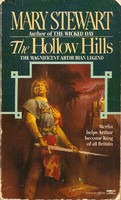
Review: The Hollow Hills

The Hollow HillsMary Stewart, The Hollow Hills

Picking up right after The Crystal Cave left off, this book follows Merlin from the day Arthur was conceived to the day he became high king of Britain. Although Merlin helped Uther Pendragon to marry Ygraine, he is currently out of favor with the king. Yet when Uther needs advice about what to do with his unborn child, Merlin is still the first person he consults. If the child is a boy, Uther must recognize him as the king’s son, just in case he is unable to produce a legitimate heir. At the same time, however, he must keep the boy far away from his court, both to protect him and to get him out of the way in case there should be another son with a better claim to the throne. Merlin suggests sending the child to one of Uther’s loyal knights, where he will be raised as a foster child ignorant of his true parentage. Meanwhile, Merlin becomes Arthur’s friend and protector, teaching him all he needs to know in order eventually to take his rightful place as the king’s heir.

I wasn’t terribly impressed with the first book in this series, The Crystal Cave, but I actually liked this book more. It starts off slowly, but once Arthur is born, the book picks up and gets significantly more interesting. Unsurprisingly, I enjoyed the political machinations aspect of the book more than the mystical aspect; I found Merlin’s visions and prophecies a little boring! I did like watching the relationship between Merlin and Arthur unfold, though, and I look forward to seeing how it continues in the next book. Overall, I’m glad I decided not to give up after The Crystal Cave, and I’m a little more excited about The Last Enchantment than I was before.

Review: A Midsummer Tempest

A Midsummer Tempest

Poul Anderson, A Midsummer Tempest

Set during an alternate version of the English Civil War, this novel follows Prince Rupert of Bohemia, one of King Charles’ most valiant allies. Unfortunately, Charles is losing his war against the Puritans, and after a particularly brutal battle, Rupert is captured by a Puritan nobleman and placed under house arrest. He immediately begins plotting his escape, but fate steps in when he meets his captor’s beautiful niece, Jennifer. The two of them end up fleeing the Puritan’s house together and receiving help from an unlikely source: Oberon and Titania, the king and queen of Faerie. They encourage Rupert to find the lost treasure of Prospero, whose magical artifacts will help the king’s cause; but Rupert must brave many dangers before he can fulfill his quest.

There are so many clever, ingenious concepts at work in this book that it’s almost too hard to list them all. First there is the obvious debt to Shakespeare: in this world, he is not merely a playwright but also the Great Historian, so everything he wrote is factually true. (Bohemia even has a sea coast!) Thus, this book is full of all the wonderful Shakespearean plot devices — faeries, star-crossed lovers, uncouth jesters, shipwrecks, and a very unusual tavern, to name a few. My favorite thing was realizing that several of the characters actually talk in iambic pentameter. Sure, it makes the style a bit choppy and stilted, but the characters talk in iambic pentameter! Add in a discussion of parallel universes, some trains, and angry Puritans getting their comeuppance, and I’m sold! I’d definitely recommend this one if you’re interested in the premise.

Review: Suddenly, a Knock on the Door

Suddenly, a Knock on the DoorEtgar Keret, Suddenly, a Knock on the Door (trans. Miriam Shlesinger, Sondra Silverston, and Nathan Englander)

This collection of short stories is a strange mixture of realism and fantasy, comedy and tragedy. Keret is an Israeli author, and several of his stories reflect the current struggles of that country; one of them begins with a conversation in a restaurant and ends with a suicide bombing. But there is no grand political pronouncement in these stories, and ultimately they’re not about politics. Rather, they depict universal human experiences like sex, friendship, death, love, loneliness, chance, and fate. My favorite story in the collection (“What, of This Goldfish, Would You Wish?”) starts with politics but ends somewhere else entirely, as a documentarian interviews both Jewish and Arab residents of Israel and meets a man with a magic goldfish. Most of these stories are dark, and many are surreal, but all of them offer a fascinating perspective on the human condition.

I don’t often read short stories, and I’d certainly never read anything by Keret before, so I was pleasantly surprised by how much I liked this collection. Keret’s style is very understated and direct, which works well in his fantastical stories especially; it’s as though he’s telling a joke with a completely deadpan expression. I also think the stories as a whole are very well-crafted, with endings that are resonant and satisfying but don’t necessarily tie everything up too neatly. I definitely teared up on more than one occasion! As usual, a few of the stories didn’t quite work for me — the titular story in particular was a bit too clever for its own good — but overall I was very impressed with this collection and plan to read more by Etgar Keret.

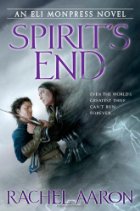
Review: Spirit’s End

Spirit's EndRachel Aaron, Spirit’s End

***Warning: SPOILERS for previous books in this series!***

At the end of The Spirit War, the only thing that stood between the tiny island kingdom of Osera and total annihilation was Eli Monpress. To save his friends, Eli did the one thing he swore he’d never do: ask the Shepherdess for help. Now Eli is forced to live in the Shepherdess’ isolated realm and submit to her marks of favor while the world around him falls apart. Someone is stealing stars, the world’s strongest spirits, which is throwing the lesser spirits into a panic. Miranda is trapped in a power struggle with the Spirit Court, Josef is taking up the reins of kingship, and Nico is still fighting against the demon inside her. But this scattered group of allies must band together to face their biggest challenge yet, which just might be the end of the world.

As the convoluted summary should make clear, this is definitely not a stand-alone novel! Rather, this book is the conclusion to the Eli Monpress quintet, and it finally resolves the overarching plot elements of the series. It was nice to get some answers to the big questions raised in previous books about who is really running the universe and what the powers of Eli’s world are up against. That said, I was a little disappointed in this book; it felt bloated and unfocused, and it spent too much time on action sequences rather than character development. I absolutely loved the first three books in this series, and I think it’s because they were very tightly focused and had a clearly defined world. In the last two books, the story became a bit too epic, if that makes sense. The uniqueness of Eli and his world were sacrificed to the tired fantasy trope of a huge good-vs.-evil battle. Overall, I’m glad I read this book because it concluded the series, but I wish Aaron had taken things in a different direction.

Review: Dark Triumph

Dark TriumphRobin LaFevers, Dark Triumph

This installment of the His Fair Assassin trilogy features Sybella, a novice of the convent of St. Mortain whose troubled past has driven her to the edge of madness. Chafing under the convent’s restrictions, Sybella is eager to receive her first assignment…until she learns that she’ll be staying in the household of the traitor D’Albret, who is waging war against the rightful duchess of Brittany. Not only is D’Albret faithless and cruel, but he also happens to be Sybella’s own father, the man who has made her entire life miserable. Sybella’s only hope is that the convent will allow her to kill him, but her actual orders are very different: She must rescue the Beast of Waroch, a skilled knight who is vital to the duchess’ cause, from D’Albret’s dungeons. As Sybella and the Beast engineer their escape, they begin to develop a strong bond. But will they reach the duchess in time to inform her of D’Albret’s latest treachery?

This book is very hard to summarize, mostly because it’s the second book in a series, and it definitely does not stand alone. The action essentially begins where the first book left off, and most of the major players have already been introduced. So if the premise of this book sounds interesting to you, I would definitely go back and read Grave Mercy first! If you’ve already read and enjoyed it, you’ll like this one too. As with the first book, there’s a nice mix of action, political maneuvering, and romance. I liked Sybella’s character but wished that the Beast had been fleshed out more; for this reason, I wasn’t totally captivated by the love story. The overarching plot of the duchess vs. D’Albret continues to be interesting, and I look forward to seeing what happens in the third book. I also want to learn more about the convent and its role in the political turmoil; there is definitely more going on there than meets the eye! As you can tell, I’m invested in the world of this series, and I highly recommend it to fans of YA and historical fantasy.

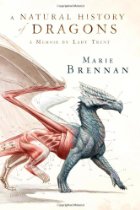
Review: A Natural History of Dragons

A Natural History of DragonsMarie Brennan, A Natural History of Dragons

This book purports to be the memoir of Lady Isabella Trent, a woman living in something analogous to 19th-century England. But in this world, dragons are real, and they are perceived as another species of wild predator like a lion or a bear. Isabella relates her lifelong obsession with dragons, beginning with her childhood. She is a curious and scientific young woman who dreams of studying dragons and adding to the world’s knowledge about them. But since such pursuits are not suitable for a lady, Isabella’s dream seems unattainable — until a fortunate marriage and a chance meeting give her the opportunity to join a scientific expedition that plans to study dragons. But Isabella’s joy at her good fortune is soon tempered by various mysteries and misfortunes that befall the expedition.

This is one of those books that pretty much deliver what you’d expect from the synopsis. If you’re intrigued by the idea of Victorian-esque setting plus dragons, you’ll probably enjoy this novel. I liked it a lot; I think Isabella is an extremely well rendered character, and her world is both convincing and interesting. I should note that in this world, dragons are seen simply as animals to be studied. They don’t (as far as this book indicates) have any magical powers or the ability to reason or communicate. So these are definitely not your standard fantasy-type dragons. Also, I think there must be sequels planned, because while the main plot of this book is resolved, there’s still a lot more to be said about Isabella’s life and work with dragons. I definitely plan to read the next book when it comes out!