Review: Neanderthal Seeks Human

Neanderthal Seeks HumanPenny Reid, Neanderthal Seeks Human

There are three things you need to know about Janie Morris: 1) She is incapable of engaging in a conversation without volunteering TMTI (Too Much Trivial Information), especially when she is unnerved, 2) No one unnerves her more than Quinn Sullivan, and 3) She doesn’t know how to knit.

After losing her boyfriend, apartment, and job in the same day, Janie Morris can’t help wondering what new torment fate has in store. To her utter mortification, Quinn Sullivan- aka Sir McHotpants- witnesses it all then keeps turning up like a pair of shoes you lust after but can’t afford. The last thing she expects is for Quinn- the focus of her slightly, albeit harmless, stalkerish tendencies- to make her an offer she can’t refuse. (Summary from Amazon.com.)

I downloaded this e-book for free, and honestly, that’s the only good thing I can say about it. I don’t think I’ve ever encountered a heroine whom I’ve despised more than Janie Morris. The novel would have you believe that Janie is very book-smart, although her nerves get the best of her in social situations. In fact, however, there is absolutely no evidence of her alleged intelligence, and her “nervousness” is so over-the-top as to be completely ridiculous. She literally cannot form complete sentences when speaking to a man she finds attractive. She also somehow fails to notice that her crush Quinn, whom she believes is a lowly security guard, is actually the owner of the company where she works. The reader, of course, has noticed it by approximately chapter two. The book’s writing style is fairly awful as well, complete with one of the most cringe-inducing sex scenes I’ve ever encountered. I can’t even remember the main conflict of the book, to be honest…all my attention was given to my utter hatred of Janie. Like I said, the book was free, but I still wish I could get those hours of my life back.

Review: Sorcerer to the Crown

Sorcerer to the CrownZen Cho, Sorcerer to the Crown

The Royal Society of Unnatural Philosophers, one of the most respected organizations throughout all of England, has long been tasked with maintaining magic within His Majesty’s lands. But lately, the once proper institute has fallen into disgrace, naming an altogether unsuitable gentleman—a freed slave who doesn’t even have a familiar—as their Sorcerer Royal, and allowing England’s once profuse stores of magic to slowly bleed dry. At least they haven’t stooped so low as to allow women to practice what is obviously a man’s profession…

At his wit’s end, Zacharias Wythe, Sorcerer Royal of the Unnatural Philosophers and eminently proficient magician, ventures to the border of Fairyland to discover why England’s magical stocks are drying up. But when his adventure brings him in contact with a most unusual comrade, a woman with immense power and an unfathomable gift, he sets on a path which will alter the nature of sorcery in all of Britain—and the world at large… (Summary from Amazon.com.)

This book ticks so many of my boxes — Regency England! Magic! Georgette Heyer comparisons! — that I knew it would be right up my alley. And my high expectations were completely justified: this is definitely one of my favorite books of the year! Zacharias is an immediately sympathetic character, his African descent automatically making him an outsider despite his theoretical position of authority. The other protagonist, Prunella, is equally appealing. She is headstrong and warmhearted, while Zacharias can be cold and reserved, so they make an excellent team. My gold standard for historical fantasy novels is Sorcery and Cecelia by Patricia C. Wrede and Caroline Stevermer, and Sorcerer to the Crown is very much in that tradition. I must say that the marketing for this book is terrible; the cover design implies a very different sort of novel, and the quote comparing it to “a cross between Georgette Heyer and Susanna Clarke” is completely inaccurate. It’s much more Heyer than Clarke, so if you’re expecting something similar to Jonathan Strange and Mr. Norrell, you’ll be disappointed. But I loved the book and am thrilled that there will be at least one sequel!

Review: Six of Crows

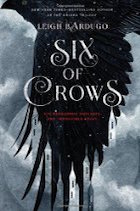
Six of CrowsLeigh Bardugo, Six of Crows

Ketterdam: a bustling hub of international trade where anything can be had for the right price–and no one knows that better than criminal prodigy Kaz Brekker. Kaz is offered a chance at a deadly heist that could make him rich beyond his wildest dreams. But he can’t pull it off alone…

A convict with a thirst for revenge.

A sharpshooter who can’t walk away from a wager.

A runaway with a privileged past.

A spy known as the Wraith.

A Heartrender using her magic to survive the slums.

A thief with a gift for unlikely escapes.

Six dangerous outcasts. One impossible heist. Kaz’s crew is the only thing that might stand between the world and destruction―if they don’t kill each other first. (Summary from Amazon.com.)

I wasn’t totally enamored with Leigh Bardugo’s Grisha trilogy when I read it earlier this year, but I liked the writing style and world-building enough to try Six of Crows, which is set in the same world as the Grisha books but in a new country and with new characters. And I’m very glad I gave it a chance, because I found this book to be a vast improvement on the Grisha trilogy! First of all, I really liked the multiple POVs; each of the six members of Kaz’s crew is given a chance to tell his or her own story, which means I legitimately cared about all of them. I don’t even know that I could pick a favorite, since all six are so fleshed-out and have such compelling backstories. The heist plot was a lot of fun and had appropriately high stakes — not to mention the requisite detours and double-crosses along the way! And of course, there are multiple romances to root for…I can’t decide whether I’m more invested in Matthias and Nina or Kaz and Inej. 🙂 Overall, I’d definitely recommend this book if you like dark fantasy and/or a good heist story.

Review: A Proper Companion

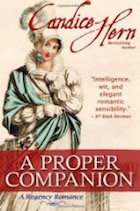
Proper Companion, ACandice Hern, A Proper Companion

Robert, Lord Bradleigh, is a rakish earl with a recently arranged betrothal to a lovely young girl he barely knows. Emily Townsend is an impoverished spinster employed as a companion to his grandmother, the formidable dowager countess. Robert agrees to help his grandmother find a husband for the beautiful Emily. But once he comes to know the charms of his grandmother’s companion, he begins to regret his hasty engagement.

This sparkling tale will take you from the Pump Room at Bath to the ballrooms of London as the unexpected and undeniable attraction between Robert and Emily blossoms into something more … something that could put one of them in danger. (Summary from Amazon.com.)

I’m going to be honest: I read this book about two months ago, and I truly don’t remember a thing about the plot. I think maybe Emily had another suitor who turned out to be evil in some way, but I’m not sure. And maybe Robert’s fiancée ended up falling in love with someone else? Like I said, the details have completely gone out of my head. So, obviously, this was not a particularly great read for me…but it wasn’t particularly awful either, or I would have remembered it! From what little I recall, the writing style was fine but not great; but after all, only a few authors can flawlessly imitate that Regency voice. I’m sure I did enjoy the book while I was reading it, because I remember looking up the sequels on Amazon (although I didn’t actually purchase them). I suppose lovers of non-bodice-ripping Regency romances would enjoy this book, but I can’t really recommend something that I can’t remember!

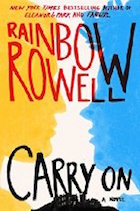
Review: Carry On

Carry OnRainbow Rowell, Carry On

Simon Snow is the worst Chosen One who’s ever been chosen.

That’s what his roommate, Baz, says. And Baz might be evil and a vampire and a complete git, but he’s probably right.

Half the time, Simon can’t even make his wand work, and the other half, he starts something on fire. His mentor’s avoiding him, his girlfriend broke up with him, and there’s a magic-eating monster running around, wearing Simon’s face. Baz would be having a field day with all this, if he were here–it’s their last year at the Watford School of Magicks, and Simon’s infuriating nemesis didn’t even bother to show up. (Summary from Amazon.com.)

As you can see, I had A LOT of feelings about this book! So if you just want the short version, skip to the last paragraph!*

Fellow lovers of Rainbow Rowell will remember her novel Fangirl, in which protagonist Cath is obsessed with the Simon Snow series and is writing fanfiction about two of its principal characters, Simon and Baz. While I really liked Fangirl overall, I noted that the “excerpts” from the Simon Snow books and from Cath’s fanfic were my least favorite parts of that novel. So, I was less than enthused when I learned that Carry On would be Rowell’s own version of the Simon/Baz romance.

I had other issues with the concept of Carry On as well. In Fangirl, it’s obvious that Simon Snow is meant to be a stand-in for Harry Potter (which makes the single HP reference in Fangirl extremely jarring!), so Carry On is, in a sense, HP fanfic. That made me feel apprehensive and a little icky, like Rowell was essentially ripping off J.K. Rowling and taking advantage of the devotion of the HP fandom. I don’t attribute any malicious motives to Rowell — I’m sure she would view Carry On as more of an homage than a copy — but the world of Simon Snow is uncomfortably similar to the world of HP.

Then there’s my own stance on fanfiction, which is that I don’t really get it. Not to take away from anyone else’s pleasure in reading or writing it, but I’ve never personally been that interested in it. I do understand the desire to remain in a beloved world and explore it further, especially if the original author left certain stories hanging and you need some closure for them. But I tend to believe the author wrote the stories s/he intended to write, and it’s not my job as a reader to “fix” storylines that didn’t turn out the way I wanted them to. So, to take the most relevant example, I know there’s a lot of Harry/Draco fanfic out there. But in the actual HP series, it’s obvious that Harry is heterosexual, and (spoilers) he eventually marries and procreates with Ginny. So I honestly don’t understand the impulse to pair Harry and Draco in fanfiction. I don’t mean to insult anyone who enjoys fanfic or who ships Harry/Draco, but I would not personally be interested in reading a slash fanfic about those characters — which is essentially the plot of Carry On, just with different character names.

AND YET.

I actually ended up liking Carry On a lot more than I expected to! Yes, the setting and principal characters are all very reminiscent of HP, and that still does bother me. I also wasn’t particularly invested in the monster plot and all the backstory about where the monster came from and all of that. It was predictable and rather generic for a fantasy novel. But one of Jenny’s (of Reading the End) comments really resonated with me: “I think Rainbow Rowell maybe just is not that good at plot.” YES. This is true of all her novels, which generally don’t have much plot to speak of. Where Rowell shines is her characters, who are flawed and struggling but also hopeful and determined to find a happy ending. I sympathized with Simon, who feels crushed by the weight of his “chosen” status and his inability to live up to everyone’s expectations. Penelope was a great friend, practical and loyal, even though she was a bit too Hermione-ish. And I adored Baz, as I always adore disdainful, elitist, painfully elegant antagonists who turn out to be not-so-secret heroes.

*The short version: I was nervous about Carry On, and if anyone other than Rainbow Rowell had written it, I definitely wouldn’t have read it. But I decided to trust Rowell, and I’m glad I did. For me, the positives (great characters and dialogue) outweighed the negatives (most notably, the extensive similarities to HP). If you’re on the fence about this book, I would encourage you to give it a try! And I’ll note that you definitely do NOT have to read Fangirl first, although you should read it anyway because it’s really good. 🙂

Review: A Curious Beginning

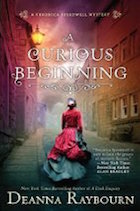
Curious Beginning, ADeanna Raybourn, A Curious Beginning

London, 1887. As the city prepares to celebrate Queen Victoria’s golden jubilee, Veronica Speedwell is marking a milestone of her own. After burying her spinster aunt, the orphaned Veronica is free to resume her world travels in pursuit of scientific inquiry—and the occasional romantic dalliance. As familiar with hunting butterflies as she is fending off admirers, Veronica wields her butterfly net and a sharpened hatpin with equal aplomb, and with her last connection to England now gone, she intends to embark upon the journey of a lifetime.

But fate has other plans, as Veronica discovers when she thwarts her own abduction with the help of an enigmatic German baron with ties to her mysterious past. Promising to reveal in time what he knows of the plot against her, the baron offers her temporary sanctuary in the care of his friend Stoker—a reclusive natural historian as intriguing as he is bad-tempered. But before the baron can deliver on his tantalizing vow to reveal the secrets he has concealed for decades, he is found murdered. Suddenly Veronica and Stoker are forced to go on the run from an elusive assailant, wary partners in search of the villainous truth. (Summary from Amazon.com.)

I’ve read and enjoyed the first few Lady Julia Grey books, so I was excited to learn that Raybourn has begun a new mystery series featuring intrepid lepidopterist Veronica Speedwell. Unfortunately, this book really didn’t work for me. It’s a good read in the sense that it’s well written and moves quickly, but I couldn’t get over my dislike of both Veronica and her partner/love interest, Stoker. Historical fiction can be difficult because the protagonists should be realistic for their time period but also sympathetic to modern readers. Veronica errs on the side of being far too modern for her era. She pursues a scientific career by traveling all over the world without a chaperone, and she engages in a variety of sexual affairs, apparently without any consequences to her reputation as a gentlewoman. I simply didn’t find her believable. As for Stoker, he’s a generic brooding alpha male type, and that’s basically all you need to know. It’s not a bad book, by any means, but it didn’t deliver what I look for in historical fiction.

Review: Girl Waits with Gun

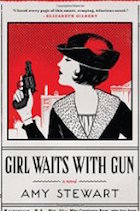
Girl Waits with GunAmy Stewart, Girl Waits with Gun

Constance Kopp doesn’t quite fit the mold. She towers over most men, has no interest in marriage or domestic affairs, and has been isolated from the world since a family secret sent her and her sisters into hiding fifteen years ago. One day a belligerent and powerful silk factory owner runs down their buggy, and a dispute over damages turns into a war of bricks, bullets, and threats as he unleashes his gang on their family farm. When the sheriff enlists her help in convicting the men, Constance is forced to confront her past and defend her family — and she does it in a way that few women of 1914 would have dared. (Summary from Amazon.com.)

For some reason, I had a couple of erroneous expectations coming into this book. I thought it was a Western and pictured Constance Kopp as a sort of hotheaded, guns-blazing, Annie Oakley figure. In fact, the book is set in New Jersey, and Constance is definitely not the aggressive cowgirl I had imagined. She is certainly a strong woman, but her strength isn’t demonstrated by violence. Rather, she is strong in her sense of justice and in her determination not to be browbeaten by the factory owner just because he is rich and male. I really admired Constance and enjoyed her relationship with her sisters; it’s obvious that they get on each others nerves occasionally, but it’s equally obvious that they are very close. I also liked the book’s historical setting and how it showcased (in a non-preachy way) some of the difficulties women faced in the early 20th century. The “family secret” referenced in the summary was fairly easy to guess, but I didn’t mind it because it’s really not the focus of the novel. The book’s ending seems to leave room for a sequel, and I would definitely read one if it ever materializes!

Review: Until There Was You

Until There Was YouKristan Higgins, Until There Was You

Cordelia Osterhagen, known to everyone as Posey, is largely content with her life. She lives in a picturesque New England town near her family, with whom she is close, and owns her own architectural salvage company. She also works at her parents’ cheesy but beloved German restaurant. But Posey’s love life is somewhat less successful; she’s never managed to find a man she loves as much as she once loved Liam Murphy, the high school bad boy whom she worshiped from afar. But now Liam is back in town, a gruff widower with a teenage daughter, and Posey’s old feelings immediately resurface. However, she tries to play it cool and slowly begins to form a friendship with him. Meanwhile, Liam is constantly stressed from his efforts to protect his daughter from every possible harm, but he’s surprised by how peaceful he feels around Cordelia Osterhagen. When their relationship takes a romantic turn, will he be able to face the possibility of real commitment? And will Posey be able to stop herself from falling head-over-heels in love again?

After the mental exercise of Embassytown, I really just needed a palate cleanser, so I naturally turned to one of the Kristan Higgins romances I hadn’t read yet. It perfectly fit the bill by providing a pleasant romance with minimal angst. All the Higgins trademarks are there: a quaint New England town, a heroine with a crazy-yet-lovable family and an improbably well-paying job, and a friendly dog or two. I liked Posey, although I couldn’t help being irritated by her job — what exactly is an architectural salvager, and how does she make enough money in her tiny hometown to stay in business? It sounds like one of those fake careers that TV people have, not something that could actually enable a person in small-town New Hampshire to make a living. Liam is a perfectly fine hero, although he’s a bit too perfect for my taste (sinfully gorgeous, loves his daughter, wounded just enough to be interesting). But despite all my nitpicking, I enjoyed the book, as I always do with Higgins’ contemporary romances.

Review: Embassytown

EmbassytownChina Miéville, Embassytown

In a futuristic world on a faraway planet, Avice Benner Cho lives in the main colonists’ city of Embassytown. The planet’s natives, whom the colonists refer to as Hosts, have a unique system of language involving two simultaneously spoken voices that makes communication with them largely impossible; while the humans can understand the Hosts, the Hosts can’t understand most humans at all. The only people even remotely able to speak to the Hosts are the Ambassadors, identical twins who have been specifically engineered for the purpose. So when a new Ambassador arrives on the planet, and they’re not identical twins at all, everyone is shocked by the sheer impossibility of it. And when this Ambassador speaks to the Hosts, even more astonishing — and dangerous — consequences ensue. Avice, though not an Ambassador, has a special relationship to the Host language because she is one of its living similes. Can she find a way to mitigate the disasters caused by the new Ambassador?

If you’re confused by my summary of this book, don’t worry — I was confused for about the first half of the novel! Miéville creates an extremely intricate world full of technobabble and doesn’t spend a lot of time explaining things; rather, the reader is thrust directly into the world and left to sink or swim. I usually don’t mind this technique, since lengthy world-building exposition can be tedious. But because the world is so complicated, it took me a while to figure out which things were important to the story and which were just window dressing. Additionally, the book jumps between two different time periods, which confused me at first. But once I figured out where the story was going and how the past and present narratives fit together, I became much more invested. People who are interested in linguistics will be fascinated by Avice’s eventual solution to communicating with the Hosts. The book also touches on issues of colonialism: although the humans aren’t overtly oppressors, there is a shadowy empire in the background to remind us that there might be hidden agendas at play. Overall, this is not the most accessible book to a casual reader, but those who persevere will be rewarded.

Review: Unnatural Death

Unnatural DeathDorothy L. Sayers, Unnatural Death

While dining out one day, Lord Peter Wimsey and his friend Inspector Parker are discussing so-called accidental deaths that might actually be murders. A young doctor overhears them and joins their conversation. He shares the story of a former patient, an elderly woman with cancer who died rather suddenly. She was terminally ill, and no signs of foul play were found on the body, so everyone believed her death was natural; but the doctor was nevertheless suspicious because she had seemed to be improving lately. The woman’s great-niece and presumed heiress was living with her at the time, so she had opportunity, but her motive was questionable because the old lady would die soon enough from natural causes. Lord Peter is intrigued by the case and decides to investigate. He employs Miss Climpson, a chatty but intelligent spinster, to temporarily relocate to the dead woman’s village and do some discreet investigating. Meanwhile, he and Parker search for other suspects, motives, and possible methods of the murder.

After rediscovering Dorothy Sayers earlier this year, I’ve embarked on a project to read all her Lord Peter Wimsey books in publication order. This is book #3 in the series, but if I recall correctly, it can be read as a standalone. I enjoyed this book a lot, but I feel like it’s a very unusual detective story. Despite a high body count, it doesn’t feel very action-packed or plot-driven. The main mystery is not whodunnit, but why and how. One of the biggest clues to the motive is a tiny change in an obscure property statute. Nevertheless, I found the mystery compelling and was eager to solve the complete puzzle of how and why the murder took place. Also, Miss Climpson is delightful; this is her first appearance in the series, but I believe she’ll be a recurring character in future books. She reminds me somewhat of a Jane Austen character — one of the good-hearted chatterboxes, like a more intelligent Miss Bates. I wasn’t completely on board with the characterization of the villain, whose psychology didn’t ring true for me. I doubt this will be my favorite Sayers mystery, but I did enjoy it and look forward to reading the rest of the series.