Review: The Count of Monte Cristo

The Count of Monte CristoAlexandre Dumas, The Count of Monte Cristo (trans. Robin Buss)

This classic novel tells the story of Edmond Dantès, a naïve young sailor who seems to be on the verge of getting everything he’s ever wanted: The owner of his ship wants to promote him to captain, and he’s about to marry his true love. But Edmond has jealous rivals, both professionally and romantically, who would like nothing more than to get rid of him and take his place. These men concoct a plan to accuse Edmond of being a Bonapartist — a deadly serious crime in a time when Napoleon has just been exiled to Elba and the French monarchy is still unstable. Although Edmond is innocent, he possesses a highly incriminating letter that seals his doom, and he is sent to France’s most notorious prison. With nothing to do but brood over the cruelty of his fate, Edmond becomes consumed by thoughts of vengeance. When he finally escapes from prison, he creates a new identity as the Count of Monte Cristo and sets out to destroy the men who ruined his life.

First of all, this novel is HUGE — the edition I read was over 1200 pages long — so I was surprised to discover how much of a page-turner it was! Although the plot is very slow-moving, Dumas cleverly builds suspense throughout the novel as Edmond’s plan of vengeance slowly reveals itself. The main thing that surprised me about this novel was how little time (comparatively speaking) it spends inside Edmond’s head. About the first quarter of the book is from his point of view, describing his feelings when he is arrested and imprisoned. But when he escapes and returns as the Count of Monte Cristo, the book barely ever relates his thoughts or feelings. Rather, the most developed characters turn out to be Edmond’s enemies (and a few friends), which makes Edmond’s actions more morally ambiguous. All in all, I’m very glad I finally took time to read this novel, whose status as a classic is well-deserved. I’ve been planning to read The Three Musketeers this year as well, and now I’m really looking forward to it!
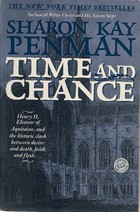
Review: Time and Chance

Time and ChanceSharon Kay Penman, Time and Chance

This novel, the sequel to When Christ and His Saints Slept, continues the story of Henry II after his accession to the throne of England. Henry and his new wife, Eleanor of Aquitaine, seemingly have a charmed life, with all the power and riches they could desire. But their great ambitions come with great costs: Henry is constantly on the battlefield defending his holdings in France and skirmishing for power in Wales, while Eleanor is forced to the sidelines and must undergo the rigors of repeated childbirth. The book tells the story of their tempestuous marriage but also examines another important relationship in Henry’s life — his friendship with his chancellor (and later Archbishop of Canterbury), Thomas Becket.

I read When Christ and His Saints Slept a few years ago, but this book contains enough reminders of past events that I was able to follow along without a problem. Overall I enjoyed this novelization of the birth of the Plantagenet dynasty; it’s what I would term an intelligent romp. Penman does her research, but she also manages to write page-turners that are filled with action, scandal, and intrigue. The parts that focused on Henry’s deteriorating relationship with Thomas Becket were both interesting and frustrating to me. Even though I knew how their argument would end, I found myself hoping against hope that they’d be able to communicate with each other and work things out! As for Henry and Eleanor, I think their story in this book will pale in comparison to the events of the sequel, when their children are all grown up. I will be reading Devil’s Brood this summer, and I’m looking forward to it!

Review: Grave Mercy

Grave MercyRobin LaFevers, Grave Mercy

Ismae has grown up hating and fearing her abusive father, and when he sells her to an equally abusive husband, she despairs of ever finding a different path for her life. But a twist of fate brings Ismae to the convent of Saint Mortain, the ancient Breton god of death. Though Brittany has been superficially Christianized, worship of the old gods still persists, and the sisters of Saint Mortain serve their god by training young women as assassins to do his will. Ismae happily embraces her new life and devotes herself entirely to Mortain. But when she is sent out into the world to do the god’s bidding, she learns that serving him is more complicated than it appears. Her task is to pose as the mistress of Gabriel Duval, a knight of the duchess of Brittany, who is desperately trying to keep the duchy independent of French rule. As Ismae encounters conspiracy and treachery at every turn, she also becomes increasingly attracted to Gabriel. But can she continue to serve Mortain while also following her heart?

I picked up this book from the library because the premise sounded interesting, but I’m still surprised by how much I liked it! First of all, convent-trained assassins? Yes, please! The book is also far more rooted in historical reality than I thought; while there are some fantasy elements, the book reads as straight historical fiction, and many of the characters and events are real. I really liked the novel’s focus on political intrigue and Ismae’s realization that, despite her  training, she is completely out of her depth at the Breton court. There aren’t many scenes of killing or ass-kicking, though, which might disappoint some readers. I also liked the romance between Ismae and Gabriel, which was predictable but still very well done. I am definitely planning to read the rest of this trilogy; book 2, Dark Triumph, just came out and focuses on two minor characters from this book. Looking forward to it!

Review: Lessons in French

Lessons in FrenchHilary Reyl, Lessons in French

In 1989, Kate is a fresh-faced college graduate who dreams of becoming an artist someday. So she’s overjoyed when she is hired as an assistant to Lydia Schell, a famous American photographer currently living in Paris. Kate is excited to make the most of this opportunity, but she soon discovers that Lydia is an extremely demanding boss. For example, Kate not only coordinates Lydia’s schedule and runs her errands, but she is also expected to help Lydia’s husband Clarence with the book he is writing about 19th-century French fashion. The longer Kate stays with the Schells, the more she realizes that their seemingly successful family is fraught with dysfunction. As Kate tries to please all parties, she is pulled in so many conflicting directions that she begins to lose her own identity in the process.

I liked the basic idea of this book — naive American girl moves to Paris and learns about herself and the world — but overall it fell far short of my expectations. My biggest problem was that every single character, including the heroine, is absolutely insufferable. Kate is a total doormat, doing every single thing the Schells tell her to do regardless of how demeaning (and how unrelated to her job description). She’s also too stupid to see some really obvious things about the Schells that are going on right under her nose. I spent the whole book wishing she’d grow a spine, and while she sort of does at the end, it’s definitely too little, too late. As for the Schells, they’re pretentious pseudo-intellectual snobs with no redeeming qualities whatsoever. I did like the 1989 setting, with the Berlin Wall coming down and the Gulf War about to begin, but it didn’t play a very big part in the novel. Basically this book made me feel angry and frustrated, and only the somewhat competent writing style kept me reading until the end.

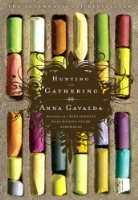
Review: Hunting and Gathering

Hunting and GatheringAnna Gavalda, Hunting and Gathering (trans. Alison Anderson)

The original French title of this novel is Ensemble, C’est Tout, which is a much more fitting name for a book about a group of lost souls who eventually find happiness with each other. Camille is literally a starving artist, wasting away to skin and bones while working a completely unfulfilling job as an office cleaner in Paris. One day she falls ill and is rescued by Philibert, a sweet-natured but socially awkward aristocrat who is living in his family’s decaying ancestral home. Philibert also has a roommate named Franck, a talented chef whose filthy language is only matched by his even filthier lifestyle. Initially, the three of them living in one house seems like a recipe for disaster; but as they learn more about one another, they slowly build an unconventional family.

I think this is a perfect cold-weather book; it just begs to be read while snuggled up in a blanket and sipping something warm. At its core, it’s a fairly simple and predictable love story, with the hero and heroine hating each other at first, then slowly changing their minds. But Gavalda’s dreamy, transparent prose helps it to rise above a stereotypical chick-lit or romance novel. There’s something very thoughtful and smart about the book as a whole; I especially loved the descriptions of Camille’s art. The only thing that bugged me about the book is that sometimes the dialogue was hard to follow — there aren’t a lot of tags to indicate who’s saying what. There’s also a lot of jumping around between different characters’ perspectives, which can be distracting. Overall, though, I really enjoyed this book and would recommend it to fans of love stories or French literature.