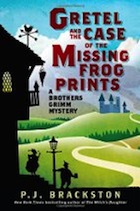
Review: Gretel and the Case of the Missing Frog Prints

Gretel and the Case of the Missing Frog PrintsP.J. Brackston, Gretel and the Case of the Missing Frog Prints

In the small town of Gesternstadt in 18th-century Germany, Gretel is something of a local celebrity. Her first claim to fame is being the Gretel, the one who escaped the clutches of an evil witch along with her gluttonous brother, Hans (a.k.a. Hansel). Now, the 35-year-old woman makes her living as a private investigator, and the biggest case of her life has just fallen into her lap. She has been summoned by Albrecht Durer the Much Much Younger, whose beautiful and beloved frog prints have been stolen. Gretel takes the case and travels to the busy metropolis of Nuremberg, accompanied by Hans, who wants to attend the city’s world-famous sausage festival. She soon stumbles across a variety of surprises, including a housecleaning hobgoblin, a secret brothel in the basement of a fancy hotel, and a veritable mafia of talking mice. And, naturally, her most promising suspect is later murdered at the scene of the crime. Can Gretel discover the thief, return the prints, and catch the murderer, all without being sidetracked by her dimwitted brother?

I got very excited by the premise of this book, which sounds like a delightfully subversive romp through both mystery and fairy-tale tropes. And indeed, there’s lots of fun stuff in this novel. Gretel has some wonderfully entertaining characteristics: she’s determined, confident, and extremely pragmatic. Hans is a good foil for her, reminding me of a Teutonic Bertie Wooster. But at the same time, I never found a reason to care about these characters; they don’t really develop over the course of the novel. Some of the humor also seemed forced, and the mystery itself was nothing special. I did enjoy the weird genre mashup of mystery plus fairy tale, and I would potentially read the sequel when it comes out. But a novel that’s pure spoof has got to be funny enough to justify itself, and I’m not sure that this one is. It certainly never reaches the zany heights of P.G. Wodehouse! Again, this book is an enjoyable read, but I was ultimately underwhelmed by it.
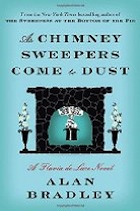
Review: As Chimney Sweepers Come to Dust

As Chimney Sweepers Come to DustAlan Bradley, As Chimney Sweepers Come to Dust

***Warning: SPOILERS for previous books in the series!***

Flavia de Luce’s life has been turned upside-down by the shocking revelation that her mother, Harriet, worked as a spy for England before her death. What’s more, Harriet was groomed for this work at an elite Canadian boarding school, where she belonged to a secret society called the Nide. Now the twelve-year-old Flavia must follow in her mother’s footsteps all the way to Miss Bodycote’s Female Academy, so that she can carry on the family’s legacy of covert service to England. But Flavia is less than thrilled about leaving Buckshaw and all her family and friends behind. Still, Miss Bodycote’s proves more interesting than Flavia expected when a dead body falls down the chimney into her bedroom on her very first night at the school. But whose body is it, and who would have placed the remains there? Was it a fellow student? The science teacher who was once tried for murder? Perhaps even the stern headmistress herself? Once again, Flavia uses her insatiable curiosity and her passion for chemistry to discover how, why, and by whom the victim was murdered. She also struggles to fit in at Miss Bodycote’s and eventually makes an important decision about her future.

This book marks a significant change in the direction of the series, as Flavia is uprooted from Bishop’s Lacey and placed in different surroundings with an entirely new cast of characters. Some people were skeptical about this change, but I was optimistic going in; if series aren’t willing to shake things up sometimes, they risk becoming stale. Unfortunately, I don’t think this particular change was terribly successful. The idea of Flavia trying to fit in at a strict boarding school filled me with glee, but this book doesn’t spend much time on her interactions with the other students, except as necessary for her investigation. And the book really suffers for not having Father, Feely, Daffy, and Dogger to be Flavia’s confidantes, friends, and sometimes enemies. I don’t read this series predominantly for the mysteries; while these are usually fine, the books’ charm lies in Flavia and her unique reactions to the people around her. And sadly, in this book, her social interactions just weren’t as funny, interesting, or poignant as they usually are. The end of this novel promises another change for Flavia, and I hope that the next book will take things in a more satisfying direction.

Review: Darkness at Pemberley

Darkness at PemberleyT.H. White, Darkness at Pemberley

This mystery novel begins at Cambridge, where a history don and an undergraduate are nearly simultaneously found shot in their rooms. The local police are called, and Inspector Buller is assigned to investigate. At first it appears that the don murdered the student and then killed himself, but Buller notices a few oddities in the don’s rooms that contradict this murder-suicide theory. He subsequently uncovers a drug scandal in the college and eventually discovers the real murderer’s identity. Unfortunately, the murderer has a cast-iron alibi, so Buller is forced to let the man go free. Buller then goes to visit his friend Charles Darcy at Pemberley and tells him about the murders. Charles, enraged by this injustice, goes to Cambridge to threaten the murderer. When Buller discovers this, he is terrified, knowing that the murderer will now come after Charles in retaliation. Almost immediately, strange things begin to happen at Pemberley, and Buller is convinced that the murderer is hiding somewhere in the house or grounds. Can he catch the murderer before his friend becomes the next victim?

Obviously, I was drawn to this book because of the title; any Austen fan will immediately recognize Pemberley as the name of Mr. Darcy’s grand estate in Pride and Prejudice. Sadly, from my point of view, there’s very little connection to Austen’s novel in this book, except that the current inhabitants of the house are still called Darcy. But this is still a very interesting and suspenseful book, despite the fact that it’s a bit schizophrenic. The first part of the book seems like a traditional locked-room mystery, and the solution is both complicated and ingenious. But as I mentioned, the murderer’s identity is discovered fairly early in the book. The novel then shifts to more of a suspense/thriller, as the inhabitants of Pemberley wait for the murderer to make his move so that they can catch him. The novel genuinely creeped me out in places; the idea of being trapped in a maze of a house, with someone pursuing you whom you can’t see, is absolutely claustrophobic and terrifying to me! So if you enjoy that kind of thing, I definitely recommend this book!

Review: Snobbery with Violence

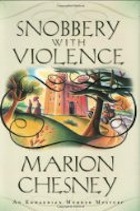
Snobbery with ViolenceMarion Chesney, Snobbery with Violence

Captain Harry Cathcart has recently been invalided out of the army and is looking for something to do with himself. Since he is a gentleman, he is not expected to work for a living; yet, although he is the younger son of a baron, the upper classes don’t entirely accept him as one of their own. Putting his ambiguous social standing to use, Harry becomes a discreet fixer for members of the upper class with problems that they’d like to keep quiet. In this capacity, he is hired to investigate Sir Geoffrey Blandon, a suitor of Lady Rose Summer, because Lady Rose’s father is unsure of the man’s intentions. Harry quickly discovers that Sir Geoffrey intends nothing honorable, but when Rose learns of Harry’s activities, she is furious with him. Unfortunately, Rose and Harry soon meet again at the Marquess of Hedley’s house party; but their constant bickering must take a backseat when one of the guests is found dead. Harry suspects murder and begins to investigate quietly. But when Rose insists on getting involved, her interference could prove deadly.

I’ve had a streak of disappointing books lately, and unfortunately, this one is no exception. I loved the idea of this book — mystery and romance in Edwardian England — but the execution fell sadly flat. Every character was a cardboard cutout, including the two protagonists. Harry is a dour alpha male type, while Rose is a feisty 21st-century heroine in period costume. She befriends her maid (a former actress), is active in the suffragette movement, and doesn’t enjoy the Season’s balls and parties like other girls do. Such characters could be interesting, if they ever rose above caricatures, but they never spoke or behaved like real human beings. The book occasionally attempts to comment on the social inequities of the era, but even its depiction of class struggles is superficial, not thought-provoking. As for the mystery, I can’t remember a thing about it, so I guess it was fine, but certainly nothing extraordinary. Marion Chesney is an extremely prolific author — she also writes as M.C. Beaton — so maybe her other books and series are better. But I have no hesitation in recommending others to skip this one!

Review: Trent’s Last Case

Trent's Last CaseE.C. Bentley, Trent’s Last Case

When internationally renowned financier Sigsbee Manderson is found dead on the grounds outside his home, the news sends shock waves throughout English society. Hoping to learn more about the circumstances of Manderson’s death, a notable newspaper magnate calls upon Philip Trent, journalist and amateur detective, to go into Manderson’s neighborhood and investigate the case. Trent soon discovers that Manderson was almost universally disliked, so there is no shortage of suspects, from either of Manderson’s two secretaries to his estranged wife. The more Trent learns about the case, the more he suspects Mrs. Manderson of being involved in her husband’s death. All too soon, Trent arrives at a theory of the case that heavily implicates Mrs. Manderson — which is unfortunate, because he has fallen head over heels in love with her. Will he do the law-abiding thing and disclose his solution to the police, or will he protect the woman he loves?

Contrary to what the title suggests, this is actually the first book featuring Philip Trent; after a 20-year gap, Bentley eventually wrote two more Trent books. Anyway, I knew I would enjoy this book from the moment I saw the dedication to G.K. Chesterton, whom I love. And indeed, there is a sort of Chestertonian twist to the mystery about halfway through, which I don’t want to spoil but which I really, really enjoyed! The writing style is a bit ponderous and old-fashioned, as you’d expect from a book originally published in 1913, but I soon got used to it. I liked Philip Trent as a character; unlike some of literature’s more famous detectives (ahem, Holmes and Poirot), he’s a fairly normal human being without dramatic idiosyncrasies. The romance is very sweet, and the solution to the mystery is both ingenious and unexpected — or at least it was to me! I would definitely recommend this book to fans of vintage mysteries, especially those who are interested in the history of the detective novel.

Review: The Gilded Shroud

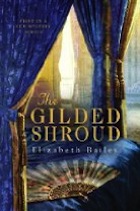
Gilded Shroud, TheElizabeth Bailey, The Gilded Shroud

Ottilia Draycott has just accepted a position as companion to the Dowager Lady Polbrook, expecting nothing more adventurous than a change of scenery after her former position as governess to her two young nephews. But on her very first day at her new post, the current Lady Polbrook (the dowager’s daughter-in-law) is found dead in her room, having been strangled sometime during the night. The household immediately falls into a panic, especially when it becomes evident that the master of the house has disappeared. Ottilia knows that suspicion is bound to fall on Randal Polbrook; no one knows where he has gone or why, and it’s common knowledge that he and his wife were estranged. But Ottilia, after examining the scene of the crime, believes the late Lady Polbrook was entertaining a lover on the night she died. She shares her suspicions with the dowager and with Lord Francis Fanshawe, the younger brother of the absent marquis. Together, they try to discover the lover’s identity and clear Randal’s name, while minimizing the scandal as much as possible. Meanwhile, the pragmatic, clear-headed Ottilia finds her objectivity compromised as she grows closer to Lord Francis.

I love a good historical mystery, and this book is a very solid member of the genre. Ottilia (despite her ridiculous name) is a very likable heroine, with a keen intelligence and a mischievous sense of humor. The other major players are also interesting, from the sharp-tongued but kindly dowager to the handsome Lord Francis. At times I felt that the characters were essentially copied from Georgette Heyer, but since I’m a big Heyer fan, I didn’t mind too much! And one big difference between this book and Heyer’s novels is that here, the servants aren’t just window dressing; they actually have some relevance to the plot. The mystery is well done, although I was able to guess the culprit before the solution was revealed in the book. I also liked the writing style, which seemed appropriate to the time period but was still fairly easy to understand. Oddly enough, my least favorite part of this book was the romance, which just seemed a bit stilted. Overall, I liked this book and will certainly read the sequel at some point, but I didn’t love it in the same way I love Kate Ross’s books, for example.

Review: Don’t Point That Thing at Me

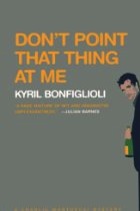
Don't Point That Thing at MeKyril Bonfiglioli, Don’t Point That Thing at Me

This picaresque novel is narrated by the Hon. Charlie Mortdecai, an art dealer who usually operates on the shady side of the law. In the opening scene he is visited by Inspector Martland (of a secret branch of the British police) in connection with a stolen Goya. Mortdecai claims to know nothing of the matter, but he cheekily admits to the reader that it is hidden under the floorboards. After Martland’s visit, Mortdecai knows he must unload the painting, but his mission is complicated by the murder of one of his associates. Even worse, someone seems to want Mortdecai dead as well — so he strikes a bargain with Martland to get diplomatic passage to America, where he hopes to make good his escape. There he encounters a variety of adventures, from constant surveillance by men in blue Buicks to the sexual aggressiveness of a rich American widow. Through it all, Mortdecai maintains a cheerful unconcern as he matches wits with several dangerous opponents.

I have very conflicting feelings about this book. On the one hand, I don’t think I understood the plot at all; there’s definitely a painting involved, and a valuable antique Rolls Royce, and various people who want Mortdecai dead, but I was always a bit confused about what was actually going on. On the other hand, Mortdecai has a delightful narrative voice — very reminiscent of Bertie Wooster, if Bertie were an art thief with a crasser mode of expression. (For example, Mortdecai’s valet/bodyguard is called Jock Strapp, which is either funny to you or it isn’t.) So the book does provide a lot of laughs, but in the end I’m not really sure what to think of it. The novel is first in a series, and I may check out the others at some point. The movie “Mortdecai,” which comes out today in the U.S., is also based on this series, and I’m interested to see how it deviates from the book. Johnny Depp seems like a very odd casting choice, for starters, but I’m nevertheless intrigued!

Review: The Devil in Music

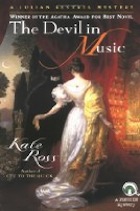
Devil in Music, TheKate Ross, The Devil in Music

This final installment of the Julian Kestrel series moves from England to Italy, as Julian encounters a five-year-old mystery while traveling on the Continent. Lodovico Malvezzi, a powerful Milanese nobleman, was murdered in 1821, but because of the unstable political situation at the time, the local officials covered up the true cause of his death. Now, in 1825, the truth has finally come out, and the police are once more searching for Lodovico’s killer. The most likely suspect is a young tenor called Orfeo, whom Lodovico had been training for a career in opera and who disappeared shortly after the murder. But Lodovico had kept the singer’s real name a secret, and no one can give a clear description of him to the police. Meanwhile, Julian suspects that Orfeo may not be the guilty party, and he begins to investigate Lodovico’s family, including his fascinating young widow, Beatrice, and his politically involved brother, Carlo. He soon discovers several motives for Lodovico’s murder — but secrets from Julian’s own past will emerge before he can unmask the killer.

As previously mentioned, this is the last book in the Julian Kestrel series, and I’m heartbroken to have come to the end of it! I absolutely love historical fiction, mysteries, and anything set in the Regency period, so this series is really the perfect fit for me. Plus, I’m a sucker for a dandy who is more than he appears to be, which is definitely the case with Julian! That said, I’m not quite sure how I feel about this book specifically. The different setting was interesting, and I enjoyed the little bits of background about Italian politics and opera that permeate the book. I also liked the resolution of the mystery, although certain aspects of it were very predictable. The book’s pacing is also a little slow, and the focus of the book is much more on Julian’s character development than on the plot. While I was glad to see some more exploration of his character, it didn’t altogether satisfy me. I think my issue is the romance between Julian and Beatrice, which just didn’t ring true for me. Still, this is a good book in a great series, and I really wish there were more Julian Kestrel mysteries!

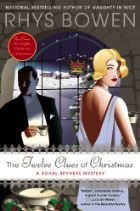
Review: The Twelve Clues of Christmas

Twelve Clues of Christmas, TheRhys Bowen, The Twelve Clues of Christmas

‘Tis the season to be jolly, but Lady Georgiana Rannoch is anticipating a bleak, joyless Christmas at her brother’s estate in Scotland. Her sister-in-law Fig has made it abundantly clear that Georgie is an unwelcome burden, so Georgie begins to search for a way to escape for the holidays. Finally, the perfect solution lands in her lap: she is offered a job as social hostess for a large house party at an English country estate. Georgie jumps at the chance to get away from Fig (and make a little money in the process), especially when she learns that her mother will also be staying in the neighborhood. When Georgie arrives at the estate, she discovers that her employer is trying to stage the perfect English Christmas for a diverse group of paying guests. But the seemingly idyllic country village is soon plagued by a string of suspicious deaths. All of them appear to be accidents, but Georgie suspects that they could be murders. But what do the dead people have in common, and who in the village would be clever and ruthless enough to kill them?

I enjoyed this latest installment of the Royal Spyness series. It has all the fluffy fun of previous books, but the mystery is a bit more substantial compared to some of Georgie’s earlier adventures. I’ve always liked the series for its frothy tone and historical trappings, especially Georgie’s run-ins with real historial figures (for example, Noel Coward makes an appearance in this book!). But historically, the mystery plots themselves have been relatively weak. This one was more complex, with several different plot threads that all tied together in the end. Georgie’s personal life also progresses a bit in this installment, as she and Darcy finally profess their love for each other and begin to talk about marriage. I always want more Darcy in these books…he seems to come in for the sole purpose of ruthlessly kissing Georgie in corridors, but there are hints that he’s also involved in some sort of espionage. I’d love him to marry Georgie and take her along on his adventures! The series seems due for some sort of shake-up, and I’m interested to see whether the status quo will change in future installments.

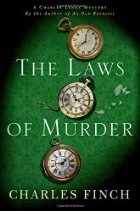
Review: The Laws of Murder

Laws of Murder, TheCharles Finch, The Laws of Murder

Victorian gentleman Charles Lenox has given up his seat in Parliament to return to his true vocation as a detective. He’s even started a detective agency with his friend John Dallington, former rival Polly Buchanan, and a talented Frenchman called LeMaire. Though the business is new, Lenox is confident that it will succeed; but a streak of bad publicity in the London newspapers causes trouble for the fledgling enterprise. Just when Lenox is considering throwing in the towel, however, an unexpected murder forces the police to seek out his services — for the victim is none other than Inspector Jenkins of Scotland Yard. Moreover, Jenkins’ body was found outside the town house of the Marquess of Wakefield, one of London’s most hardened (yet so far uncatchable) criminals. Was Jenkins investigating Wakefield when he met his death? Was Wakefield himself the killer? Lenox and his fellow detectives are on the case, but the conspiracy they uncover is more shocking than they ever could have imagined.

I like this series a lot, and this book is another good installment; but I have to confess, one month later, it’s hard for me to remember much about it! I do recall thinking that the mystery was a little predictable, but there were certainly enough twists and turns to keep me interested. The book also takes time to check in with the various secondary characters who comprise Lenox’s world, which I appreciated — although I would have liked to see even more of McConnell, Lady Jane, and the others! I also think it was a smart move to make Lenox part of a detective agency, as this introduces some new characters and relationships into the mix. The agency also illustrates some interesting areas of blindness in Lenox, especially regarding class. When the business begins to fail, Lenox is upset, but he is never in danger of experiencing real financial hardship. Some of his colleagues, however, depend on the agency for their livelihood, and this doesn’t occur to Lenox initially. So I appreciate that we got a little character growth in this installment, and I look forward to the next book!