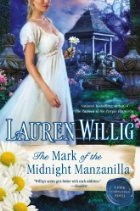
Review: The Mark of the Midnight Manzanilla

Mark of the Midnight Manzanilla, TheLauren Willig, The Mark of the Midnight Manzanilla

In the autumn of 1806, a popular novel called The Convent of Orsino (written by none other than Miss Gwen!) has sparked a vampire craze in fashionable society. Rumors swirl around one man in particular — Lucien, Duke of Belliston — whose long absence from society is seen as evidence that he is a creature of the night. Practical, outspoken Sally Fitzhugh is determined to prove this rumor false, so she seeks out an acquaintance with the duke. For Lucien, the rumor escalates from inconvenient to dangerous when a young woman is murdered at a society ball, with what appear to be fang marks on her throat. Lucien and Sally quickly realize that someone is framing Lucien for the murder, so together they decide to find the real killer. Is it someone with a personal grudge against Lucien, or could the nefarious French spy known as the Black Tulip be at work again? The more time Lucien and Sally spend together, the more they are drawn to each other; but before they can be together, they must defeat a cunning killer.

This 11th novel in the Pink Carnation series once again combines romance, historical fiction, and a touch of intrigue for a very enjoyable read. I wasn’t totally enthused about the plot of this installment beforehand, since vampires aren’t really my thing, but fortunately they’re not a big part of the story. I also didn’t completely warm up to Lucien or Sally, both of whom seem like types rather than characters…Sally in particular just seems like a younger version of Miss Gwen. But there’s still an awful lot to enjoy in this book! I was pleasantly surprised by the resolution of the mystery, which is quite clever and hangs together well. And as always, I adore the light, tongue-in-cheek tone of the series; it doesn’t take itself too seriously and aims to be entertaining above all else. I should mention that the contemporary story takes some significant steps forward in this installment, with Eloise facing important decisions both personally and professionally. So I’m really looking forward to the next (and last!) Pink Carnation novel, which will finally tell the story of the Carnation herself!
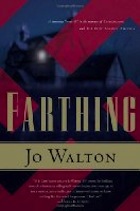
Review: Farthing

FarthingJo Walton, Farthing

This novel is a murder mystery with a twist: what if a fascist English government had made a separate peace with Hitler? In the world of this book, it’s 1949, and war still rages between the Third Reich (which now encompasses all of Europe) and the Soviet Union, but England has managed to remain at peace. The “Farthing set,” who engineered the treaty with Hitler, have congregated at an English country estate, where Lucy (the daughter of the house) and her husband David are staying. Because David is Jewish, they both endure various snubs and cruelties from the other guests. Then a notable member of the Farthing set is murdered, and his corpse is decorated with Jewish symbols. Lucy is convinced that her husband has been framed, and Inspector Carmichael of Scotland Yard agrees. But as the English government becomes more totalitarian and anti-Semitic, both Lucy and Carmichael must make devastating choices that could allow the murderer to go free.

This book was unsettling, to say the least, and I have very conflicting feelings about it. Part of the story is told from Lucy’s perspective, and I really enjoyed her character and her narrative voice. I also think the book very skillfully depicts a nation’s slow slide into despotism; one of the most heartbreaking and effective parts of the book, for me, was David’s strong faith in England. Despite the hardships he endures, he is convinced that Jews will never be persecuted in England the way they are in the Reich…but of course, events in the book ultimately prove him wrong. On the negative side, the “mystery” element of the book is very underdeveloped. I also became irritated by the sheer number of secret, illicit, and/or adulterous relationships in the book; it seemed like EVERY character was involved, which strained my credulity. (Also, everyone seems to have really good “gaydar,” if you’ll pardon the expression!) Overall, I’m not sure the positives outweighed the negatives for me, and I’m still undecided about continuing with the series.

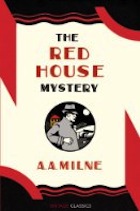
Review: The Red House Mystery

Red House Mystery, TheA.A. Milne, The Red House Mystery

In the time-honored tradition of the classic British mystery, a house party goes terribly awry when one of the guests is murdered and the host disappears. Mark Ablett, owner of the Red House, enjoys collecting people around him, so the house party includes such diverse characters as his private secretary, a military man, an actress, and several idle young people. The party appears to be going well until Ablett learns that his brother, the black sheep of the family who had been living in Australia, will be visiting the Red House for an unspecified but sinister reason. When Robert is inevitably murdered, Mark is nowhere to be found. Is he the murderer, or did someone else in the house party do the deed? Young man-about-town Antony Gillingham just happens to arrive on the scene at a pivotal moment, so he decides to try his skill as an amateur detective; but ultimately he discovers that the solution to the mystery is far more tragic than amusing.

When I came across this book a few years ago, I was delighted to discover that the creator of Winnie the Pooh had written a mystery story! It follows many conventions of the classic Golden Age mystery — such as being “fair,” with all clues presented to the reader as the detective discovers them — but it turned out to be a bit darker and sadder than I was expecting. Tony discovers the murderer’s identity fairly early in the book, so the bulk of the mystery lies in discovering how and why the deed was done. And the thing is, I found the murderer very sympathetic! So I was disappointed that this character turned out to be the guilty party. Also, unlike many mysteries from this period, this book doesn’t contain much humor, nor are there any subplots to lighten the mood of suspense and doom. Tony’s sidekick provides a few funny moments, but otherwise the tone remains pretty dark. Finally, Tony’s character isn’t developed very much, which disappointed me; he seemed really interesting, and I would have liked to know more about his backstory. The book is still worth reading if you enjoy Golden Age mysteries, but I have to admit, it wasn’t my favorite.

Review: The Haunted Bookshop

Haunted Bookshop, TheChristopher Morley, The Haunted Bookshop

In this sequel to Parnassus on Wheels, bibliophile Roger Mifflin has temporarily abandoned his traveling bookstore for a more permanent location on Gissing Street in Brooklyn. He calls his store the Haunted Bookshop, claiming that it is “haunted” by the ghosts of great literature. One day a young salesman named Aubrey Gilbert enters the store, hoping to persuade Roger to advertise with his firm; instead, the two men have an intense discussion that leaves Aubrey with a newfound appreciation for literature. When Aubrey returns to the shop a few days later, he is immediately smitten with Titania Chapman, the beguiling new shopgirl. But as he starts to visit the store more regularly, he notices something strange: an old and rather obscure volume keeps disappearing from the Haunted Bookshop and then re-appearing without warning. Is there a literary-minded thief frequenting the bookstore, or is something more sinister at work?

This is one of those cozy little books that take you back to a simpler time, and I found it absolutely charming! Roger Mifflin’s enthusiasm for books is infectious, and the novel is full of his musings on literature, both in general and about specific books. Unfortunately, I didn’t recognize most of the titles he mentioned, presumably because they’ve gone out of fashion (and print!) since the book was published in 1919. But this is definitely the type of book that reminds me of the huge number of books in the world that I still haven’t read! The mystery plot is clever, though very slight and easy to guess (and very much a product of its time). I also liked the central characters, especially Aubrey, who makes a lot of endearing mistakes in his quest to solve the mystery and win Titania’s heart. All in all, I finished this book wishing that I could stop by the Haunted Bookshop for dinner and a literary discussion with these characters.

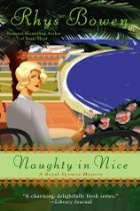
Review: Naughty in Nice

Naughty in NiceRhys Bowen, Naughty in Nice

Lady Georgiana Rannoch is facing yet another a dreary winter in London. Despite her royal pedigree — she’s 34th in line to the throne of England — she has no income, and the worldwide depression in the wake of World War I has made it impossible for her to find work. What’s more, her brother Binky and his intolerable wife, Fig, have decided to close up their London house, which means Georgie will be essentially homeless. Fortunately, the queen comes to her rescue by sending her to the French Riviera on a secret mission: she must recover a stolen snuffbox, believed to be in the possession of one Sir Toby Groper. At first, Georgie is ecstatic to be in Nice, mingling with rich English pleasure-seekers and dashing French aristocrats. She even meets Coco Chanel, who asks her to model one of the looks from Chanel’s new collection. But then a priceless necklace is stolen and a man is murdered — and in the eyes of the French police, Georgie is the prime suspect! Can she clear her name by finding the real thief and murderer?

I’m really enjoying the Royal Spyness series, and this book (the 5th installment) is no exception. It’s a light, exuberant mystery that still manages to incorporate a lot of information about this time period. For example, the Prince of Wales and his paramour, Wallis Simpson, make brief appearances in the book, and there are also a few mentions of Hitler as he begins his rise to power in Germany. In addition to the setting, I enjoyed the plot of this book, which is a bit more substantial than some of the earlier books in the series. Georgie is a fun character, but she’s not really much of a detective; she tends to stumble onto the solution of the mystery rather than actually investigating or deducing anything. In this book, though, she actually does take some initiative and is able to put the pieces together — though not before her own life is endangered once more. All in all, I think this is one of the better installments of the series, and I’m planning to continue with The Twelve Clues of Christmas in December!

Review: A Blunt Instrument

Blunt Instrument, AGeorgette Heyer, A Blunt Instrument

When wealthy Englishman Ernest Fletcher is found in his study with his head bashed in, his relatives and neighbors are shocked. Ernest was well-liked and seemingly had no enemies, so why would anyone want to kill him? But as Superintendent Hannasyde and Sergeant Hemingway investigate the case, they soon uncover several motives. First there’s Neville Fletcher, the dead man’s nephew and heir to his fairly large fortune. Then there is Helen North, who has a secret involving Ernest that she doesn’t want anybody — especially her husband — to know about. Or the culprit could be Abraham Budd, a businessman who was complicit in some of Ernest’s shady financial dealings. But as the police collect motives and unearth secrets, they become more and more puzzled by the conflciting testimony about what actually happened on the night of the murder. And when a second victim appears, Hannasyde and Hemingway know they will have to act fast to catch a partiuclarly elusive killer.

In general I prefer Heyer’s romances to her mysteries, but I really enjoyed this book! There are some wonderful characters in this one: the vague, mischievous Neville, who is much sharper than he appears; the blunt, monocle-wearing Sally Drew, who writes detective novels; Constable Glass, the Bible-quoting policeman; and the impatient, down-to-earth Sergeant Hemingway. The dialogue is witty and sparkling, as usual, and I loved the romance(s) that emerged throughout the course of the book. The mystery itself is also a bit more substantial than in some of Heyer’s other books, and I was surprised by the Christie-esque twist that revealed the murderer’s identity. Overall, if you’re interested in trying Heyer’s mysteries, I think this is a really good place to start! (Hannasyde and Hemingway are recurring characters in her mysteries, but the books absolutely do not have to be read in order.) I’m reading these mysteries in chronological order, so I’ll be interested to see whether they get even better as they go on!

Review: In the Woods

In the WoodsTana French, In the Woods

Detective Rob Ryan and his partner, Cassie Maddox, are two up-and-coming detectives on the Dublin Murder Squad. But Ryan is hiding a secret about his past: his real name is Adam Ryan, and when he was 12 years old, his two best friends vanished in the woods of Knocknaree without a trace. Ryan was even with them at the time, but he has no memory of what happened to them — or why they disappeared while he was found. Ryan has apparently done a good job of recovering from this trauma and moving on with his life, but he is deeply shaken when he and Cassie are assigned to another case in Knocknaree, where a young girl has been murdered. As Ryan returns to his hometown and is confronted with memories he didn’t even know he had, he wonders whether the girl’s murder is connected to his own past. Ultimately, Ryan knows that this case will have deep personal importance for him — but will it make his career or destroy it?

I’m having a hard time collecting my thoughts on this book. At first I thought I wasn’t going to like it at all — in fact, I almost gave up after the flowery prologue — but eventually I got completely sucked in. The strongest aspect of the book, for me, was the relationship between Ryan and Cassie. Ryan isn’t a particularly likable character, but the bond between him and Cassie is so strong that you can’t help feeling he must be a pretty good guy after all. The way this relationship evolves and changes throughout the book kept me riveted. The novel’s narrative structure also creates a lot of suspense: Ryan is the narrator, and he says right from the start that he tells lies. So I was constantly wondering whether he was lying about certain things, and I became really invested in both mysteries as a result. That said, the book’s ending drove me a little crazy: some things made me sad, others frustrated me, and others I actually liked a lot. So I’m still undecided about this book; but I am glad I read it, and I will certainly be reading The Likeness at some point as well!

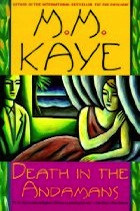
Review: Death in the Andamans

Death in the AndamansM.M. Kaye, Death in the Andamans

Caroline Ophelia Phoebe Elizabeth Randal, known to her friends as Copper, is staying with school chum Valerie on the tiny island of Ross in the Andaman Islands. The vast majority of the population is Burmese, but there is a small British community on the island as well, and Copper and Val naturally form part of this society. At first Copper views the island as a paradise, especially when compared to her rather dreary life in London; and the most upsetting aspect of her visit so far is her feelings for Nick Tarrent, a visiting naval officer who is friends with Valerie’s fiancé. But everything changes one fateful day when a terrible storm leads to widespread destruction on the island, and one of the British plantation owners is found dead. His death is assumed to be accidental until another visiting officer, who happens to be a doctor, suspects foul play. Then the doctor himself is murdered, and it slowly dawns on Copper and the others that the murderer has to be one of them — the storm has cut off all access from the outside world. Can Copper and her friends unmask the murderer before he or she kills again?

I’ve finally read the last of M.M. Kaye’s “Death in…” books, and I’m sorry to have reached the end of them. They all essentially follow the same formula — young woman visits exotic location, falls in love, and becomes involved with a murder — but it’s a formula that appeals to me, so I don’t mind! This book did a wonderful job describing the setting, which is unsurprising, since Kaye actually lived in the Andamans for a while and even experienced a storm like the one in the book! The fact that Copper and her friends were completely cut off from the outside world produced the proper atmosphere of creepy suspense; I was reminded at times of Agatha Christie’s And Then There Were None. I didn’t particularly like the fact that there was a lot of head-hopping in the book, from Copper to Val to Nick to various other characters. I also thought the solution of the mystery came out of nowhere. While the plot does hang together, I wasn’t terribly satisfied by the revelation of the murderer, as many other suspects could just as easily have committed the murders for the same reason. Overall, though, I enjoyed this book and am sad that I don’t have any more M.M. Kaye mysteries to look forward to!

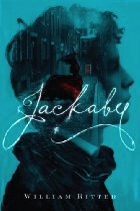
Review: Jackaby

JackabyWilliam Ritter, Jackaby

Abigail Rook has just arrived in the New England town of New Fiddleham with nowhere to go and no way to earn a living. As she sits in a tavern and ponders her next move, she encounters a strange man who turns out to be R.F. Jackaby, a private investigator with an extraordinary gift for detecting paranormal activity. Abigail’s talent for observation lands her a job as Jackaby’s assistant, and she is immediately embroiled in the investigation of a gruesome murder. Jackaby is convinced that the killer is supernatural, but the police scoff at the very idea — except for one young detective named Charlie Cane. With Cane’s help, Jackaby and Abigail pursue the investigation, encountering a banshee, a helpful madwoman, and a possible bridge troll along the way. Meanwhile, Abigail relishes the excitement of her new job, but several people warn her to stay away from Jackaby. She wants to keep her job, but will it cost her her reputation — or even her life?

Despite the fact that this book is classified as YA or even middle-grade, I really enjoyed it! The book is narrated by Abigail, a plucky protagonist who is suddenly thrown into a magical world with nothing but her wits to rely on. I like that she is basically ordinary; though smart and brave, she doesn’t have superpowers, so she is very relatable as she encounters the surprises and challenges of this world. Jackaby is a really fun character as well, with more than a few similiarities to Benedict Cumberbatch’s Sherlock Holmes! I also loved the richly imagined world of this novel, especially the random little gags that didn’t have much to do with the main plot, such as the frog in Jackaby’s office, or what happened to his former assistant. The mystery itself was fairly easy to solve — I figured out whodunnit almost as soon as the guilty character was introduced — but the fun of the book is the characters and setting. I’d definitely recommend this book to fans of historical fantasy, and I’m looking forward to the sequels!

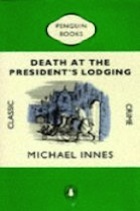
Review: Death at the President’s Lodging

Death at the President's LodgingMichael Innes, Death at the President’s Lodging

This first installment of the Inspector Appleby series is a classic locked-room mystery set in the fictional St. Anthony’s college, where its president, Dr. Umpleby, has just been murdered. Because of the prominence of the victim, Inspector Appleby is summoned from Scotland Yard to assist the local police. He soon learns that the layout of the college would have made it impossible for someone without a key to access the scene of the crime. Therefore, suspicion centers around the other fellows of the college, most of whom either had a key or could easily obtain one. As Appleby begins his investigation, he notices strong tensions among these men and uncovers various professional rivalries. He also begins to realize that the case is cluttered with many side issues and diversions. But as he sifts the relevant facts from the distractions, Appleby eventually reaches a conclusion as bizarre as it is shocking.

I’ve now read two mysteries by Michael Innes, and what I’ve learned is that I love his solutions, but I’m not terribly fond of how he gets there! In most mysteries that I read, there’s not a lot of irrelevant information; every fact the detective discovers is a clue. In this book, on the other hand, much of what Appleby discovers isn’t relevant to the solution of the murder. This is certainly more realistic than, say, a Poirot mystery, but it made the reading experience more difficult for me. I also didn’t like the relative lack of character delineation. It’s been less than a month since I read this book, and already I couldn’t tell you the main suspects’ names! Nobody (including Appleby) has much personality, so the murder is more like a logic puzzle than a dramatic event involving actual human beings. All that said, I really did love the solution to this one, which got downright farcical in places! So overall, I’m glad I read this book, but I doubt I’ll get sucked into the rest of the series — which is probably a good thing!