Review: Borrower of the Night

Borrower of the NightElizabeth Peters, Borrower of the Night

This novel introduces Vicky Bliss, a confident, no-nonsense art historian and professor at a small Midwestern university. She and her colleague/boyfriend Tony stumble across a clue to a lost work by Tilman Riemenschneider, a 16th-century German woodcarver. They decide to embark on a friendly competition to see who can discover the artifact first — a competition Vicky is determined to win. She sets off immediately for the supposed location of the artifact, Castle Drachenstein in Rothenburg, Germany. Unfortunately, Tony is hot on her trail, along with several other parties interested in recovering the lost masterwork. As Vicky and her competitors begin their search, they soon realize that something is amiss at Castle Drachenstein, and the root of the trouble lies in the distant past. Is the castle being haunted by the ghost of a former countess, or is there a less supernatural explanation for the danger Vicky finds herself in?

I’ve read and enjoyed the first few books in the Amelia Peabody series, so I was interested to try this series as well. Overall, I thought it was a fun read and a pretty decent mystery. The emphasis wasn’t so much on the “whodunit” aspect of things; rather, the novel focuses on the suspense and danger evoked by the gothic setting. In that respect, I was reminded a lot of Mary Stewart’s novels (which I also really enjoy), and the archaelogical aspect of the plot called to mind “Indiana Jones.” I also liked reading about Vicky, whose sassy comments and progressive (in the 1970s) views always seemed to stir up trouble. I didn’t always like or agree with her, but she was consistently amusing! Overall, I found this book a fun read and will definitely be picking up the sequels at some point.

Review: Roseanna

RoseannaMaj Sjöwall and Per Wahlöö, Roseanna (trans. Lois Roth)

This book begins in the summer of 1965, when a dead body is dredged up from the bottom of a Swedish lake. The corpse is female and naked, with no clothing, jewelry, or personal effects of any kind. The police determine that she was raped and strangled to death, but they have absolutely no clue as to her identity, much less the murderer’s. Police inspector Martin Beck launches an investigation with the help of his colleagues; after weeks of diligent searching, they are able to identify the woman as Roseanna McGraw, an American woman who was touring Sweden by cruise. Slowly, Beck and the other policemen begin to piece together Roseanna’s final days, and with help from the American police, they are able to learn something about her character as well. Beck gradually begins to form an opinion about the personality of the murderer, and sifting through the scanty data gives him a specific suspect. But due to the lack of hard evidence in the case, Beck and his colleagues must set a daring, and dangerous, trap.

I’m a big fan of the mystery genre in general, but I tend to gravitate toward mysteries in which the reader is able to solve the crime right alongside the detective. This book is definitely not like that, but it offers a fascinating alternative perspective on what a mystery novel can be. The focus isn’t on the victim’s character or on a list of potential suspects who can be eliminated one by one; rather, it’s a very realistic portrayal of how police investigations actually work, with all the tedium and frustration and dead ends they entail. One detail I loved is how the case actually took the policemen months to solve, and how they were also working on other cases in the meantime. Interestingly, Beck’s personality is basically irrelevant, and we don’t learn much about him even though this is the first book in “his” series. Crime-solving is much more of a communal endeavor in this novel than it is in the (predominantly) British and American mysteries I’ve read — indicating a broader cultural difference, I suspect! Be that as it may, I enjoyed this book and would recommend it to mystery lovers, even though it was a departure from my normal reading experience.

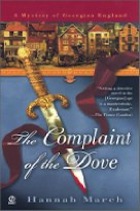
Review: The Complaint of the Dove

Complaint of the Dove, TheHannah March, The Complaint of the Dove

In 1760s England, private tutor Robert Fairfax is charged with escorting his pupil, Matthew Hemsley, to London for a bit of town polish. But Fairfax is apprehensive: how can he introduce Matthew to the worldly, sophisticated atmosphere of London while at the same time protecting him from bad influences? Unfortunately, during their very first trip to the theater, Matthew instantly falls in love with the beautiful and popular actress Lucy Dove. Though she is a sweet and talented girl, her profession is most unsuitable, so Fairfax hopes that Matthew’s infatuation is only temporary. But Matthew gets into even bigger trouble when Lucy is murdered shortly afterwards, and he is found at the crime scene under very suspicious circumstances. When Matthew is actually arrested for the murder, Fairfax knows it is his duty to clear his pupil’s name — which means launching an investigation to discover the real killer.

I discovered this series by accident at a library book sale where the second and third books were available for 25 cents each, so of course I had to track down the first book as well! I was intrigued by the concept of a Georgian mystery, since I haven’t seen many novels set in that era (especially compared to the much more popular 19th century!). Fortunately (or perhaps unfortunately, given the magnitude of my TBR list already), I’ve discovered a new mystery series to enjoy! I loved the period detail: the crush of theatergoers more interested in each other than in what’s happening onstage; the elaborate wigs, patches, and high heels worn by aristocratic men and women alike; the rudimentary knowledge of medicine, including the ingestion of mercury as a cure for venereal disease. It’s a fascinating time period, and March really brings the era to life. I also liked Robert Fairfax as a sleuth, and I look forward to seeing how his complex character will develop in subsequent books. Overall, I’d definitely recommend this book to fans of historical mysteries!

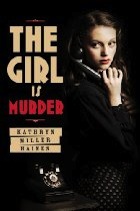
Review: The Girl Is Murder

Girl Is Murder, TheKathryn Miller Haines, The Girl Is Murder

Fifteen-year-old Iris Anderson is having a hard time. About a year ago, her Pop returned from Pearl Harbor with a missing leg, which meant he was no longer able to do the active work required by his business as a private investigator. As a result, Pop and Iris have moved from their old affluent neighborhood to a poor area on the Lower East Side, and Iris has to go to public school instead of the elite private school she formerly attended. Hoping to get closer to her only surviving parent (her mother committed suicide shortly after Pop returned from the war), Iris tries to help Pop with his cases, but he forbids her from having anything to do with the PI business. When one of the boys at Iris’ new school goes missing, however, she can’t help but do a little sleuthing. Along the way, she makes a few friends at her new school, including the unpopular Pearl and the glamorous, fast-talking Suze; but as Iris navigates her way through various cliques and social minefields, how will she know whom she can really trust?

If you enjoy Haines’ Rosie Winter mysteries, you’ll feel right at home in the world of this novel, set in the fall of 1942. The book isn’t about World War II, yet the war permeates almost every aspect of Iris’ life, from the slang used by Suze and the other cool girls at school to the disturbing racisim and anti-Semitism espoused by some of the characters. (These attitudes are definitely not condoned by the book, however; they simply mirror the atttitudes of many Americans at that time.) I liked Iris as a protagonist; her problems are specific to her era yet also universal, as she struggles with her own identity, fitting in, and building a relationship with a distant parent. Her voice is occasionally too precocious for a 15-year-old, but I found that flaw forgivable since she’s so entertaining. As a mystery, the book is very weak; Iris doesn’t spend much time investigating anything, and she’s not even the one who solves the case! So I’d recommend this to someone looking for an interesting YA book about World War II, but it’s not a great read for a mystery fan.

Review: The Raven in the Foregate

Raven in the Foregate, TheEllis Peters, The Raven in the Foregate

In December of A.D. 1141, the Benedictine Abbey of Sts. Peter and Paul in Shrewsbury welcomes a new parish priest to Holy Cross Church in the Abbey Foregate. The former priest was a kindly old man much beloved by his parishioners, so everyone is nervous about what to expect from the newcomer. Father Ainoth soon confirms the monks’ worst fears: although he is a scholar and a scrupulously holy man, he is extremely harsh with his congregation and soon stirs up bad feeling in Shrewsbury. When his drowned corpse is found in the river near the mill, it’s up to Brother Cadfael, herbalist and amateur detective, to solve the mystery. Cadfael also acquires a new assistant, supposedly the nephew of Father Ainoth’s houskeeper, but it soon becomes obvious that the boy is more than he seems. Meanwhile, both the abbey and the town continue to be affected by the ongoing civil war between King Stephen and Empress Maud.

This book is the 12th installment of the Cadfael series, and anyone who likes the series will enjoy this book as well. Once again Cadfael finds himself in the position of having to solve a murder, aid a pair of young lovers, uncover a political secret, and hide that secret from the local authorities in the interest of a higher justice. As a longtime fan of the series, I can’t help but love every Cadfael book, but I must admit that the prose does occasionally veer toward the purple end of the spectrum. Also, because Peters sticks to almost the same formula in every book, I found the plot pretty predictable. I was a bit disappointed that the murder and the political intrigue weren’t more closely connected; I thought more could have been done with certain aspects of the story to make the plot more exciting. Still, I love the series and definitely plan to read the remaining eight books. They’re wonderfully relaxing reads if you enjoy a medieval setting!

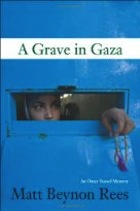
Review: A Grave in Gaza

Grave in Gaza, AMatt Beynon Rees, A Grave in Gaza

Omar Yussef, a middle-aged teacher at a school in Bethlehem, is accompanying his boss Magnus Wallender on an inspection of the UN schools in Gaza, along with James Cree, another UN official. Almost as soon as they cross the border, however, they are confronted with injustice and violence: a professor who exposed corruption at his university has just been arrested and will likely be killed, unless Omar can prevent it from happening. Meanwhile, a lieutenant in a Palestinian military group has just been killed, and the presumed culprit is part of an arms-smuggling organization called the Saladin Brigade. But when Omar speaks to the alleged murderer, he begins to wonder whether the man is actually guilty. As Omar and his colleagues investigate these issues, they realize that the two crimes might be connected. At the same time, they are drawn deeper and deeper into a rivalry between military leaders who are fighting for control of Gaza; as a result, their own lives may be in danger.

As with The Collaborator of Bethlehem, the strength of this book is its depiction of life in contemporary Palestine. Rees uses his journalistic background to portray the conflicts, corruption, and political turmoil of this region in an extremely vivid way. At the same time, he illustrates the lives of ordinary Palestinians with great sympathy, showing how they try to do their best in very difficult circumstances. Read as a mystery novel, the story isn’t particularly compelling; although Omar Yussef does solve the lieutenant’s murder, that investigation is secondary to his discovery of how the various crimes and acts of violence are linked together. I liked learning a little more about Omar Yussef’s past in this installment of the series, as well as seeing more of his friendship with the Bethlehem police chief. There are also a few new characters that I’ll be interested to follow in future books. Overall, this is a book and series I’d highly recommend for its setting, and I will probably seek out the third Omar Yussef mystery at some point.

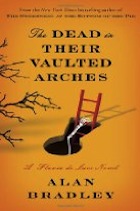
Review: The Dead in Their Vaulted Arches

Dead in Their Vaulted Arches, TheAlan Bradley, The Dead in Their Vaulted Arches

***Warning: MAJOR SPOILERS for previous books in this series!***

At the end of Speaking from Among the Bones, Flavia and her family received the shocking news that her mother, who disappeared many years ago somewhere in Tibet, had been found. This book begins with the de Luce family waiting at the train station for Harriet’s body to come home. Though Flavia is shocked and grieving, she can’t help wondering why Winston Churchill himself has come to pay his respects. Then there’s the man on the platform who whispers a mysterious message into Flavia’s ear and falls to his death on the tracks minutes later. Or was he pushed? As Flavia tries to sort out her feelings about her mother’s death, she can’t help but dig into the secrets of her family’s past — which, of course, turn out to be much bigger and more important than she ever imagined. Not only does she eventually solve the case of the man who died at the train station, but she discovers shocking information about Harriet’s death — and about her own future destiny.

I’ve enjoyed the Flavia de Luce series from the start, but this book is definitely my new favorite. The mystery plot is only so-so; the backstory of Flavia’s mother is rather predictable, and the villain of the book doesn’t have a terribly coherent motivation for some of the events that take place. Still, there is definitely more to be learned about the de Luce family’s past, and I’m sure additional solutions will be revealed in future books! I also think some of the secondary characters got short shrift in this installment; I wanted more of the vicar, the inspector, Adam Sowerby, and the other denizens of Bishop’s Lacey. But despite these nitpicks, I think this book got the most important thing exactly right: the reactions of Flavia and her father and sisters to Harriet’s death. This novel is a story of bereavement and grief much more than a mystery story, and in that light I think it’s fantastic. If you’re a fan of this series, you definitely won’t want to miss this installment! I can’t wait to see what’s next for Flavia and the rest of the de Luces.

Review: Fer-de-Lance

Fer-de-LanceRex Stout, Fer-de-Lance

This novel introduces the famous detective team of Nero Wolfe, an eccentric genius whose skill in detection is rivaled only by his fondness for orchids, and Archie Goodwin, his streetwise secretary. Although they live in comparative luxury, Wolfe and Archie have not been immune to the effects of the Great Depression, and they certainly won’t turn down any opportunity of making some hard cash. So when a worried Italian woman comes to their doorstep asking them to track down her missing brother, they are eager to take the case. Due to Wolfe’s obese build and strange fears of the outside world, he refuses to leave his home; so it’s up to Archie to investigate the man’s disappearance. He soon discovers, however, that the missing Italian man is just one piece of a much larger puzzle involving the sudden death of a prominent university professor. While Archie collects evidence, Wolfe applies his considerable talents to solving the mystery.

This is my first encounter with Nero Wolfe and Archie Goodwin, but it certainly won’t be my last! I loved Archie as the narrator; his wry, amusing voice reminds me of the fast-talking banter of the great screwball comedies of the 1930s. It was great fun to see the investigation through his eyes, as he applies his own special brand of persuasion to the various suspects and interested parties. Nero Wolfe, by contrast, is significantly less interesting, since the inner workings of his mind remain largely mysterious. He did have some funny moments, though, and I liked his extremely formal patterns of speech. He and Archie make a nice contrast in that regard, since Archie is full of contemporary slang and has an almost aggressively casual tone. As for the mystery itself, it is quite well-plotted, even if the solution isn’t very surprising. The only thing I disliked was that the book keeps going after the culprit’s identity is revealed. For me, the fun of reading a mystery is trying to solve it; once the solution is discovered, I don’t want to read a long denouement about how the guilty party was finally caught. So I thought the end dragged a bit; but other than that, I enjoyed this mystery and look forward to reading more in the series.

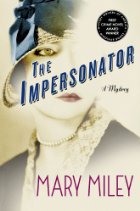
Review: The Impersonator

Impersonator, TheMary Miley, The Impersonator

Leah Randall is a talented but impoverished actress who has worked on the vaudeville circuit her whole life. During the course of one performance, she notices a strange man watching her intently. Eventually this man, Oliver Beckett, approaches her with an astonishing proposal. He tells Leah the story of his niece, Jessie Carr, heiress to a substantial fortune, who vanished from her home several years ago without a trace. Leah bears a striking resemblance to Jessie, so Oliver proposes a scheme: Leah will pose as Jessie and return “home” to claim her inheritance, which she will then split with Oliver. At first Leah wants nothing to do with it, but when she is fired from her vaudeville act and can’t get other work, she eventually reconsiders. With Oliver’s help, she assumes Jessie Carr’s identity and travels to the Carrs’ home in Oregon. But the more time she spends with the Carrs, the more she becomes determined to discover what really happened to Jessie all those years ago.

If you read that plot summary and thought, “That sounds an awful lot like Brat Farrar by Josephine Tey,” well, you’d be right. The premise is exactly the same — Miley even acknowledges that Tey’s novel was the main inspiration for her own — but I enjoyed Miley’s novel in its own right. I especially liked the period details about vaudeville, speakeasies, and other highlights of life in the 1920s. There were even references to some Supreme Court cases of the era, which I appreciated as a law school survivor. I also liked Leah’s narrative voice: she’s plain-spoken, independent, and very aware of both her talents and her flaws. The thing is, though, Brat Farrar is still by far the superior book. Miley’s novel is a bit disorganized at times, including several subplots that are more distracting than intriguing. I also hated the romantic aspect of this book; it was unbelievable and underdeveloped. I did enjoy the book overall and found it very readable, but if the premise sounds interesting to you, you should really just read the original instead!

Review: Whom the Gods Love

Whom the Gods LoveKate Ross, Whom the Gods Love

Alexander Falkland, one of the darlings of English society, has just been murdered — bashed over the head with a poker in the middle of a party at his own house. The Bow Street Runners are at a loss to discover the killer; after all, who would want to murder a man who was universally liked? When the official investigation goes nowhere, Alexander’s father enlists the help of Regency dandy/sleuth Julian Kestrel. As a man of Alexander’s own social class, Julian has unique access to his friends and associates that the Bow Street Runners could never obtain. Julian agrees to take the case, but he warns Alexander’s father that unpleasant truths might emerge. And indeed, the further Julian digs into Alexander’s life, the more shocking secrets he uncovers, including several motives for murder.

I absolutely loved the first two books in the Julian Kestrel series, and I’m thrilled to be able to say that I loved this one as well! The strength of most mystery series depends on the protagonist, and Julian Kestrel is a wonderful sleuth: intelligent, intuitive, willing to cooperate with the police (a rare trait!), and always impeccably dressed. I also think this book is very well-plotted. Obviously there is more to Alexander Falkland than meets the eye, but the various twists and turns of the plot kept me in suspense until almost the very end of the book. My only problem with the book is that I really liked one particular character who ended up doing a horrible thing in the course of the plot. Because of this, the resolution of the mystery wasn’t completely satisfying for me; but I suppose that’s a testament to the author for making me care so much about that character! In short, I’d definitely recommend this book (and the entire series) to anyone who enjoys mysteries or historical fiction!