Review: A Girl Like You

A Girl Like YouGemma Burgess, A Girl Like You

Abigail Wood has just had a terrible realization: she doesn’t know how to be single. She’s been with the same man since college but is recently on the market again, and now she’s trying to navigate the London dating scene…with no clue what she’s doing. Her sister Sophie and best friend Plum shower her with well-meaning (and often contradictory) advice, but Abigail still seems to end up dating — and getting dumped by — the wrong men. Desperate, she seeks help from her flatmate Robert, a smooth-talking man who can seemingly get any woman he wants. Abigail decides to try Robert’s tips, and she’s shocked (and pleased) to discover that they actually work! Abigail becomes more confident in her career as well as her love life, and she’s never been happier. But when she meets a guy she really, really wants to impress, she’s suddenly not sure that she can keep following Robert’s advice.

I really loved Gemma Burgess’ first book, The Dating Detox, so when I found out she’d written another one, I put it on my wishlist immediately. I’m happy to say that it didn’t disappoint! If you like chick lit, I can’t recommend this author highly enough. Abigail is a fun heroine with a sassy, tongue-in-cheek style, and I think that she’s a very relatable character — sort of a much-less-obnoxious Carrie Bradshaw. I certainly can’t imagine myself doing some of the things that Abigail does, but it was fun to escape into her world for a while! I also loved Abigail’s friends, who have their own lives apart from her drama but who still manage to be there and support her. The overall plot of which man Abigail will end up with is fairly transparent, but it was still fun watching her realize it. I’m disappointed that I don’t have any more Gemma Burgess books to read…hopefully she’ll write another one soon!

The Cinderella Deal

The Cinderella DealJennifer Crusie, The Cinderella Deal

Daisy Flattery is a free spirit, an artist with a penchant for adopting stray animals and telling stories that are “unreal but not untrue.” She couldn’t be more unlike her upstairs neighbor, Lincoln Blaise, a reserved academic who dreams of becoming a college professor. But fate brings Daisy and Linc together in a surprising way: Linc has just been interviewed for a great job at a small liberal-arts college, but the unspoken catch is that he needs a wife if he wants to get hired. Linc immediately invents a fiancée and offers Daisy money to pose as the lucky woman. Daisy doesn’t like Linc much, but she’s flat broke, so she accepts his proposal. But the more time they spend together, the more Daisy and Linc realize that their fake relationship might actually have a real future.

Is the premise of this book preposterous? Yes, yes it is…but this book was such a fun little read! Despite the incredibly familiar opposites-attract plot, this book seemed like a breath of fresh air to me. I just really loved both Daisy and Linc; despite appearances, they are both fundamentally kind, big-hearted people who are ready to take a chance on love. There’s a great mixture of romance and humor, and I think it would make a wonderful chick flick. I also enjoyed the book’s setting, which is primarily a small college town with plenty of quirky secondary characters. I would definitely recommend this book to people who are feeling grumpy or depressed — it’s an instant mood-lifter!

Review: Grave Mercy

Grave MercyRobin LaFevers, Grave Mercy

Ismae has grown up hating and fearing her abusive father, and when he sells her to an equally abusive husband, she despairs of ever finding a different path for her life. But a twist of fate brings Ismae to the convent of Saint Mortain, the ancient Breton god of death. Though Brittany has been superficially Christianized, worship of the old gods still persists, and the sisters of Saint Mortain serve their god by training young women as assassins to do his will. Ismae happily embraces her new life and devotes herself entirely to Mortain. But when she is sent out into the world to do the god’s bidding, she learns that serving him is more complicated than it appears. Her task is to pose as the mistress of Gabriel Duval, a knight of the duchess of Brittany, who is desperately trying to keep the duchy independent of French rule. As Ismae encounters conspiracy and treachery at every turn, she also becomes increasingly attracted to Gabriel. But can she continue to serve Mortain while also following her heart?

I picked up this book from the library because the premise sounded interesting, but I’m still surprised by how much I liked it! First of all, convent-trained assassins? Yes, please! The book is also far more rooted in historical reality than I thought; while there are some fantasy elements, the book reads as straight historical fiction, and many of the characters and events are real. I really liked the novel’s focus on political intrigue and Ismae’s realization that, despite her  training, she is completely out of her depth at the Breton court. There aren’t many scenes of killing or ass-kicking, though, which might disappoint some readers. I also liked the romance between Ismae and Gabriel, which was predictable but still very well done. I am definitely planning to read the rest of this trilogy; book 2, Dark Triumph, just came out and focuses on two minor characters from this book. Looking forward to it!

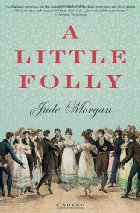
Review: A Little Folly

A Little FollyJude Morgan, A Little Folly

Louisa Carnell and her brother Valentine have grown up in the shadow of their tyrannical father, who devoted his energy to controlling their lives and repressing their spirits. So when he finally dies, the Carnell siblings are ready to come out of their shells and experience life. They re-establish contact with some distant cousins (who had been estranged from the family when their father was alive) and eventually go off to visit them in London. However, their ignorance of the world soon leads them into some fairly big trouble: Valentine becomes attached to a married woman, and Louisa has to navigate her way among various suitors who might hope to win her fortune rather than her love.

Despite — or perhaps because of — my fanatical devotion to Jane Austen and Georgette Heyer, I’m almost always disappointed by books that attempt to mimic their plots and style. The copies are almost never as good as the originals, and why read something inferior when you could have the real thing? But Jude Morgan is a writer of Regency-era historical fiction whose books I truly enjoy, and this book is no exception. I loved Louisa as a heroine because she is both romantic and level-headed. It was also nice to read a book that featured a close sibling relationship. I enjoyed the compelling storyline, witty dialogue, and satisfying romance. In short, definitely recommended to fans of fiction set in this time period!

Review: The Best Man

The Best ManKristan Higgins, The Best Man

Faith Holland hasn’t been back to her hometown for three years — ever since her fiancé Jeremy revealed that he was gay and left her at the altar. Now she’s coming home to refurbish an old barn on her family’s vineyard, but she’s not sure she can handle being around Jeremy again. Unfortunately, she keeps running into his best friend, Levi Cooper, whom Faith blames for ruining her wedding by encouraging Jeremy to come out. Meanwhile, Levi is annoyed that he keeps running into Faith; he remembers her as the goody-goody who would have (albeit unknowingly) ruined his best friend’s life. Neither of them expected that they would feel so attracted to each other; but can Faith and Levi ever build a future together when they have such a complicated past?

I really like Kristan Higgins’ contemporary romances, so of course I had to buy this one as soon as it came out. There are a few differences between this book and the other Higgins novels that I’ve read, but I think they’re good differences. First of all, normally Higgins writes from the heroine’s point of view, but in this book she uses a 3rd-person p.o.v. that follows Faith and Levi in turn. I was glad that she focused on the hero and heroine equally, so that I could get some insight into both characters and understand where they were both coming from. I also really liked Levi, because he’s not quite the stereotypical romantic hero. He’s occasionally crude, shallow, and quick to judge, which makes him a real person rather than an idealized fantasy. Overall, I devoured this novel and am looking forward to Higgins’ next book!

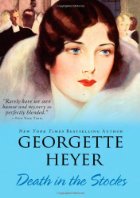
Review: Death in the Stocks

Death in the StocksGeorgette Heyer, Death in the Stocks

When a dead man wearing evening dress is found locked in the stocks on the village green, the local police are only too happy to turn the case over to Scotland Yard. The corpse is Arnold Vereker, a universally despised man who kept a tight hold on the family purse strings. When Superintendent Hannasyde questions Vereker’s young relatives, they all declare themselves extremely happy that their unpleasant half-brother is dead at last. Hannasyde doesn’t know what to make of Antonia, Kenneth, and their various love interests, but he suspects that there are secrets hidden beneath their lighthearted jokes. He sifts through the muddle of motives and alibis with help from Giles Carrington, the Vereker family’s solicitor, who has his own reasons for wanting to uncover the murderer.

I’m a longtime fan of Georgette Heyer’s romances, but I’m quickly coming to love her mysteries as well! As someone who loves a good period piece, I found this an extremely fun book to read. The mystery is perfectly fine, with some interesting little twists and red herrings; I figured out some pieces of the puzzle but didn’t ultimately guess whodunit. However, the real pleasure of this book is the characters, their witty conversations and their blossoming romantic attachments. While the Verekers and their friends take center stage, though, Superintendent Hannasyde is also an intriguing sleuth, and I look forward to reading about more of his cases in subsequent Heyer novels.

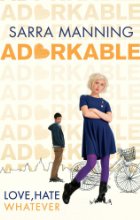
Review: Adorkable

AdorkableSarra Manning, Adorkable

Jeane Smith has never been what you’d call a normal teenager. She dyes her hair weird colors (it’s currently gray, like an old lady’s), buys her clothes at jumble sales, and has a blog on youth culture that’s turned into a full-fledged brand. Jeane has no patience for the boring, vapid teenagers who go to her school, so she’s shocked when all-around golden boy Michael Lee approaches her and informs her that his girlfriend and Jeane’s boyfriend appear to have a thing for each other. At first Jeane is angry and suspicious, which causes her to turn her wrath on Michael. In turn, Michael is extremely put off by Jeane’s in-your-face attitude. But when one of their arguments inexplicably turns into a makeout session, Jeane and Michael begin spending more time together and growing closer to each other in the process.

I really liked Manning’s novel You Don’t Have to Say You Love Me, so I was excited to read this one when it came out. I ended up devouring it in a single day — it may not be great literature, but it sucked me in! What I really like about these characters is that they’re not too good to be true. They have real flaws, to the extent that they’re downright unlikeable at times: Jeane is obnoxious, Michael is cocky, and they’re both extremely self-centered. But the beauty of the story is that it lets you see that they are both lovable despite their faults. I also liked that Jeane and Michael’s relationship is not the perfect, magical love that so often seems to appear in romance novels (both YA and adult). For example, Michael still has a deep attachment to his first love, and his relationship with Jeane doesn’t make that previous relationship any less significant. So I would definitely recommend this book to fans of YA romance.

Review: Warm Bodies

Warm BodiesIsaac Marion, Warm Bodies

In this unusual take on the zombie novel, the protagonist is one of the walking dead. Sometime in the near future, civilization has collapsed, and the world is a perpetual battleground between the living and the undead. “R” and his fellow zombies live in an abandoned airport, where they shuffle around mindlessly and occasionally hunt the living to satisfy their desire for human brains. But “R” is different; though he can’t speak or move like a living person, he is a thoughtful and sensitive soul who can’t help wondering why the world is in such terrible shape. Then he meets Julie, a living girl who sparks an unusual desire in him: instead of eating her brain, he wants to protect her. As “R” and Julie slowly get to know one another, they decide that it’s time to heal their damaged world — and maybe heal each other in the process.

I am emphatically not a reader of zombie novels, but so many people have raved about this one that curiosity got the better of me. Overall I thought the portrayal of zombies was very clever. In the world of this novel, they’re not necessarily mindless monsters; they just can’t communicate with the living (and, of course, they eat brains). But some things did confuse me: for example, “R” says he can’t remember anything about his former life, yet he’s able to make complex literary references (he mentions Moby Dick at one point). Why can he remember these details but not the bigger picture of his life? But speaking of literary references, I don’t think it’s a coincidence that the characters’ names are “R” and Julie — there’s even a balcony scene! The book also mentions John Lennon’s “Imagine,” which got me to thinking…in a sense, this book hypothesizes what kind of world might exist if the lyrics of “Imagine” came true. Imagine there’s no countries, no religion, no possessions…and you might get a world close to this one. (Of course, Lennon also imagines world peace, so it’s not exactly identical.) Anyway, I have mixed feelings about this book, but I did find it quite thought-provoking.

Review: Eleanor & Park

Eleanor & ParkRainbow Rowell, Eleanor & Park

Eleanor is a chubby new girl with out-of-control red hair and weird clothes. Park is a quiet half-Korean boy who clings to his position at the edge of the cool group. In the normal course of things, they would have no reason to speak to each other. But the first day that Eleanor gets on the bus, she is immediately taunted and ostracized by the other students — and Park surprises himself by letting her sit next to him. Tentatively, Eleanor and Park begin to build a friendship, which gradually deepens into an intense love. But the odds are stacked against them: Park’s parents don’t warm to the prickly Eleanor, and Eleanor’s family life is such a disaster that Park can’t even come to her house. Plus, they’re both smart people and know that high school relationships rarely last forever. Will their relationship be able to survive these obstacles, or will love ultimately tear them apart?

After loving Rowell’s debut novel, Attachments, I naturally had to check out this book too…and happily, it is equally awesome! Both Eleanor and Park are wonderful, likable characters, and it was lovely to see each of them through the other’s eyes. I completely believed in their passionate love for each other, which is unusual for me with teen romance. I tend to scoff at happily-ever-after endings in YA, because very few high school relationships actually work out over the long term. But this book swept me away with its giddy intensity, and I found myself happily rooting for Eleanor and Park to make it. I also really enjoyed the pop culture references that are sprinkled throughout the book; it’s set in the 1980s, so there are many mentions of New Wave and cassette tapes and feathered bangs. I would definitely recommend this book to fans of romance or chick lit, even those who don’t normally read YA.

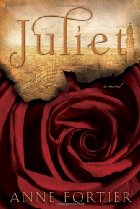
Review: Juliet

JulietAnne Fortier, Juliet

Julie Jacobs and her twin sister, Janice, have lived with their Aunt Rose ever since their parents died tragically when they were babies. When Aunt Rose dies, her will stipulates that Janice will inherit her entire fortune, including the house. Julie is shocked and angered by this slight, until she discovers that Aunt Rose has left her some old documents that belonged to her mother — documents that hint at a treasure hidden somewhere in Siena, Italy. Julie immediately goes to Siena in hopes of discovering this hypothetical treasure, but she soon finds that her inheritance — and indeed her whole identity — is bound up in the story of Romeo and Juliet. Far from being the fictional creation of William Shakespeare, their story is based on true events that occurred in Siena in the 1300s. As Julie digs deeper into the medieval legend of Romeo and Juliet, she eventually discovers some priceless artifacts connected to the lovers and finds her own destiny in the process.

Though Romeo and Juliet is by no means my favorite Shakespeare play (that would be Much Ado About Nothing, in case you were wondering!), I was excited to read this book for its combination of literary detection and romance. Unfortunately, I ended up not liking it very much! My main problem is that the heroine, Julie, is too whiny. She constantly complains about Janice’s poor treatment of her growing up, and she’s always bemoaning her “unattractive” appearance, even though she immediately catches the eye of a handsome Italian. I also hated her narrative style, which is completely stilted and unrealistic. The dialogue is almost uniformly terrible. As for the actual story, parts of it were interesting, especially in the historical chapters. But as events unfolded, I grew more and more irritated at the supernatural elements of the plot, which I was not expecting at all. Basically there’s this Ancient Curse ™ that hangs over Julie and her paramour, who are sort of reincarnations of the original Romeo and Juliet, and they need to break it in order to live happily ever after. The farther I got through the book, the more I went from “not great, but still readable” to “I can’t wait for this mess to end!” Overall, not recommended.