Review: Crosstalk

crosstalkConnie Willis, Crosstalk

In a near-future society, people are looking for ever more efficient ways to communicate and connect with each other. A new experimental procedure, the EED, allows couples to feel each other’s emotions and thus (theoretically) strengthen their relationship. Briddey Flannigan is thrilled when her boyfriend Trent asks her to get an EED with him, but her nosy family doesn’t like the idea, nor does her reclusive colleague C.B. Nevertheless, Briddey goes ahead with the procedure, only to discover that something has gone terribly wrong — she’s now connected to C.B., not Trent. Moreover, she doesn’t just sense his emotions; she seems to be able to read his mind. Now, with C.B.’s help, Briddey must figure out why this connection occurred and learn how to break it, before the negative effects of their telepathic connection cause irreversible damage.

I’m huge Connie Willis fan, so I had high expectations for this book, and I’m happy to say I wasn’t disappointed! This novel has just as much humor and romance as her other light novels, with an added dash of commentary on the negative aspects of incessant communication. I really enjoyed the little asides about past scientific research into telepathy, as well as the speculation that famous historical figures who heard voices (most notably Joan of Arc) might actually have been telepathic. I do think the plot had a few too many twists and turns at the end; the book’s length could have been trimmed somewhat. But I was having such a ball following Briddey and C.B.’s story that I barely noticed at the time! To be fair, the book does have its flaws, which I think the NPR review covers quite well — I can definitely see the reviewer’s point. But I still loved the book, and I would definitely recommend it to Willis fans! Newcomers to her work might want to start with To Say Nothing of the Dog or Doomsday Book (although the latter is much darker) instead.

Mini-Reviews #7: Home stretch

You guys, I did it–I finally caught up with my review backlog! 🙂 I’m hoping to do a better job of keeping up with reviews in the future, and hopefully I can be better about visiting other people’s blogs, too! In the meantime, here’s my last batch of mini-reviews, at least for now:

This Savage SongBoy Is Back, The

Victoria Schwab, This Savage Song — Set in a future where the United States has disintegrated into tiny, isolated city-states, humans and monsters live under an uneasy truce that could snap at any moment. Kate Harker is a human teenager whose father ensures the safety of humans who are willing to pay for his protection. August Flynn is a monster capable of stealing a person’s soul through song, but he’s trying desperately not to give in to his frightening hunger. When August and Kate meet and become friends, they search for a way to keep the peace between monsters and humans. I liked this book a lot; the world-building is excellent, and both Kate and August are intriguing characters. Much of the novel is a setup for the planned sequels, so there’s not a lot of closure in the end (although there’s no cliffhanger per se). But I definitely liked this one enough to continue with the series–looking forward to book #2!

Meg Cabot, The Boy Is Back — I’m pretty sure it was Meg Cabot’s The Boy Next Door that originally got me into chick lit, so I jumped at the chance to read this latest installment in the series. Becky Flowers has made it big in her small town, but she’s never forgotten her high school sweetheart, the one who got away. Reed Stewart is said sweetheart, a professional golfer who left town after graduation and never came back. When he returns to help care for his ailing parents, he and Becky reconnect…and of course, we all know where this is going. I didn’t actually care too much about the central romance–“old flame” isn’t one of my favorite tropes–but I loved the humor and the colorful characters that surrounded Becky and Reed’s story. I also enjoyed the fact that it’s a modern epistolary novel, told entirely through texts, emails, and even online reviews. Definitely recommended for fans of light, fluffy chick lit.

Arabella of MarsEdenbrookeEveryone Brave Is Forgiven

David D. Levine, Arabella of Mars — Three words, y’all: Regency space opera! I loved the idea of combining 19th-century British society with space travel (they use sailing ships!). Ultimately, this is a really fun adventure story wherein Arabella, dressed as a boy, joins the crew of a ship bound for Mars. There’s a handsome captain, a possibly sentient automaton, a mutiny, and a Martian uprising, and it’s all good fun. If you like the premise, you’ll really enjoy this one!

Julianne Donaldson, Edenbrooke — As with Donaldson’s other novel, Blackmoore, I enjoyed this “proper” Regency romance. Marianne Daventry is invited to Edenbrooke along with her sister Cecily, who hopes to marry the heir to the estate. When Cecily is detained in London, Marianne goes to Edenbrooke alone, and she soon finds herself attracted to the handsome and charming Philip–not realizing that he is the very heir her sister is pursuing. This was an entertaining read, but I couldn’t help being impatient with Marianne; it takes her forever to realize that Philip is the heir, and even longer to accept the fact that she’s in love with him. The book is still a pleasant read, but Donaldson isn’t destined to become a favorite author.

Chris Cleave, Everyone Brave Is Forgiven — This novel is a tale of love and loss set during  the early years of World War II. Mary North is an idealistic, privileged young woman who thinks the war is a great adventure, until the Blitz forces her to confront its ugly realities firsthand. Tom Shaw is an educator who isn’t seduced by the glamor of war; he just wants to keep doing his job. And Alistair Heath is Tom’s best friend, who enlists right away but soon realizes that the war might take more than he is willing to give. I wasn’t sure I would like this book at first–the prose definitely has A Style, and I was worried it might get in the way–but I ultimately found it very compelling. There are a lot of heartbreaking moments, but there’s also some great banter and great friendships. Overall, I’d definitely recommend this one to fans of World War II novels.

Review: The River of No Return

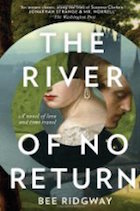
River of No Return, TheBee Ridgway, The River of No Return

Nicholas Falcott, Marquess of Blackdown, is about to die on the battlefield at Salamanca. But instead of being trampled by a French cavalry horse, he suddenly disappears in a blaze of light and reappears in the 21st century. There, Nicholas finds himself under the protection of the Guild, a secret society of individuals with the ability to jump forward in time. The Guild provides Nick with a new identity, plenty of money, and enough information about the modern world for him to survive in the present. Nick believes it’s impossible to go back to his original time — until one day, out of the blue, the Guild leaders order him to do just that. They tell him about a rival group of time travelers whose attempts to change history will result in widespread disaster, unless Nick can go back to 1815 and stop them. But when he jumps back to his own time, he learns that the Guild is keeping secrets from him. He also reconnects with Julia Percy, his beautiful young neighbor who is somehow connected to this feud between time travelers.

This is a book I should have loved: it’s got Regency England, romance, intrigue, and time travel! But sadly, the novel’s underwhelming execution didn’t live up to its great premise. One of the biggest problems for me was the pacing. It took forever to set up the world and introduce Nick and Julia as characters. Once Nick jumps back to 1815 (about 1/4 of the way into the book), things pick up a little, but the pacing still drags. Nothing really important occurs until the last 50 pages or so, when the characters suddenly learn a whole lot of new information at breakneck speed. My other big problem with this novel is that NOTHING IS RESOLVED IN THE END. Nick eventually learns more about the future catastrophe that the time travelers are trying to prevent, but he doesn’t actually do anything about it. So basically, this book is one long setup for a payoff that isn’t going to happen until the sequel — and I don’t think it’s actually been published yet, so it could be a long wait! I’ll admit that I am a bit curious to know how things turn out, but it may not be worth the aggravation this book caused me.

Review: The Day Lasts More Than a Hundred Years

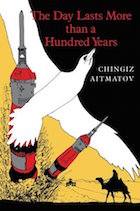
Day Lasts More Than a Hundred Years, TheChingiz Aitmatov, The Day Lasts More Than a Hundred Years (trans. John French)

Set in Kazakhstan in the latter half of the 20th century, this novel centers around Yedigei, a railway worker at the isolated Boranly-Burannyi train station in the middle of the steppe. He has lived with his wife and daughters in the tiny community by this train station for many years, and the other families who live there are practically his family also. When his neighbor and friend Kazangap dies, Yedigei takes responsibility for burying him properly at the ancient Kazakh cemetery of Ana-Beiit, even though it is a long journey from Boranly-Burannyi. Yedigei is able to arrange a small funeral procession that includes several men from the village, a camel, and even a tractor. As the procession makes its way through the steppe, Yedigei reflects on his relationship with Kazangap and on several other significant events in his life. Eventually, his quest collides with a momentous scientific discovery involving contact with intelligent life on another planet.

For me, this book was very put-down-able; I never felt like I simply had to know what was going to happen next. Nonetheless, I was surprised by how much I ultimately enjoyed the story. It certainly took me to an entirely different place and time — I’ve barely read any Soviet literature, and I definitely haven’t read anything set in Kazakhstan before. I think the book wonderfully describes Yedigei’s way of life in a way that is both very specific and somehow accessible to contemporary Western readers. I also loved the meditative quality of the prose, which is enhanced by the frequent repetition of certain phrases and paragraphs throughout the book. The bulk of the novel is told in flashback as Yedigei recalls various incidents, and these flashbacks provide most of the plot. In the book’s present, not much actually happens, but I never felt like things were moving too slowly. The sci-fi aspect of the plot seemed pretty disposable to me, but I was certainly curious while reading to see how it would connect with Yedigei’s story! Overall, even though this book wasn’t a page-turner, I’m really glad I stuck with it.

Review: Uncharted Territory

Uncharted TerritoryConnie Willis, Uncharted Territory

Renowned planetary explorers Findriddy and Carson have a simple mission: to investigate and map out the alien planet they’re currently surveying. But their task is fraught with several complications. Their alien guide, Bult, is hellbent on extorting every last possible penny from Earth by fining Fin and Carson for everything from “destroying indigenous flora” (stepping on the grass) to “disturbing the land surface” (leaving footprints). Earth is also watching Fin and Carson with an eagle eye, theoretically to prevent them from destroying the indigenous environment and customs, but actually to evaluate what natural resources might be worth exploiting. Then a visiting scientist, Evelyn Parker, arrives to tag along on Fin and Carson’s cartographical expeditions, complicating the already volatile relationship between them. Evelyn’s speciality is the mating customs of various species, both human and alien; and it’s no coincidence that as the expedition continues, all parties find themselves exploring the uncharted territory within their own hearts as well.

I’m such a huge Connie Willis fan, so I was very glad to finally read this short novel. It’s one of her comedic offerings (think Bellwether, not Doomsday Book), and I loved her satire on political correctness and the “noble savage” myth. (Not that she paints the aliens as villains, either; they’re just regular people, no better or worse than the visiting Earthers.) There’s also a lot of playfulness surrounding gender: Evelyn turns out to be a man, and Fin’s gender isn’t revealed until quite a ways into the story. Of course, this all foreshadows the eventual emergence of the romantic plot, and I really enjoyed the resolution of that as well. It’s a bit predictable but also quite funny. Overall, I’d say this book is a pleasant diversion, although it lacks the thoughtfulness and depth of Willis’ longer novels. I wouldn’t necessarily recommend it for newcomers to this author, but her fans should definitely enjoy it!

Review: Embassytown

EmbassytownChina Miéville, Embassytown

In a futuristic world on a faraway planet, Avice Benner Cho lives in the main colonists’ city of Embassytown. The planet’s natives, whom the colonists refer to as Hosts, have a unique system of language involving two simultaneously spoken voices that makes communication with them largely impossible; while the humans can understand the Hosts, the Hosts can’t understand most humans at all. The only people even remotely able to speak to the Hosts are the Ambassadors, identical twins who have been specifically engineered for the purpose. So when a new Ambassador arrives on the planet, and they’re not identical twins at all, everyone is shocked by the sheer impossibility of it. And when this Ambassador speaks to the Hosts, even more astonishing — and dangerous — consequences ensue. Avice, though not an Ambassador, has a special relationship to the Host language because she is one of its living similes. Can she find a way to mitigate the disasters caused by the new Ambassador?

If you’re confused by my summary of this book, don’t worry — I was confused for about the first half of the novel! Miéville creates an extremely intricate world full of technobabble and doesn’t spend a lot of time explaining things; rather, the reader is thrust directly into the world and left to sink or swim. I usually don’t mind this technique, since lengthy world-building exposition can be tedious. But because the world is so complicated, it took me a while to figure out which things were important to the story and which were just window dressing. Additionally, the book jumps between two different time periods, which confused me at first. But once I figured out where the story was going and how the past and present narratives fit together, I became much more invested. People who are interested in linguistics will be fascinated by Avice’s eventual solution to communicating with the Hosts. The book also touches on issues of colonialism: although the humans aren’t overtly oppressors, there is a shadowy empire in the background to remind us that there might be hidden agendas at play. Overall, this is not the most accessible book to a casual reader, but those who persevere will be rewarded.

Review: Illusionarium

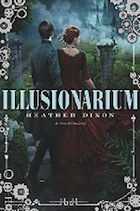
IllusionariumHeather Dixon, Illusionarium

Jonathan has always viewed himself as a completely ordinary young man. He works as an apprentice to his father, one of the foremost scientists in the city, but he is preparing to go to university in a few months. However, all his plans are derailed when the king tasks his father with an important assignment. All throughout the country, a terrible illness is gripping its women, and now the queen has succumbed. Jonathan and his father have only a few days to find the cure before she dies. Their only hope seems to lie with Lady Florel, the most famous scientist in the country. She suggests using a drug called fantillium, which causes shared hallucinations and can thus be used to speed up the apparent passage of time. This will effectively give Jonathan and his father more time to experiment with a cure. Jonathan soon discovers that he is skilled at using fantillium to create hallucinations, or illusions, to impress his audience. But his use of the drug has a dark side, as well as the potential for a shockingly drastic effect on his entire society.

This is a book with a lot of interesting ideas, but it all felt a little half-baked to me. I think the problem is that there are too many plotlines for this relatively short novel, and I wasn’t sure where I was supposed to focus my attention. There’s the “race against time to find a cure for the disease” story, which does get resolved in the end, but we still don’t know much about what caused the disease or why it only affects women (at least, not that I can remember). There’s the “look at this cool drug that causes illusions, but what about the possible negative consequences?” story, which is probably the most developed plot. But to me, it seemed a bit inconsequential in the end…while the illusions would probably be great to watch on the big screen, they’re not particularly exciting in book form. And then there’s some business with parallel universes, but those are never really explained or explored either. I did like Jonathan as a character, and I loved his enemy-turned-ally Lockwood. But unfortunately, character development definitely takes a backseat to plot in this book. Overall, it’s not a bad read, but I wasn’t particularly engaged by it.

Review: Saga, Volumes 3-4

Saga Volume 3Saga Volume 4

Brian K. Vaughan & Fiona Staples, Saga: Volume Three and Saga: Volume Four

Volumes 3 and 4 of this saga (see what I did there?) continue the story of star-crossed lovers Marko and Alana and their daughter, Hazel, who is now a toddler. Fleeing their many pursuers, the family first takes shelter with Alana’s favorite author, D. Oswald Heist, whose romance novels have a surprisingly political subtext. But they’re unable to stay there for long, since a variety of people (and other entities) are hot on their trail. These pursuers include: The Will, a bounty hunter who’s still grieving for his dead paramour; Marko’s ex-fiancée Gwendolyn, who has a score to settle; a robot prince who’s following orders, even though he’d rather be at home with his wife and son; and two tabloid reporters named Upsher and Doff. Now, in addition to the many dangers that Marko and Alana will face if they’re caught, they also begin to face troubles within their marriage. Alana gets a job that introduces her to a dangerous drug, while Marko is tempted by a young mother he meets while at the playground with Hazel.

I enjoyed the first two volumes of this series, and I’m pleased that these two volumes continue to be entertaining, with a nice blend of dark humor and pathos. I remember being a little bit confused in the earlier installments because of the plethora of characters, but I think I’m clearer now about what’s going on. I was particularly happy to get a little more background on the robot kingdom, so I can see now how they fit into the bigger picture. I’m genuinely concerned about Hazel and her little family, and I hope they will be able to stick together going forward! I also have a soft spot for The Will and am interested to see what happens to him next. I definitely think that fans of graphic novels and/or science fiction should check out this series. Unfortunately, I believe only four volumes have been published as of now, but I’ll definitely look for Volume 5 when it comes out!

Review: Saga, Volumes 1-2

Saga Volume 1Saga Volume 2

Brian K. Vaughan & Fiona Staples, Saga: Volume One and Saga: Volume Two

This graphic novel tells the story of one family’s struggle to survive in the midst of a brutal interplanetary war. Alana is from Landfall, the largest planet in the galaxy. Marko is from Wreath, its satellite. When they meet, they fall in love almost immediately; but unfortunately for them, Landfall and Wreath have been at war for as long as anyone can remember. Since both Alana’s and Marko’s people disapprove of their marriage, the star-crossed lovers have no choice but to flee. They end up on the remote backwater planet of Cleave, where their daughter Hazel is born. The story is narrated by Hazel as she describes her parents’ escape from the forces seeking to tear them apart. But various parties from both Landfall and Cleave are pursuing this family, and it will take all their courage and ingenuity to survive.

After seeing some positive reviews of Saga, I decided to give the series a try, even though I generally don’t read graphic novels. (I have nothing against them, but I’m not a very visual person, so I generally find the artwork more distracting than helpful for the story.) I’m very glad I gave this series a chance, since I ended up enjoying it quite a bit. The story is very compelling and spans several genres, from romance to survival adventure to space opera. I loved the banter between Alana and Marko, who clearly care a lot about each other and express their love through teasing. I also found Hazel’s voice to be very compelling, and I look forward to seeing how she grows as the series progresses. There’s some colorful language and a few graphic (ha ha) images, so be warned if that bothers you. Overall, I definitely plan to continue with the series, and I already have Volumes 3 and 4 from the library!

Review: The Ruby Red Trilogy

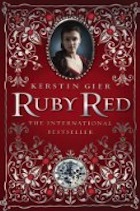
Ruby RedSapphire BlueEmerald Green

Kerstin Gier, Ruby Red, Sapphire Blue, and Emerald Green (trans. Anthea Bell)

Gwyneth Shepherd belongs to an unusual family: every generation, one of its members has the ability to travel through time. Gwyneth has always assumed that her cousin Charlotte has this gift, and Charlotte has spent her entire life preparing for it. But to everyone’s shock, it is Gwyneth who unexpectedly travels through time, revealing herself as the true possessor of the gift. Unfortunately, Gwyneth doesn’t have Charlotte’s extensive training in history and etiquette to help her navigate the past. Moreover, it seems that her family, as well as a secret cabal of fellow time-travelers, is keeping a lot of crucial information from her. For example, what is the meaning of the mysterious prophecy involving “the ruby”? Who is the Count Saint-Germain, and what is his plan for Gwyneth? And most importantly, can Gwyneth trust her partner in time travel, Gideon de Villiers, whose unpredictable behavior both frustrates and attracts her?

First off, I’m very glad that I read all these books at once, because there’s definitely no resolution to the story at the end of Ruby Red or Sapphire Blue. I did enjoy the series overall, but in looking back, I find myself focusing more on its flaws. The plot feels very cluttered to me: Gwyneth and Gideon are constantly jumping back and forth through time to uncover various secrets, yet at the same time, nothing much really happens until about halfway through the second book. The series sets up lots of mysteries, but most of them are fairly easy to solve. It all just felt a little overwrought to me. Also, I was not a fan of the romance; I don’t think Gwyneth should have put up with Gideon’s mixed signals and condescending behavior! I do have to say, I was impressed with how the time travel itself was handled; the timeline of the series makes sense, and I didn’t catch any glaring logical inconsistencies. If you like the genre and don’t mind YA, this series is worth a read, but I’m glad I got the books from the library instead of buying them.