Mini-Reviews: Archive, Swept, Otherwhere

Genevieve Cogman, The Dark Archive

In the penultimate installment of the Invisible Library series, Irene Winters and her friends face a whole new set of problems. They’re the targets of various assassination attempts (even more so than usual), a new master criminal is on the loose in London, and an old enemy unexpectedly resurfaces. To figure out exactly who’s after them and why, Irene and company travel to a scientific exposition that leads to a dramatic showdown in Barcelona’s Sagrada Familia. As with the series in general, I liked this book, though I didn’t find it particularly hard to put down. With only one book left in the series, I’m wondering if everything will be wrapped up in a satisfying way. All along I’ve suspected that the Library may not be completely benign, but I fear the last book won’t explore that idea and will force me to take it at face value. I also question the durability of Irene and Kai’s relationship (and whatever happened to her unresolved sexual tension with Vale?). Looking forward to reading the last book to see how it all turns out.

Beth O’Leary, Swept Away

The back cover of this novel asks, “What if you were lost at sea … with your one-night stand?” And that’s the entire plot of this contemporary romance. Lexi and Zeke meet in a bar on the north coast of England. They have great sex in Zeke’s houseboat, but due to a miscommunication, neither of them secures the boat to the dock. So the next morning, they’ve been washed out to sea and must work together to survive and find their way home. I really like Beth O’Leary’s writing in general, and this book mostly worked for me. I loved the slow-burn romance; both Lexi and Zeke are very guarded people, and it’s lovely to watch them gradually let each other in. The survival stuff wasn’t as compelling for me, and I never really felt they were in serious danger (though of course in real life, they totally would be!). So The Flatshare is still my favorite O’Leary novel, but I did enjoy this one very much as well.

Emily J. Taylor, The Otherwhere Post

Maeve’s father is a notorious murderer, so for the past several years she’s lived under assumed names, never staying in one place long or getting too close to anyone. When she receives an anonymous letter saying her father was innocent, she’s determined to find out more. The answers may be at the Otherwhere Post, a place that teaches the art of scriptomancy—magic-infused writing that allows people to travel between worlds. But the search is dangerous, and Maeve may not be ready for the answers she finds. I really liked the concept of this novel (a school for magic writing! Alternate universes!), but for me, the plot and characters didn’t live up to it. Everything just felt a bit predictable—the characterization, the romance, the “twists” all felt like exactly what you’d find in a typical YA fantasy novel. Plus, Maeve does some unethical (and stupid) things in the course of her quest, which made her a less sympathetic character to me. Overall, a fine but not an exceptional read.
Review: Love in Lowercase

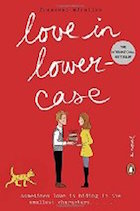
Love in LowercaseFrancesc Miralles, Love in Lowercase (trans. Julie Wark)

Samuel is a thirty-something professor of German living in Barcelona, ringing in the New Year alone with no sense of joy or optimism for the year ahead. But his life suddenly becomes much less lonely with the arrival of a stray cat who immediately demands his attention and affection. The cat leads Samuel to his upstairs neighbor Titus, who is compiling a collection of inspirational stories. Samuel eventually agrees to help the elderly and ailing Titus with his book, which opens up Samuel to a host of new people and experiences. He befriends Valdemar, a possibly homeless conspiracy theorist who philosophizes with him late into the night. He mildly flirts with the veterinarian who comes to give the cat its shots. And by sheer happenstance, he runs into Gabriela, the girl he fell madly in love with as a child but whom he hasn’t seen in decades. But will Samuel be able to transcend his solitary habits and actually act on his feelings?

I should say up front that I didn’t particularly enjoy this book, but I don’t think it’s necessarily the book’s fault. Based on the title and cover, I was expecting a romantic comedy. The cover art looks similar to that on Rainbow Rowell’s books, so I think that made me subconsciously expect a Rowell-esque story. But this book is very different; in fact, the romance is quite weak, which disappointed and sometimes even aggravated me. It’s not that I always need a strong romantic plot in my books, although I admit it’s usually a plus! But if there’s going to be a romance, I’d like for it to be emotionally satisfying…and for me, this one wasn’t. Gabriela is barely a character at all; she’s merely an idealized romantic fantasy for Samuel to moon over. And in fact, the romance isn’t even the main plot. The book mostly just follows Samuel around Barcelona as he philosophizes (in a not particularly deep manner) about life and love. So I wasn’t a fan of this book, but maybe I would have liked it more if I’d gone into it with different expectations.

Review: The Shadow of the Wind

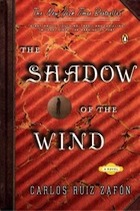
Shadow of the Wind, TheCarlos Ruiz Zafón, The Shadow of the Wind (trans. Lucia Graves)

When Daniel Sempere is ten years old, his father takes him to the Cemetery of Forgotten Books for the first time. There he must choose one book that calls to him, and it will be his job to protect it forever. Daniel chooses a novel called The Shadow of the Wind by Julián Carax, unaware that this simple decision will alter the entire course of his life. Daniel reads the book and loves it, so he tries to find other novels by Carax, only to discover that there are none. Someone is systematically destroying every copy of every book Julián Carax ever wrote, and he is calling himself Laín Coubert, one of Carax’s names for the devil. As Daniel comes of age in mid-20th-century Barcelona, he makes it his mission to discover who is destroying Carax’s books and why. His quest leads him to a long-buried secret involving friendship, passion, madness, and true love. But the more deeply Daniel digs into Carax’s mysterious background, the more he discovers parallels to his own life, and the more danger he finds himself in.

This is one of those books that just didn’t grab me, for some reason. I found myself able to put it down for days at a time, and when I finally did power through it, my mind kept wandering. But I don’t quite understand why, becasue I honestly liked a lot of things about this book! First of all, I’m now dying to visit Barcelona because of the vivid descriptions of its streets, neighborhoods, and restaurants. I also enjoyed the almost Dickensian depictions of the secondary characters, like this one:

His mouth was glued to a half-smoked cigar that seemed to grow out of his mustache. It was hard to tell whether he was asleep or awake, because he breathed like most people snore.

The plot is fairly melodramatic, but it’s undeniably interesting and full of event. Maybe I was a bit put off by the staggering number of coincidences connecting Daniel’s story to Carax’s, or maybe I didn’t like the portrayal of the female characters (who are basically nothing more than male fantasies). Ultimately, I just didn’t connect that much to the story or characters, so it was an effort for me to finish the book.

Review: Isla and the Happily Ever After

Isla and the Happily Ever AfterStephanie Perkins, Isla and the Happily Ever After

Isla Martin has had a crush on Josh Wasserstein since their first year together at the School of the Americas in Paris. But because of his relationship with another girl and her own shyness, nothing has ever happened between them, and Isla is convinced nothing ever will. But then, the summer before their senior year, she bumps into Josh in a Manhattan cafe and actually finds the courage to talk to him. It soon becomes obvious that her crush isn’t as unrequited as she thought, and the two embark on a giddy, passionate relationship. But even the intensity of first love can’t blind Isla to the pitfalls ahead of them: Josh is an artistic slacker who might get kicked out of school despite his talent, while Isla is a bright girl who works hard but doesn’t know what to do after graduation. Can Isla and Josh stay together when everything, from geography to family issues to their own future paths, seems determined to keep them apart?

I’ve been waiting for this novel, the companion to Anna and the French Kiss and Lola and the Boy Next Door, for YEARS, and I was definitely not disappointed! This book really captures the feeling of being young and in love, with its dizzying highs, despairing lows, and all the accompanying drama. Isla is a sweet but spunky heroine, and I personally found her more relatable than Anna or Lola: she’s shy and has a rich interior life, but she has a little more trouble turning her dreams into reality. I like that this book highlights the differences between a crush and a real relationship; even though Isla gets to date the boy of her dreams, their relationship is far from perfect! This book is full of all the swoonworthy romantic moments you’d expect in a Perkins novel, though it’s certainly more explicit than Anna and Lola. The book is definitely geared to a teenage audience (unsurprisingly, since it’s YA), so I did occasionally feel like I was a bit too old for the story. But I still really enjoyed the book and would recommend it to anyone who wants a dramatic, romantic read!

Review: The Spanish Bride

Spanish Bride, TheGeorgette Heyer, The Spanish Bride

Brigade-Major Harry Smith is a Rifleman in Wellington’s army, fighting Napoleon’s forces in Spain and Portugal. He participates in the Siege of Badajos, a long and drawn-out battle that results in plunder, rape, and violence when the allied British and Portuguese soldiers finally conquer the town. As Harry tries to maintain order and discipline, he is approached by two Spanish women who are seeking protection from the carnage within the city. As soon as he lays eyes on the younger of the women, Juana, he falls instantly in love with her, and she with him. Against the advice of Harry’s comrades, they marry immediately, and Juana accompanies her husband throughout the rest of the Peninsular campaign. As she “follows the drum” and experiences life as a soldier, she demonstrates the courage and fiery temperament that make her a perfect match for Harry. Together, the Smiths witness history as they eventually see Napoleon’s final defeat at Waterloo.

I am a huge fan of Georgette Heyer’s Regency romances, but I found that I had to approach this book with entirely different expectations. Although the novel features two young, passionate lovers, it is much more about military history than it is about romance. Harry and Juana Smith were actual historical figures, and Heyer got most of her information from Harry’s journals, as well as from other comtemporary accounts including Wellington’s own dispatches. As a result, there is a lot of great historical detail in the book, but not a lot of plot or character development. While Harry and Juana are very vivid characters, their journey is not the focus of the book. I think the trick to enjoying The Spanish Bride is viewing it as a work of military history with a few romantic touches. If you approach it that way, you’ll find it very readable and entertaining. But if you go into it expecting a tale of romance and suspense with the Napoleonic Wars as a backdrop, you’ll find it extremely dull! So overall, I’d recommend this book if you’re interested in the time period, but you have to adjust your expectations.