Review: A Curious Beginning

Curious Beginning, ADeanna Raybourn, A Curious Beginning

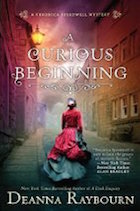
London, 1887. As the city prepares to celebrate Queen Victoria’s golden jubilee, Veronica Speedwell is marking a milestone of her own. After burying her spinster aunt, the orphaned Veronica is free to resume her world travels in pursuit of scientific inquiry—and the occasional romantic dalliance. As familiar with hunting butterflies as she is fending off admirers, Veronica wields her butterfly net and a sharpened hatpin with equal aplomb, and with her last connection to England now gone, she intends to embark upon the journey of a lifetime.

But fate has other plans, as Veronica discovers when she thwarts her own abduction with the help of an enigmatic German baron with ties to her mysterious past. Promising to reveal in time what he knows of the plot against her, the baron offers her temporary sanctuary in the care of his friend Stoker—a reclusive natural historian as intriguing as he is bad-tempered. But before the baron can deliver on his tantalizing vow to reveal the secrets he has concealed for decades, he is found murdered. Suddenly Veronica and Stoker are forced to go on the run from an elusive assailant, wary partners in search of the villainous truth. (Summary from Amazon.com.)

I’ve read and enjoyed the first few Lady Julia Grey books, so I was excited to learn that Raybourn has begun a new mystery series featuring intrepid lepidopterist Veronica Speedwell. Unfortunately, this book really didn’t work for me. It’s a good read in the sense that it’s well written and moves quickly, but I couldn’t get over my dislike of both Veronica and her partner/love interest, Stoker. Historical fiction can be difficult because the protagonists should be realistic for their time period but also sympathetic to modern readers. Veronica errs on the side of being far too modern for her era. She pursues a scientific career by traveling all over the world without a chaperone, and she engages in a variety of sexual affairs, apparently without any consequences to her reputation as a gentlewoman. I simply didn’t find her believable. As for Stoker, he’s a generic brooding alpha male type, and that’s basically all you need to know. It’s not a bad book, by any means, but it didn’t deliver what I look for in historical fiction.

Review: The Lure of the Moonflower

Lure of the Moonflower, TheLauren Willig, The Lure of the Moonflower

***Warning: Possible spoilers for previous books in the series!***

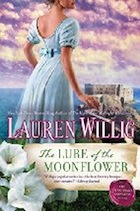
This last installment of the Pink Carnation series finally tells the story of the Pink Carnation herself, Miss Jane Wooliston. It’s 1807, and Napoleon’s armies have invaded Portugal. Officially, the Portuguese royal family have departed for South America; unofficially, the mad Queen Maria is still in the country, providing a focal point for the Portuguese resistance. If the French capture Queen Maria, it will be a decisive victory for Napoleon, so Jane is determined to prevent it by finding her first. But since she is ignorant of both the Portuguese language and the country’s terrain, she’ll need the help of Jack Reid, otherwise known as the Moonflower. Jack, the black sheep of the Reid family, has spied for many nations other than his own, including France. Can Jane trust him not to betray her? And when Jack meets Jane, he’s astonished to discover that the Pink Carnation is a demure young Englishwoman. Can he trust her to maintain her composure — especially when her former lover, a French spy known as the Gardener, is also on Queen Maria’s trail?

I’ve been a fan of the Pink Carnation series ever since the first book, so of course I was eagerly anticipating the final installment. I was especially excited to see that Jane was paired with Jack Reid: they have good chemistry and a believable conflict, as they are both accomplished spies who have trouble trusting each other and showing any hint of vulnerability. Their romance is the main focus of the book, with the spy plot largely being an excuse to get them together — which is fine by me, since I just wanted to see a satisfying ending for these characters whom I’ve grown to love over the course of the series. I do have some complaints, however, mostly because of the stories left untold. For example, we get a little bit of Jane’s romance with the Gardener, but that really should have been its own book. There are also a few minor characters from the series that I wish had gotten more closure. But Willig does include an afterword where she explains her decision to end the series here and gives a little “Where are they now?” update on all her recurring characters. So overall, I think this was a worthy ending to a delightful series, and I look forward to re-reading all the books one of these days!

Review: A School for Brides

School for Brides, APatrice Kindl, A School for Brides

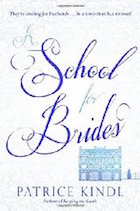
The students of the Winthrop Hopkins Female Academy all know that their primary goal is not to receive a scholarly education but to learn the ladylike skills necessary to attract a husband. The problem is that the school is located in Lesser Hoo, Yorkshire, a country village with absolutely no eligible men. There are currently six girls of marriageable age at the school, and they are constantly bemoaning the dearth of potential husbands in the area. Fortunately, a chance encounter with some gentlemen who are visiting a nearby estate for hunting season provides them with all the romance and intrigue their hearts desire. Some of the girls fall in love with relative ease, while others find various obstacles in their paths. But when a valuable necklace goes missing and the school’s footman is the chief suspect, the girls and their paramours band together to clear his name and find the real culprit.

I had previously read and enjoyed Patrice Kindl’s [Keeping the Castle], which is set in the same village and features some of the minor characters in this book. So I was predisposed to enjoy this novel, and by and large I found it a pleasant read. The writing is light and brisk, very evocative of Georgette Heyer’s style (though of course not as good). I also liked the fact that the girls’ romances develop in a variety of ways. Some of them are true love stories with a happy ending, but some of them end in heartbreak, while one girl marries a kind man she doesn’t love after being betrayed by another suitor. This variety of outcomes especially makes sense in the Regency era, when marriage was basically the only choice for a gently bred young woman. The one thing I didn’t like was that, because of the sheer number of characters to follow, none of them are given much depth. I wasn’t particularly invested in any of the romances, nor did the mystery of the stolen necklace hold my interest (mostly because it was so easy to figure out). But for those who enjoy witty Regency fluff, I’d recommend this book as a fun read.

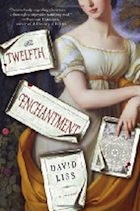
Review: The Twelfth Enchantment

Twelfth Enchantment, TheDavid Liss, The Twelfth Enchantment

As a young woman of no fortune in 19th-century England, Lucy Derrick’s choices are extremely limited. Her parents are dead, so she is forced to live with her odious uncle and his cruel housekeeper. Her only means of escape is to accept the advances of a prosperous local mill owner, but she doesn’t love the man and has delayed making a final decision. But everything changes when Lucy encounters the dashing Lord Byron, the principal landowner in the area. Byron shows up on Lucy’s doorstep with a mysterious illness that is soon revealed to be magical in origin. To Lucy’s surprise, she is actually able to help him through exercising her own magical abilities. This chance encounter leads Lucy into a shadowy world whose existence she had never before suspected — a world of changelings and faeries and soulless beings who cannot die. Assisted by her friend Mary Crawford (of Mansfield Park fame) and by Jonas Morrison, the man who once broke her heart, Lucy must navigate a supernatural power struggle and find an ancient spell book that will vanquish her immortal enemies once and for all.

This was my first encounter with David Liss, and I think it’s probably not the right entry point into his work. My understanding of his other books is that they are serious historical fiction, with plenty of exploration of the gritty realities of life in former eras. This book contains a lot of those same concerns, with Luddites and Rosicrucians both being fairly integral to the plot. But at the same time, this novel also has a lot of Regency romance tropes, like the lovely but impoverished young woman who seeks marriage both for love and for economic stability. As a result, the book felt slightly schizophrenic to me. Personally, I was more interested in Lucy’s individual character development and her romantic relationships than in the broader power struggle, so everything about the aforementioned Luddites and Rosicrucians was a real slog for me. In other words, it’s too heavy for a light, fluffy read; but the Regency-romance elements detract from the serious historical fiction aspects of the book. Some things did work for me, particularly the central romance, but overall I think the book suffers from trying to blend two very different genres.

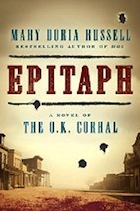
Review: Epitaph

EpitaphMary Doria Russell, Epitaph: A Novel of the O.K. Corral

In the late 19th century, Tombstone, Arizona was a thriving silver-mining town in the American West, but it has become known to history only as the site of the infamous gunfight at the O.K. Corral. The story has been told many times and has become part of the mythology of the Wild West. But what was the fight really like for the men and women who lived it? What were its real causes? Who was really to blame? This novel, the follow-up to Doc, seeks to re-examine the legend and portray events as they really happened — or might have happened. The story begins more than a year before the gunfight, with local and national politics having a significant effect on daily life in Tombstone. Wyatt Earp wants to be sheriff someday, but although he is a man of integrity, he is too naive to realize that others are manipulating him. Meanwhile, the Clantons and the McLaurys are cattle thieves, pejoratively dubbed “cow boys,” who resent the intrusion of the lawmen onto their traditional way of life. These two conflicting ideologies are bound to clash, but in the fallout from the gunfight, the truth is obscured by many conflicting versions of the story, until at last it is covered by legend.

My summary of this book was a pain to write, and I definitely didn’t do it justice, but all you really need to know is that I loved this book! When I read Doc a couple years ago, I thought, “This is why I love historical fiction!” And the same is true of this follow-up novel. I love how Russell is able to take legendary historical figures and make them real, living, breathing people. I love how she pays as much attention to the women of Tombstone as to the men, from the Earp brothers’ common-law wives to the beguiling Josephine Sarah Marcus, whose love for Wyatt Earp would eventually lead to her distorting the events of the gunfight and building Wyatt into a legend. I also got a huge kick out of the fact that each chapter heading is a phrase from the Iliad, which emphasizes the epic, mythic nature of the stories surrounding the gunfight. Another fun fact is that “Epitaph” was the name of one of the local newspapers in Tombstone, so even the book’s title has many layers of meaning. My one complaint is that I would have liked a little bit more of Doc Holliday and his lover, Kate. But anyone who loved Doc should definitely read this novel too! Highly recommended for fans of historical fiction.

Review: Courtship & Curses

Courtship and CursesMarissa Doyle, Courtship & Curses

Lady Sophie Rosier is about to make her debut during the London Season, but what should be an exciting prospect is sad and scary for her. Her beloved mother has recently passed away, and the illness that claimed her life has also left Sophie with a deformed leg and an unattractive limp. Sophie is painfully aware that the denizens of society will view her differently; she won’t even be able to dance at the Season’s balls and other entertainments. Moreover, Sophie is hiding the fact that she has magical abilities, since witchcraft is feared and frowned upon by society. But when certain members of the War Office begin falling victim to mysterious “accidents,” Sophie is able to perceive that magic is involved. With the help of her best friend Parthenope, as well as a potential suitor, Sophie must discover the culprit and save the Duke of Wellington himself.

This book contains a lot of my favorite things: the Napoleonic era, an underdog heroine, magic, and romance. As such, I found it an enjoyable read, but certain things didn’t quite gel for me. First, I’m a little bit confused about the role of magic in the novel. It seems to be a social taboo — when one character learns of Sophie’s abilities, he is absolutely repulsed by it — but the why is unclear. Plus, Sophie’s own mother taught her to cultivate her abilities, which seems like a bad idea if society shuns practitioners of magic. I also would have liked a little more tension in the romance between Sophie and her paramour. On the other hand, I really enjoyed the more lighthearted moments in the book, especially those involving the mischievous Parthenope! Overall, this was a fun read, and if a sequel appears, I’ll most likely read it as well.

Review: The Devil in Music

Devil in Music, TheKate Ross, The Devil in Music

This final installment of the Julian Kestrel series moves from England to Italy, as Julian encounters a five-year-old mystery while traveling on the Continent. Lodovico Malvezzi, a powerful Milanese nobleman, was murdered in 1821, but because of the unstable political situation at the time, the local officials covered up the true cause of his death. Now, in 1825, the truth has finally come out, and the police are once more searching for Lodovico’s killer. The most likely suspect is a young tenor called Orfeo, whom Lodovico had been training for a career in opera and who disappeared shortly after the murder. But Lodovico had kept the singer’s real name a secret, and no one can give a clear description of him to the police. Meanwhile, Julian suspects that Orfeo may not be the guilty party, and he begins to investigate Lodovico’s family, including his fascinating young widow, Beatrice, and his politically involved brother, Carlo. He soon discovers several motives for Lodovico’s murder — but secrets from Julian’s own past will emerge before he can unmask the killer.

As previously mentioned, this is the last book in the Julian Kestrel series, and I’m heartbroken to have come to the end of it! I absolutely love historical fiction, mysteries, and anything set in the Regency period, so this series is really the perfect fit for me. Plus, I’m a sucker for a dandy who is more than he appears to be, which is definitely the case with Julian! That said, I’m not quite sure how I feel about this book specifically. The different setting was interesting, and I enjoyed the little bits of background about Italian politics and opera that permeate the book. I also liked the resolution of the mystery, although certain aspects of it were very predictable. The book’s pacing is also a little slow, and the focus of the book is much more on Julian’s character development than on the plot. While I was glad to see some more exploration of his character, it didn’t altogether satisfy me. I think my issue is the romance between Julian and Beatrice, which just didn’t ring true for me. Still, this is a good book in a great series, and I really wish there were more Julian Kestrel mysteries!

Review: The Laws of Murder

Laws of Murder, TheCharles Finch, The Laws of Murder

Victorian gentleman Charles Lenox has given up his seat in Parliament to return to his true vocation as a detective. He’s even started a detective agency with his friend John Dallington, former rival Polly Buchanan, and a talented Frenchman called LeMaire. Though the business is new, Lenox is confident that it will succeed; but a streak of bad publicity in the London newspapers causes trouble for the fledgling enterprise. Just when Lenox is considering throwing in the towel, however, an unexpected murder forces the police to seek out his services — for the victim is none other than Inspector Jenkins of Scotland Yard. Moreover, Jenkins’ body was found outside the town house of the Marquess of Wakefield, one of London’s most hardened (yet so far uncatchable) criminals. Was Jenkins investigating Wakefield when he met his death? Was Wakefield himself the killer? Lenox and his fellow detectives are on the case, but the conspiracy they uncover is more shocking than they ever could have imagined.

I like this series a lot, and this book is another good installment; but I have to confess, one month later, it’s hard for me to remember much about it! I do recall thinking that the mystery was a little predictable, but there were certainly enough twists and turns to keep me interested. The book also takes time to check in with the various secondary characters who comprise Lenox’s world, which I appreciated — although I would have liked to see even more of McConnell, Lady Jane, and the others! I also think it was a smart move to make Lenox part of a detective agency, as this introduces some new characters and relationships into the mix. The agency also illustrates some interesting areas of blindness in Lenox, especially regarding class. When the business begins to fail, Lenox is upset, but he is never in danger of experiencing real financial hardship. Some of his colleagues, however, depend on the agency for their livelihood, and this doesn’t occur to Lenox initially. So I appreciate that we got a little character growth in this installment, and I look forward to the next book!

Review: In for a Penny

In for a PennyRose Lerner, In for a Penny

The young Lord Nevinstoke, known to his friends as Nev, loves nothing more than a good time, whether it’s drinking with his friends or dallying with his mistress. But when his father dies unexpectedly, Nev suddenly inherits the responsibility of being head of the family, as well as a mountain of crushing debt. With a large estate to repair and no money for the task, his only choice is to marry a rich woman, and heiress Penelope Brown fits the bill nicely. Since Penelope’s father is a tradesman, she is not of Nev’s class, but her money seems a fair trade for his title. Nev and Penelope marry quickly, but despite their growing attraction to each other, they encounter many obstacles. Nev’s estate is in even worse shape than he thought, and he has no knowledge of business matters. His tenants have grown increasingly discontented as the estate has become less prosperous. And meanwhile, Penelope feels uprooted from everything familiar and thrust into a place where she doesn’t belong. Will Nev and Penelope be able to solve these problems and finally find happiness together?

I enjoy a good Regency romance every once in a while, and I’d read that this one is the next best thing to Georgette Heyer. I don’t know if I’d go that far, but I do think the book is very well written and often entertaining. I enjoy the “marriage of convenience turns into something more” trope, so I was predisposed to like the plot, and I also liked both Nev and Penelope as characters. Specifically, I was a big fan of how Nev grows and changes throughout the book. He starts out as a careless young man — albeit a likable one — who lives entirely for pleasure. But when he is confronted with his responsibilities for the first time, he takes them seriously and tries to learn all he can. I also sympathized with Penelope quite a bit, as she experiences a lot of insecurity when she marries “above” herself. I did get annoyed at all the misunderstandings between her and Nev, though; every time it seemed like they were finally on the same page, one of them would second-guess the relationship for no good reason. There was also a lot more, ahem, “romance” than I was expecting. But overall, as Regency romances go, this is a fairly enjoyable one.

Review: Bellman & Black

Bellman & BlackDiane Setterfield, Bellman & Black

This atmospheric novel tells the story of William Bellman, who makes one decision in childhood that will alter the entire course of his life. When he is ten years old, he and a few friends are playing in the field near their village, and they see a rook on a far-off tree branch. Will bets his friends that he can hit the bird with his slingshot, and to everyone’s astonishment, he actually does it. Will and his friends soon forget the incident, but from then on, rooks become a touchstone and a bad omen for William Bellman. As he gets older, he becomes more and more successful: first he get a job at his uncle’s mill, then rises through the ranks until he eventually runs it. He marries and has children, and he begins to make a very comfortable living. But when an illness sweeps through the village and takes most of William’s family, he will do anything to save his remaining daughter — including making a desperate deal with the mysterious Mr. Black. William’s encounter with Black leads him to an entirely different business venture, one that eventually threatens to consume him.

I absolutely loved Diane Setterfield’s debut novel, The Thirteenth Tale, so I had high expectations for this book. Unfortunately, I’m coming away from it with mixed feelings. The writing style is just as rich and gorgeous as I remember, and I found myself reading very quickly despite the slow-moving plot. I also admire the novel’s atmosphere of suspense; it has a wonderfully autumnal, sinister quality, despite the fact that not a lot of scary stuff actually happens. In fact, that may be my biggest problem with the book: there’s this great buildup of tension throughout the novel, but in the end there’s no payoff. The interludes about rooks — and William’s encounters with them throughout the book — are meant to heighten the suspense, I think, but I didn’t really understand their role in the story. Frankly, I was a bit confused about the story as a whole; I was expecting a Faustian narrative in which William essentially sells his soul for success, but that’s not really what happens. In short, I’m not sure what I’m supposed to be taking away from this book — but I’m definitely not giving up on Setterfield yet!