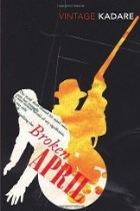
Review: Broken April

Broken AprilIsmail Kadare, Broken April (trans. from the Albanian)

In the remote mountains of Albania, communities live by the ancient rule of the Kanun, a code of conduct that governs every aspect of their lives. The most important part of the Kanun is the rules for blood feuding, which is an integral part of mountain life. Such feuds can endure for centuries and affect every aspect of the community. At the beginning of this novel, Gyorg is lying in wait to kill the man who killed his brother, in accordance with the dictates of the blood feud. But once he kills the man, his own life will be forfeit after a 30-day truce. Now living under a sentence of death, Gyorg travels throughout the countryside musing on the Kanun, fate, and his own impending death. Meanwhile, newlyweds Bessian and Diana have (unconventionally) decided to honeymoon in the wild Albanian mountains, to learn more about this harsh, rule-governed way of life. But while they start out as tourists, their exposure to the rules of the Kanun eventually changes them both in unexpected ways.

This is a very slow-paced, meditative novel that focuses entirely on the Kanun and the different characters’ responses to it. The visitors, especially Bessian, simultaneously romanticize the practice of blood feuding and regard it as a quaint, outdated custom. Gyorg, whose life is more directly affected, wishes he could somehow survive but views the Kanun as inevitable and unchangeable. I liked how Kadare shows the custom from these varying perspectives, so that the reader gets a fuller picture of what it actually means for the people involved. Something else I found particularly fascinating is that the novel is set between the two World Wars, when Albania was a monarchy, but Kadare wrote it in the 1970s, when the country was under Soviet control. So perhaps his exploration of the Kanun is indirectly a critical examination of a different set of harsh, all-encompassing laws. All in all, I found this book a very interesting window into a foreign (to me) culture, and I’d recommend it to people who find the premise interesting.

Review: Roseanna

RoseannaMaj Sjöwall and Per Wahlöö, Roseanna (trans. Lois Roth)

This book begins in the summer of 1965, when a dead body is dredged up from the bottom of a Swedish lake. The corpse is female and naked, with no clothing, jewelry, or personal effects of any kind. The police determine that she was raped and strangled to death, but they have absolutely no clue as to her identity, much less the murderer’s. Police inspector Martin Beck launches an investigation with the help of his colleagues; after weeks of diligent searching, they are able to identify the woman as Roseanna McGraw, an American woman who was touring Sweden by cruise. Slowly, Beck and the other policemen begin to piece together Roseanna’s final days, and with help from the American police, they are able to learn something about her character as well. Beck gradually begins to form an opinion about the personality of the murderer, and sifting through the scanty data gives him a specific suspect. But due to the lack of hard evidence in the case, Beck and his colleagues must set a daring, and dangerous, trap.

I’m a big fan of the mystery genre in general, but I tend to gravitate toward mysteries in which the reader is able to solve the crime right alongside the detective. This book is definitely not like that, but it offers a fascinating alternative perspective on what a mystery novel can be. The focus isn’t on the victim’s character or on a list of potential suspects who can be eliminated one by one; rather, it’s a very realistic portrayal of how police investigations actually work, with all the tedium and frustration and dead ends they entail. One detail I loved is how the case actually took the policemen months to solve, and how they were also working on other cases in the meantime. Interestingly, Beck’s personality is basically irrelevant, and we don’t learn much about him even though this is the first book in “his” series. Crime-solving is much more of a communal endeavor in this novel than it is in the (predominantly) British and American mysteries I’ve read — indicating a broader cultural difference, I suspect! Be that as it may, I enjoyed this book and would recommend it to mystery lovers, even though it was a departure from my normal reading experience.

Review: Transformations

TransformationsAnne Sexton, Transformations

This book is a collection of poetry, and I don’t really know how to review it, or even whether “reviewing” is appropriate for something that is supposed to strike you in a fundamental, visceral way. The poems are all re-imaginings of fairy tales as told by the Brothers Grimm, and Sexton uses the old stories to shed light on modern themes and concerns. For example, here’s the end of “Cinderella”:

Cinderella and the prince
lived, they say, happily ever after,
like two dolls in a museum case
never bothered by diapers or dust,
never arguing over the timing of an egg,
never telling the same story twice,
never getting a middle-aged spread,
their darling smiles pasted on for eternity.
Regular Bobbsey Twins.
That story.

The stories are all set in that quasi-medieval fairytale past, which is interestingly juxtaposed with some very modern language. When the witch in “Hansel and Gretel” is cooked in the oven, “Her blood began to boil up / like Coca-Cola.” When the prince in “Cinderella” tries the glass slipper on every maiden in the kingdom, the narrator observes, “The prince was getting tired. / He began to feel like a shoe salesman.”

All in all, this collection didn’t make a huge impact on me, but I would recommend it to people who like poetry and fairy tales. I’d definitely like to read more of Anne Sexton’s work!

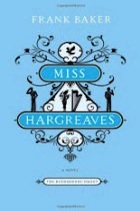
Review: Miss Hargreaves

Miss HargreavesFrank Baker, Miss Hargreaves

When Norman Huntley and his friend Henry are on holiday in Ireland, they decide on a whim to visit the exceedingly ugly church of the village of Lusk. As their tour guide rhapsodizes about the church’s history, he mentions one of its former clerics. Intending to make a joke at the tour guide’s expense, Norman pretends to have heard of this cleric from a (fictional) common acquaintance, Miss Constance Hargreaves. He immediately — with assistance from Henry, who plays along — invents an entire personality and history for Miss Hargreaves, and after a while, the two young men almost believe she is real. But nothing can prepare Norman for the shock of discovering that a woman calling herself Miss Hargreaves is coming to visit him, and she is completely identical to the made-up description he and Henry had concocted! Miss Hargreaves soon embarrasses Norman with her eccentricities, and he begins to wish he could get rid of her — but how can he do so? And if he is really responsible for her existence, should he?

When I first picked up this book, I expected it to be a light, fluffy comedic tale, similar to most of the other early-20th-century British fiction I’ve read. I mean, the synopsis almost sounds like something out of P.G. Wodehouse! But while this book does have its comic moments — like everything that comes out of Norman’s father’s mouth! — it’s actually much more serious than it sounds. Norman’s reaction to learning that he has (presumably) created another human being runs the gamut from shock to amusement to horror. He’s often quite cruel to Miss Hargreaves when she doesn’t show him the love and respect he feels are his due. In this sense, I think Baker was making a point about the dangers of playing God: Norman created Miss Hargreaves and is therefore in some sense responsible for her, but he is too proud and impatient and flawed to fulfill his responsbilities. Overall, this is an odd little book that raises some fairly serious philosophical questions. Recommended if the premise sounds interesting to you!

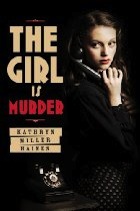
Review: The Girl Is Murder

Girl Is Murder, TheKathryn Miller Haines, The Girl Is Murder

Fifteen-year-old Iris Anderson is having a hard time. About a year ago, her Pop returned from Pearl Harbor with a missing leg, which meant he was no longer able to do the active work required by his business as a private investigator. As a result, Pop and Iris have moved from their old affluent neighborhood to a poor area on the Lower East Side, and Iris has to go to public school instead of the elite private school she formerly attended. Hoping to get closer to her only surviving parent (her mother committed suicide shortly after Pop returned from the war), Iris tries to help Pop with his cases, but he forbids her from having anything to do with the PI business. When one of the boys at Iris’ new school goes missing, however, she can’t help but do a little sleuthing. Along the way, she makes a few friends at her new school, including the unpopular Pearl and the glamorous, fast-talking Suze; but as Iris navigates her way through various cliques and social minefields, how will she know whom she can really trust?

If you enjoy Haines’ Rosie Winter mysteries, you’ll feel right at home in the world of this novel, set in the fall of 1942. The book isn’t about World War II, yet the war permeates almost every aspect of Iris’ life, from the slang used by Suze and the other cool girls at school to the disturbing racisim and anti-Semitism espoused by some of the characters. (These attitudes are definitely not condoned by the book, however; they simply mirror the atttitudes of many Americans at that time.) I liked Iris as a protagonist; her problems are specific to her era yet also universal, as she struggles with her own identity, fitting in, and building a relationship with a distant parent. Her voice is occasionally too precocious for a 15-year-old, but I found that flaw forgivable since she’s so entertaining. As a mystery, the book is very weak; Iris doesn’t spend much time investigating anything, and she’s not even the one who solves the case! So I’d recommend this to someone looking for an interesting YA book about World War II, but it’s not a great read for a mystery fan.

Review: The World of Jeeves

World of Jeeves, TheP.G. Wodehouse, The World of Jeeves

This book is an omnibus of short stories describing the adventures of Bertie Wooster, an amiable but dim aristocrat in early 20th-century England, and Jeeves, the consummate gentleman’s gentleman. Bertie is a friendly soul who just wants to be left alone to enjoy himself. Unfortunately, he has plenty of friends and relatives who are continually making demands on him, both financially and emotionally. His terrifying Aunt Agatha holds him in contempt, yet she is constantly trying to “improve” him and set him up with equally terrifying young females. His friend Bingo Little is always falling desperately in love with some girl or other, and for some reason he always approaches Bertie for help. Though Bertie is not overburdened with brains, he has a generous heart and usually wants to help. Good thing he has Jeeves, whose gravity and intelligence always manage to get Bertie and his friends out of whatever scrapes they’re in.

What can I say about Jeeves and Wooster that the entire world hasn’t said already? Wodehouse has a very specific style and brand of humor, and literally nobody does it better than he does. Bertie’s narrative voice is an utter joy to read, showcasing his own lack of intelligence but also satirizing the pretentious language of some popular fiction at the time. Strangely enough, his friends and family all think of him as the village idiot, but he’s probably smarter than most of his friends — definitely wiser than poor Bingo, for example! And the interplay between Bertie and Jeeves is wonderful; Jeeves always appears completely respectful and subservient, yet he dominates Bertie mercilessly (for his own good, of course!). I definitely recommend the story “Bertie Changes His Mind,” which is narrated by Jeeves and demonstrates how skillfully he is able to manipulate his employer. My one caveat is that you should pace yourself while reading this book, because the stories are all very similar and could become tedious after a while. But I loved it and would recommend it to anyone who enjoys British humor and wants a good belly laugh!

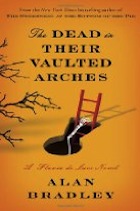
Review: The Dead in Their Vaulted Arches

Dead in Their Vaulted Arches, TheAlan Bradley, The Dead in Their Vaulted Arches

***Warning: MAJOR SPOILERS for previous books in this series!***

At the end of Speaking from Among the Bones, Flavia and her family received the shocking news that her mother, who disappeared many years ago somewhere in Tibet, had been found. This book begins with the de Luce family waiting at the train station for Harriet’s body to come home. Though Flavia is shocked and grieving, she can’t help wondering why Winston Churchill himself has come to pay his respects. Then there’s the man on the platform who whispers a mysterious message into Flavia’s ear and falls to his death on the tracks minutes later. Or was he pushed? As Flavia tries to sort out her feelings about her mother’s death, she can’t help but dig into the secrets of her family’s past — which, of course, turn out to be much bigger and more important than she ever imagined. Not only does she eventually solve the case of the man who died at the train station, but she discovers shocking information about Harriet’s death — and about her own future destiny.

I’ve enjoyed the Flavia de Luce series from the start, but this book is definitely my new favorite. The mystery plot is only so-so; the backstory of Flavia’s mother is rather predictable, and the villain of the book doesn’t have a terribly coherent motivation for some of the events that take place. Still, there is definitely more to be learned about the de Luce family’s past, and I’m sure additional solutions will be revealed in future books! I also think some of the secondary characters got short shrift in this installment; I wanted more of the vicar, the inspector, Adam Sowerby, and the other denizens of Bishop’s Lacey. But despite these nitpicks, I think this book got the most important thing exactly right: the reactions of Flavia and her father and sisters to Harriet’s death. This novel is a story of bereavement and grief much more than a mystery story, and in that light I think it’s fantastic. If you’re a fan of this series, you definitely won’t want to miss this installment! I can’t wait to see what’s next for Flavia and the rest of the de Luces.

Review: The Letters of Nancy Mitford and Evelyn Waugh

Letters of Nancy Mitford and Evelyn Waugh, TheCharlotte Mosley, ed., The Letters of Nancy Mitford and Evelyn Waugh

“I want to write a sad story of a man who gave up drink and hated all his chums. It is me.” — Evelyn Waugh, 12 November 1944.

Nancy Mitford and Evelyn Waugh were two of the most popular and respected authors of the early and mid-20th century; they were also lifelong friends who kept up a correspondence lasting more than two decades. This book is a collection of their letters to each other, which are full of jokes, literary allusions, and most of all gossip. They each had a very pointed, satirical sense of humor that was frequently directed at members of their own social set — and quite often at each other. In many ways they couldn’t be more different: Waugh was very conservative, old-fashioned, and staunchly Roman Catholic, while Mitford was a spiritually indifferent socialist living as an expatriate in Paris. But their correspondence reveals that they understood one another and shared a deep, affectionate friendship. Through their discussions of current events, important people, and of course books (both their own and other people’s), Mitford and Waugh’s letters provide a unique window into their age.

It’s taken me a long time to write this review, because how can one “review” a collection of letters that weren’t (necessarily) meant to be public? All I can say is that I enjoyed reading them. I’ve read a few books by each of these authors — Mitford’s The Pursuit of Love and Love in a Cold Climate, Waugh’s Brideshead Revisited and A Handful of Dust — but otherwise I didn’t know much about either of them. I do think some level of familiarity with their work is helpful, but you definitely don’t have to be an expert in order to enjoy these letters. They’re often hilarious (how I shrieked, as Nancy would say) and also have some interesting discussions about literature. I want to read more of their books now! Of course, their chatter about mutual friends and acquaintances was hard to follow, although the editor did a fairly good job of identifying people in footnotes; but I still enjoyed this collection overall. If you’re interested in early- and mid-20th-century literature, this might be a good book to seek out.

Review: The Two Mrs. Abbotts

Two Mrs. Abbotts, TheD.E. Stevenson, The Two Mrs. Abbotts

Warning: SPOILERS for Miss Buncle’s Book and Miss Buncle Married.

This third book in the “Miss Buncle” series jumps forward in time to explore life in an English village during World War II. Barbara Abbott, née Buncle, now lives in Wandlebury with her husband and two adorable children. The war apparently has little effect on her life, except that there is less food available at the market. But Barbara’s niece by marriage, Jerry Abbott, is dealing with the fact that her husband Sam is fighting somewhere in Africa; in the meantime, she has opened her home to soldiers and evacuees. But despite the privations and worries of wartime, there are still plenty of opportunities for gossip and romance! Sullen Lancreste Marvell has fallen in love with an unsuitable woman; famous authoress Janetta Walters is coming to Wandlebury to speak at the village bazaar; and Jerry’s brother Archie finally seems to be ready for marriage. Finding herself in the midst of these entanglements, will Barbara be able to engineer a happy ending?

I’m so happy that Sourcebooks is re-releasing D.E. Stevenson’s books! I really loved the first two “Miss Buncle” books, and this one is also quite fun and charming, though it definitely suffers by comparison. The problem with this book is that it lacks cohesion; there are several little plots going on, but they are largely independent of one another. Some plots also seem to peter out with no resolution; for example, in the beginning of the book, an old friend of Barbara’s comes to visit, and it seems as though she is going to be a big part of the story, but then she vanishes about halfway through the book. Ultimately the biggest story is about Archie’s courtship, which is quite sweet, but it’s not really developed in much depth. I did like reading a World War II novel that isn’t really about the war, but nevertheless the war affects many aspects of the characters’ lives. The happy, wholesome picture of village life in this book was most likely vanishing at the time Stevenson wrote the novel. Overall, I’d recommend this book to people who liked the other “Miss Buncle” books and are looking for a nice comfort read.

Review: Fer-de-Lance

Fer-de-LanceRex Stout, Fer-de-Lance

This novel introduces the famous detective team of Nero Wolfe, an eccentric genius whose skill in detection is rivaled only by his fondness for orchids, and Archie Goodwin, his streetwise secretary. Although they live in comparative luxury, Wolfe and Archie have not been immune to the effects of the Great Depression, and they certainly won’t turn down any opportunity of making some hard cash. So when a worried Italian woman comes to their doorstep asking them to track down her missing brother, they are eager to take the case. Due to Wolfe’s obese build and strange fears of the outside world, he refuses to leave his home; so it’s up to Archie to investigate the man’s disappearance. He soon discovers, however, that the missing Italian man is just one piece of a much larger puzzle involving the sudden death of a prominent university professor. While Archie collects evidence, Wolfe applies his considerable talents to solving the mystery.

This is my first encounter with Nero Wolfe and Archie Goodwin, but it certainly won’t be my last! I loved Archie as the narrator; his wry, amusing voice reminds me of the fast-talking banter of the great screwball comedies of the 1930s. It was great fun to see the investigation through his eyes, as he applies his own special brand of persuasion to the various suspects and interested parties. Nero Wolfe, by contrast, is significantly less interesting, since the inner workings of his mind remain largely mysterious. He did have some funny moments, though, and I liked his extremely formal patterns of speech. He and Archie make a nice contrast in that regard, since Archie is full of contemporary slang and has an almost aggressively casual tone. As for the mystery itself, it is quite well-plotted, even if the solution isn’t very surprising. The only thing I disliked was that the book keeps going after the culprit’s identity is revealed. For me, the fun of reading a mystery is trying to solve it; once the solution is discovered, I don’t want to read a long denouement about how the guilty party was finally caught. So I thought the end dragged a bit; but other than that, I enjoyed this mystery and look forward to reading more in the series.