Review: The Rose Rent

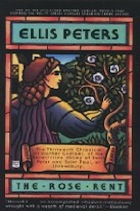
Rose Rent, TheEllis Peters, The Rose Rent

In this 13th installment of the Brother Cadfael series, the Benedictine Abbey of Saints Peter and Paul is disturbed by yet another murder — and this time the victim is one of their own. Judith Perle, a young widow, rents a valuable cottage to the abbey in exchange for a single white rose to be paid from its garden once a year. Brother Eluric is charged with delivering the rose, but a few days before payment is due, he is found dead in the cottage garden. Moreover, the rosebush has been disfigured, its branches hacked off. As the monks mourn Brother Eluric’s death, Cadfael wonders who could have done such a terrible deed. His investigation ultimately centers around Judith Perle, whose wealth and beauty have attracted several new suitors. Because of the cottage’s value, any man who married Judith would want it to be included in her dowry; and if the abbey failed to pay the rose rent, the cottage would return to Judith’s estate without restrictions. As Cadfael searches for Brother Eluric’s killer among the men in Judith’s life, a kidnapping and a second murder ultimately reveal the culprit.

It’s hard to believe that a series could still be good after 13 books, but this latest installment of the Cadfael series was just as enjoyable to me as the first book. There’s a definite formula to this series: there’s almost always a romantic subplot, and the real-life historical events of the era occasionally impinge on Cadfael and the other inhabitants of Shrewsbury. But if you enjoy this formula, which I do, you’ll love the series! I always recommend starting with book one, [A Morbid Taste for Bones], but I think you could read this book without missing any key information and without spoilers for the earlier books. As for this novel in particular, I really don’t have much else to say about it! Simply put, I liked it and will continue with the series. Only seven more books to go!

Review: Here’s Looking at You

Here's Looking at YouMhairi McFarlane, Here’s Looking at You

Aureliana Alessi was never the most popular girl in school. On the contrary, her bushy hair, dumpy figure, and acne-filled complexion ensured that she was frequently teased and bullied. Her worst torment of all came at the hands of James Fraser, the popular boy she had a crush on, who brutally humiliated her at the end-of-year talent show. Now, 10 years later, Aureliana has shed her old persona and her old name: she goes by Anna, and she loves her job as a history professor. But when her department agrees to assist a local museum with an upcoming exhibit, Anna is shocked to run into James Fraser again; he’s part of the publicity firm handling the exhibit. James is as handsome as ever, but he still seems to be the same shallow, self-absorbed person he was in high school. Worst of all, he doesn’t even recognize Anna, much less remember what he did to her. Nevertheless, as Anna and James start to spend more time together, they gradually become friends. She even finds herself harboring romantic feelings for him again. But will their fragile relationship survive when James discovers who Anna really is?

When I first heard about this book, the plot summary intrigued me right away. It seemed like the kind of thing that could be done either very well or VERY badly, depending on how the author handled the situation. I also felt a personal connection to the plot, since I was frequently picked on in school, and those experiences definitely still affect me today. Fortunately, I was pleasantly surprised by this book! I found Anna a very relatable character, and her various emotions toward James — everything from anger to desire to embarrassment — made sense to me. I also think James is portrayed very well. He’s not an admirable character, especially in the beginning of the book; he’s selfish and lost, and the company he keeps isn’t helping. But his backstory is just sympathetic enough that I was rooting for him to change, and I could understand why Anna wanted to be around him. Toward the last third of the book, I realized that this book borrows its basic outline from [Pride and Prejudice], which was a nice bonus for me! But the novel stands very well on its own merits, and I’d recommend it to people who like their chick lit with a little depth.

Review: Murder Underground

Murder UndergroundMavis Doriel Hay, Murder Underground

Miss Euphemia Pongleton is an unpleasant old woman living in a dreary but respectable London boardinghouse. When she is strangled on the steps of the Belsize Park underground station, her fellow boardinghouse residents are surprised rather than saddened; but they soon move past their shock to speculate on who might have done the deed. The police have arrested one suspect, the boyfriend of a maid in the boardinghouse who had been involved with some petty thievery. But the maid is convinced her man is innocent, and the boarders entertain themselves by coming up with alternate theories of the murder. Naturally, Miss Pongleton’s nephew Basil, who always seems to need money and who depends on inheriting his aunt’s fortune, is a prime suspect. But Basil, despite some highly suspicious behavior on the day of the murder, insists that he is innocent. Are his protests a clever ruse, or could someone else in the boardinghouse have wanted Miss Pongleton dead?

This was a very enjoyable Golden Age mystery, although there’s really nothing that makes it stand out from the genre as a whole. But sometimes formulaic plots are comforting, and that’s why I usually enjoy mysteries from this era. There’s the unpleasant murder victim whom we don’t need to mourn; a variety of suspects with a variety of motives, secrets, and questionable alibis; the secondary love story; and the amateur detectives who solve the crime without the involvement or assistance of the police. The mystery is well plotted, and I didn’t guess who the murderer was (although I suspected almost every character at one point or other). There are also some lovely bits of humor, such as when the boardinghouse residents fight tenaciously — but silently — over who gets to sit in Miss Pongleton’s chair. All in all, I’d recommend this to fans of Golden Age mysteries, but it’s definitely not a stellar example of the genre.

Review: Darkness at Pemberley

Darkness at PemberleyT.H. White, Darkness at Pemberley

This mystery novel begins at Cambridge, where a history don and an undergraduate are nearly simultaneously found shot in their rooms. The local police are called, and Inspector Buller is assigned to investigate. At first it appears that the don murdered the student and then killed himself, but Buller notices a few oddities in the don’s rooms that contradict this murder-suicide theory. He subsequently uncovers a drug scandal in the college and eventually discovers the real murderer’s identity. Unfortunately, the murderer has a cast-iron alibi, so Buller is forced to let the man go free. Buller then goes to visit his friend Charles Darcy at Pemberley and tells him about the murders. Charles, enraged by this injustice, goes to Cambridge to threaten the murderer. When Buller discovers this, he is terrified, knowing that the murderer will now come after Charles in retaliation. Almost immediately, strange things begin to happen at Pemberley, and Buller is convinced that the murderer is hiding somewhere in the house or grounds. Can he catch the murderer before his friend becomes the next victim?

Obviously, I was drawn to this book because of the title; any Austen fan will immediately recognize Pemberley as the name of Mr. Darcy’s grand estate in Pride and Prejudice. Sadly, from my point of view, there’s very little connection to Austen’s novel in this book, except that the current inhabitants of the house are still called Darcy. But this is still a very interesting and suspenseful book, despite the fact that it’s a bit schizophrenic. The first part of the book seems like a traditional locked-room mystery, and the solution is both complicated and ingenious. But as I mentioned, the murderer’s identity is discovered fairly early in the book. The novel then shifts to more of a suspense/thriller, as the inhabitants of Pemberley wait for the murderer to make his move so that they can catch him. The novel genuinely creeped me out in places; the idea of being trapped in a maze of a house, with someone pursuing you whom you can’t see, is absolutely claustrophobic and terrifying to me! So if you enjoy that kind of thing, I definitely recommend this book!

Review: Snobbery with Violence

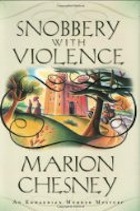
Snobbery with ViolenceMarion Chesney, Snobbery with Violence

Captain Harry Cathcart has recently been invalided out of the army and is looking for something to do with himself. Since he is a gentleman, he is not expected to work for a living; yet, although he is the younger son of a baron, the upper classes don’t entirely accept him as one of their own. Putting his ambiguous social standing to use, Harry becomes a discreet fixer for members of the upper class with problems that they’d like to keep quiet. In this capacity, he is hired to investigate Sir Geoffrey Blandon, a suitor of Lady Rose Summer, because Lady Rose’s father is unsure of the man’s intentions. Harry quickly discovers that Sir Geoffrey intends nothing honorable, but when Rose learns of Harry’s activities, she is furious with him. Unfortunately, Rose and Harry soon meet again at the Marquess of Hedley’s house party; but their constant bickering must take a backseat when one of the guests is found dead. Harry suspects murder and begins to investigate quietly. But when Rose insists on getting involved, her interference could prove deadly.

I’ve had a streak of disappointing books lately, and unfortunately, this one is no exception. I loved the idea of this book — mystery and romance in Edwardian England — but the execution fell sadly flat. Every character was a cardboard cutout, including the two protagonists. Harry is a dour alpha male type, while Rose is a feisty 21st-century heroine in period costume. She befriends her maid (a former actress), is active in the suffragette movement, and doesn’t enjoy the Season’s balls and parties like other girls do. Such characters could be interesting, if they ever rose above caricatures, but they never spoke or behaved like real human beings. The book occasionally attempts to comment on the social inequities of the era, but even its depiction of class struggles is superficial, not thought-provoking. As for the mystery, I can’t remember a thing about it, so I guess it was fine, but certainly nothing extraordinary. Marion Chesney is an extremely prolific author — she also writes as M.C. Beaton — so maybe her other books and series are better. But I have no hesitation in recommending others to skip this one!

Review: High Rising

High RisingAngela Thirkell, High Rising

This gentle novel chronicles daily life in an English village between the wars. The protagonist is Laura Morland, a widowed mother of four sons, who earns a living by writing popular but insubstantial novels. Though three of her boys are grown up, she has her hands full with the youngest, Tony, who is currently obsessed with toy trains. She also observes the follies and foibles of her neighbors and friends, and she is not above interfering when the situation warrants it. For example, wealthy widower George Knox has just hired a conniving secretary who bullies his daughter and appears determined to become his wife; since George is oblivious, Laura takes it upon herself to get rid of the odious woman. Then there’s Sibyl Knox, a sweet young girl with no matrimonial prospects as yet, but Laura has a particular match in mind. And finally, there’s loyal Anne Todd, who has sacrificed everything to care for her sick mother but who still longs for a little romance. Can Laura surmount these various obstacles and ensure happy endings for all involved?

This is my first encounter with Angela Thirkell, but it definitely won’t be my last! In the past few years, I’ve discovered that I really love the types of books published by Persephone, Virago, and Bloomsbury. They’re usually written by women, usually in the 20th century prior to World War II, and they usually deal with the quiet, domestic problems of village life. For me, these books are a form of escapism to a (supposedly) simpler time, but they are also wonderful character studies that explore various forms of human weakness with humor and compassion. In this book, for example, there are no real heroes or villains; even Miss Grey, the objectionable secretary, is ultimately more pathetic than evil. The book is sweet and often quite funny, especially in its descriptions of Tony. I was a little disappointed that Laura herself didn’t end up finding a suitable match, but I suppose that only adds to the realism of the book. Overall, I’m not sure I’ll be re-reading this particular book, but I’ll definitely be continuing with the Barsetshire series!

N.B. I should add that the edition I read (pictured) is full of typos, misspellings and other errors. I’d suggest finding a different version if you can!

Review: Courtship & Curses

Courtship and CursesMarissa Doyle, Courtship & Curses

Lady Sophie Rosier is about to make her debut during the London Season, but what should be an exciting prospect is sad and scary for her. Her beloved mother has recently passed away, and the illness that claimed her life has also left Sophie with a deformed leg and an unattractive limp. Sophie is painfully aware that the denizens of society will view her differently; she won’t even be able to dance at the Season’s balls and other entertainments. Moreover, Sophie is hiding the fact that she has magical abilities, since witchcraft is feared and frowned upon by society. But when certain members of the War Office begin falling victim to mysterious “accidents,” Sophie is able to perceive that magic is involved. With the help of her best friend Parthenope, as well as a potential suitor, Sophie must discover the culprit and save the Duke of Wellington himself.

This book contains a lot of my favorite things: the Napoleonic era, an underdog heroine, magic, and romance. As such, I found it an enjoyable read, but certain things didn’t quite gel for me. First, I’m a little bit confused about the role of magic in the novel. It seems to be a social taboo — when one character learns of Sophie’s abilities, he is absolutely repulsed by it — but the why is unclear. Plus, Sophie’s own mother taught her to cultivate her abilities, which seems like a bad idea if society shuns practitioners of magic. I also would have liked a little more tension in the romance between Sophie and her paramour. On the other hand, I really enjoyed the more lighthearted moments in the book, especially those involving the mischievous Parthenope! Overall, this was a fun read, and if a sequel appears, I’ll most likely read it as well.

Review: The Ruby Red Trilogy

Ruby RedSapphire BlueEmerald Green

Kerstin Gier, Ruby Red, Sapphire Blue, and Emerald Green (trans. Anthea Bell)

Gwyneth Shepherd belongs to an unusual family: every generation, one of its members has the ability to travel through time. Gwyneth has always assumed that her cousin Charlotte has this gift, and Charlotte has spent her entire life preparing for it. But to everyone’s shock, it is Gwyneth who unexpectedly travels through time, revealing herself as the true possessor of the gift. Unfortunately, Gwyneth doesn’t have Charlotte’s extensive training in history and etiquette to help her navigate the past. Moreover, it seems that her family, as well as a secret cabal of fellow time-travelers, is keeping a lot of crucial information from her. For example, what is the meaning of the mysterious prophecy involving “the ruby”? Who is the Count Saint-Germain, and what is his plan for Gwyneth? And most importantly, can Gwyneth trust her partner in time travel, Gideon de Villiers, whose unpredictable behavior both frustrates and attracts her?

First off, I’m very glad that I read all these books at once, because there’s definitely no resolution to the story at the end of Ruby Red or Sapphire Blue. I did enjoy the series overall, but in looking back, I find myself focusing more on its flaws. The plot feels very cluttered to me: Gwyneth and Gideon are constantly jumping back and forth through time to uncover various secrets, yet at the same time, nothing much really happens until about halfway through the second book. The series sets up lots of mysteries, but most of them are fairly easy to solve. It all just felt a little overwrought to me. Also, I was not a fan of the romance; I don’t think Gwyneth should have put up with Gideon’s mixed signals and condescending behavior! I do have to say, I was impressed with how the time travel itself was handled; the timeline of the series makes sense, and I didn’t catch any glaring logical inconsistencies. If you like the genre and don’t mind YA, this series is worth a read, but I’m glad I got the books from the library instead of buying them.

Review: Honeymoon Hotel

Honeymoon HotelHester Browne, Honeymoon Hotel

Rosie has loved London’s Bonneville Hotel ever since she was a child. In former years it was a destination spot for Hollywood stars who wanted to conduct their affairs discreetly, but now it’s a bit run-down and has lost some of its sparkle and glamor. As the Bonneville’s events manager, Rosie hopes to restore the hotel to its former glory, specifically by turning it into London’s most desirable wedding venue. She pursues this goal with single-minded practicality and a rigid attention to detail, despite the fact that she herself was once left at the altar. But Rosie’s plans encounter a snag when the owner of the Bonneville brings his son Joe onto the hotel staff. Joe has spent the last several months in America, and his laid-back attitude and ignorance of the wedding industry drive Rosie crazy — especially when his thoughtless comments cause one bride to call off her wedding. But when a well-known model expresses interest in booking her wedding at the Bonneville, Rosie and Joe must find a way to work together despite their differences.

I enjoy a good chick lit novel from time to time, and I’ve liked some of Hester Browne’s previous novels, so I was eager to read her latest offering. Unfortunately, I found this to be a very forgettable read. There’s nothing particularly bad about it, that I recall; it just didn’t do anything special for me. The plot is a bit of a cliché — girl is too uptight, boy is too relaxed, how will they ever get along? — and nothing about the details or characters really elevated it above that level, for me. I especially had trouble seeing the appeal of Joe, whose character really isn’t developed beyond being laid-back and carefree. So I didn’t care very much about the romance. Also, the book focuses a LOT on Rosie’s job and the minutiae of wedding planning, which even I found dull, and I’m interested in that kind of thing! It’s certainly a readable book, and I do recommend the author for fans of British chick lit, but I definitely wouldn’t read it again.

Review: Trent’s Last Case

Trent's Last CaseE.C. Bentley, Trent’s Last Case

When internationally renowned financier Sigsbee Manderson is found dead on the grounds outside his home, the news sends shock waves throughout English society. Hoping to learn more about the circumstances of Manderson’s death, a notable newspaper magnate calls upon Philip Trent, journalist and amateur detective, to go into Manderson’s neighborhood and investigate the case. Trent soon discovers that Manderson was almost universally disliked, so there is no shortage of suspects, from either of Manderson’s two secretaries to his estranged wife. The more Trent learns about the case, the more he suspects Mrs. Manderson of being involved in her husband’s death. All too soon, Trent arrives at a theory of the case that heavily implicates Mrs. Manderson — which is unfortunate, because he has fallen head over heels in love with her. Will he do the law-abiding thing and disclose his solution to the police, or will he protect the woman he loves?

Contrary to what the title suggests, this is actually the first book featuring Philip Trent; after a 20-year gap, Bentley eventually wrote two more Trent books. Anyway, I knew I would enjoy this book from the moment I saw the dedication to G.K. Chesterton, whom I love. And indeed, there is a sort of Chestertonian twist to the mystery about halfway through, which I don’t want to spoil but which I really, really enjoyed! The writing style is a bit ponderous and old-fashioned, as you’d expect from a book originally published in 1913, but I soon got used to it. I liked Philip Trent as a character; unlike some of literature’s more famous detectives (ahem, Holmes and Poirot), he’s a fairly normal human being without dramatic idiosyncrasies. The romance is very sweet, and the solution to the mystery is both ingenious and unexpected — or at least it was to me! I would definitely recommend this book to fans of vintage mysteries, especially those who are interested in the history of the detective novel.