Review: A Whiff of Death

A Whiff of DeathIsaac Asimov, A Whiff of Death

Professor Louis Brade is a middle-aged chemistry professor whose biggest problem is his ongoing struggle for tenure. But his life gets much more complicated when one of his students, Ralph Neufeld, is found dead in the research lab. Outward signs point to an accident; Ralph was preparing an experiment at the time, and he might have accidentally used a poisonous chemical instead of the identical-looking harmless one. But Professor Brade knows that Ralph was a meticulous chemist who would never have made such a mistake. He is reluctant to voice his suspicion that Ralph was murdered, however — especially when it becomes clear that Brade himself is a promising suspect. Can Brade discover the cause of Ralph’s death, clear his name, and avoid becoming the murderer’s next victim?

I was surprised and delighted to discover that Isaac Asimov also wrote detective novels! And I have to say, I was very impressed with this mystery. I enjoyed the academic setting, and although chemistry plays a large role in the story, it’s very easy for non-scientists to follow as well. I also liked Brade as a main character, mostly because of how normal he is compared to other fictional detectives: He’s an intelligent but not brilliant professor, and he has a happy-ish marriage that nevertheless has its fair share of conflict. Finally, I really loved the policeman in this case, whose breezy manner conceals a very sharp mind. The interplay between the policeman and Brade was one of my favorite parts of the book. Overall, I’d definitely recommend this to fans of older mysteries, and I plan to look for more of Asimov’s detective stories.
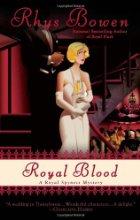

Review: Royal Blood

Royal BloodRhys Bowen, Royal Blood

Lady Georgiana Rannoch, still both royal and impoverished, is desperately searching for a way to make ends meet — especially when her brother Binky and his odious wife Fig come to London expecting her to feed and house them. So when the queen suggests that Georgie represent the British crown at a royal wedding in Romania, she jumps at the chance for a taste of adventure and temporary freedom from her financial woes. When Georgie arrives at the royal palace — which is inevitably located in Transylvania — she is impressed by its suitably gloomy and gothic atmosphere. But when one of the wedding guests, an unpopular Bulgarian dignitary, is poisoned during the house party, it’s up to Georgie to discover the murderer before the tragedy escalates into an international incident.

I started this series a few years ago but lost track of it somewhere along the way, so I’m glad I finally decided to pick up the next book! I really enjoy the light, breezy tone of this series. Georgie is an extremely likable protagonist, a bit silly sometimes, but also full of spunk. I also love the 1930s setting, which allows for glamorous evening parties but also hints at the international strife that will soon erupt into World War II. The mystery plot itself is very slight, with a solution that basically comes out of nowhere; but since I enjoy the setting and characters, I can forgive a relatively weak plot. I definitely wouldn’t recommend the book as a stand-alone novel, but fans of historical mysteries and cozies should give this series a try!

Review: The Club of Angels

The Club of AngelsLuis Fernando Verissimo, The Club of Angels (trans. Margaret Jull Costa)

The narrator of this short book, Daniel, is a member of a very exclusive society of gourmands: He and nine other men regularly meet at each other’s houses to feast on the most delicious, exotic, flavorful meals they can create. The club hasn’t met recently due to some bad blood between the members, but then Daniel meets the mysterious chef Lucídio, who agrees to cook for them. The club members all converge on Daniel’s apartment and are delighted to find that Lucídio’s cooking is the best they’ve ever tasted. But then one of the guests mysteriously dies the next day — and the meal Lucídio had prepared was that guest’s favorite dish. The club continues to hold more dinners, and another member dies after each one. Yet for some reason, Daniel and his friends can’t resist experiencing these exquisitely perfect meals, even with the knowledge that each bite could be their last.

From the moment I read the epigraph of this creepy little novel, I was hooked: “All desire is a desire for death. — A possible Japanese maxim.” Verissimo wasn’t being lazy in his attribution; the saying is actually referenced in the novel, and it highlights Daniel’s unreliability as a narrator. From the start, he warns us that he might be making up the whole story, and then he goes on to give a brief philosophy of the detective novel. So you’ll know within the first two pages whether you’ll like this book or not; I thought it was weird and thought-provoking and very good! My library shelves it in the mystery section, which doesn’t make sense to me, since “whodunit” is clear from the outset (well, kind of). But watching the motives slowly unfold was interesting and surprisingly suspenseful. I should also point out that this book is set in Brazil, and the main characters are essentially a microcosm of Brazilian society, from the political protester to the ex-priest to the criminal. Overall, I enjoyed this book a lot and would definitely recommend it, as well as Verissimo’s other novel, Borges and the Eternal Orangutans.

Review: Behold, Here’s Poison

Behold, Here's PoisonGeorgette Heyer, Behold, Here’s Poison

Gregory Matthews is a domestic tyrant and an all-around unpleasant man, so none of his family members are particularly grieved when he suddenly dies after eating a rich dinner. Everyone, including the local doctor, is ready to accept a verdict of death by heart failure, until the dead man’s overbearing sister insists on a post-mortem. When the autopsy reveals that Matthews was actually poisoned, however, the family is thrown into turmoil. The taint of suspicion touches everyone, from the victim’s sister-in-law, who lives in his house, to his heir, the sophisticated and sarcastic Randall Matthews. Inspector Hannasyde of Scotland Yard is on the case, and he soon finds Randall’s attitude suspicious; meanwhile, Randall claims he is working on his own to discover the murderer. But will he or the police succeed before the guilty party kills again?

I’ve been reading Heyer’s mysteries in publication order, and overall I’ve been enjoying them (though not as much as I love her Regency romances!). Sadly, I think this novel is my least favorite so far. Heyer’s greatest strength isn’t crafting suspenseful mysteries; rather, she excels in creating vivid, likable characters and witty dialogue. In this book, though, I just didn’t find the central characters very likable or interesting. Randall in particular got on my nerves; while Heyer has successfully done similarly urbane, dandified characters in her romances, in this case I found him more irritating than intriguing. The romantic storyline also felt undeveloped and unsatisfying. This book wasn’t a terrible read, by any means, but I’d recommend one of Heyer’s other mysteries instead.

Review: The Collaborator of Bethlehem

The Collaborator of BethlehemMatt Beynon Rees, The Collaborator of Bethlehem

Omar Yussef, a teacher at the Dehaisha refugee camp in Bethlehem, is a fussy, polite, middle-aged man with a combover. He’s the last person anyone would ever expect to make trouble, especially in the politically charged atmosphere of Bethlehem, where one wrong step (literally or figuratively) could place him and his family in lethal danger. But when a prominent Palestinian freedom fighter (or terrorist, depending on whom you ask) is shot just outside his own home, Omar can’t help getting involved — especially when his friend George Saba, a Christian and therefore a convenient scapegoat, is arrested for the killing. Omar knows that George is innocent and even finds evidence proving that he could not have committed the crime. But Omar’s friend the police chief is unwilling to investigate the matter further, since clearing George’s name would anger the militant Palestinians who champion the dead man as a martyr. So Omar resolves to investigate on his own; but the more he digs into the events surrounding the murder, the more he risks his own life.

I don’t know if I can say I liked this book…it’s very dark and very serious, and “liking” doesn’t seem like an appropriate response to it. But I’m extremely glad I read this novel, because it introduced me to a setting and a conflict that I honestly know very little about. The book does a wonderful job of depicting everyday life in Bethlehem, where the threat of violence is omnipresent and where the voices of extremism are much louder than the voices of moderation and peace. I really appreciated that the book does not paint either Israelis or Palestinians as the “bad guys,” but rather focuses on the struggles of individual people to do the right thing (or not) in a terrible situation. This novel is technically a murder mystery, but I found the detective work to be the least interesting part of the story. The urgency of the plot comes not from the hunt for the killer, but from Omar’s race against time to save his friend George. Overall, I found this book a fascinating read and will probably seek out more mysteries featuring Omar Yussef.

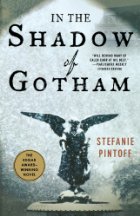
Review: In the Shadow of Gotham

In the Shadow of GothamStefanie Pintoff, In the Shadow of Gotham

After the tragic death of his fiancée, Detective Simon Ziele needs to get out of New York City. He joins the police force of a small town north of the metropolis, hoping that the work will be a respite from the suffering he’s left behind. But when a well-to-do young woman is brutally murdered — in her own house, in broad daylight — Ziele discovers that he can’t fully escape the violence and tragedy of his past. He receives the help of a criminal psychologist at Columbia University who believes that one of his own research subjects may be responsible for crime. Ziele is skeptical about the psychologist’s methods but accepts his help in hunting for the main suspect. But as they search for the man, Ziele is forced to return to New York City and confront some of the memories of his past.

This book had been sitting on my shelf for years, so I’m very glad I finally took the time to read it! I haven’t read many books set in turn-of-the-century America, but it’s certainly a fascinating setting for a murder mystery. This book takes full advantage of the setting, frequently mentioning the Tammany Hall political machine and exploring the gap between rich and poor. The mystery itself was fine but not particularly surprising; I didn’t guess “whodunit,” but I came up with a solution that, frankly, I would have enjoyed more than the actual answer! Nonetheless, I liked Simon Ziele and plan to continue with the series. I would definitely recommend this book to fans of historical mysteries.

Review: A Death in the Small Hours

A Death in the Small HoursCharles Finch, A Death in the Small Hours

Victorian gentleman and amateur detective Charles Lenox has largely given up sleuthing in the pursuit of other interests. A rising member of Parliament, he’s just been asked to give the opening speech for the next session — a very great honor that fills him with both pride and anxiety. But when his uncle, a well-to-do country squire, writes him a letter describing some recent acts of vandalism, Charles is tempted to return to his previous life of detection. He eventually accepts his uncle’s invitation, reasoning that a little time away from London will give him the peace and quiet necessary to work on his speech. When petty vandalism escalates to murder, however, Charles must use all his former skills to uncover the sinister secrets lurking within his uncle’s village.

I always enjoy the Charles Lenox mysteries, but I think this one is a bit of a weak link. My biggest complaint is that the mystery is very perfunctory and almost uninteresting. Although the solution was creative, with the appropriate number of red herrings and so forth, I just didn’t seem to care about it very much! To be fair, the main purpose of the book seems to be Charles’ internal development rather than the external mystery: he is beginning to learn that being a member of Parliament isn’t the dream career he thought it would be. I do love Charles’ character and am interested to see what will happen to him next; I was also very glad to see more of Dallington and would love to see him take a central role in upcoming books! Overall, I definitely plan to continue the series, but this is not one of the strongest installments.

Review: Spies and Prejudice

Spies and PrejudiceTalia Vance, Spies and Prejudice

Berry Fields isn’t exactly your typical teenage girl. Working as an assistant for her P.I. father, Berry is more likely to spend her weekend tailing a suspect than hanging out at the mall. She has also caught so many cheating boyfriends and husbands in the act that she doesn’t fully trust any of the guys she meets. So when drop-dead gorgeous Tanner and his stepbrother Ryan show up at her school, Berry is immediately suspicious and hostile — especially when she overhears Tanner dismiss her as “nothing amazing.” Meanwhile, Berry continues to grieve for her mother, who died eight years ago in a supposed accident. But Berry can’t help suspecting that there’s more to the story…and the more time she spends with Tanner, the more she’s convinced that he’s hiding something.

First off, this is definitely not a book you want to judge by its cover (which is pretty awful, am I right?). It has been described as a cross between Pride and Prejudice and “Veronica Mars,” and if that concept appeals to you, I think you’ll enjoy this book! I found Berry a very believable and interesting character, and her investigation into her mother’s death was a great way to propel the story forward. The romance between her and Tanner was well done, not too melodramatic or sappy, and the mystery balanced out the love story very well. I didn’t 100% understand the final solution to the mystery, but I was reading pretty quickly by that point, so I probably just missed a few background facts along the way. Finally, I really liked the way P&P was incorporated into the story; there’s enough for Austen fans to pick up on and appreciate, but it’s not an exact replica of the original plot. I like the fact that this book uses the P&P framework but incorporates its own spin. Definitely recommended to YA and Austen fans!

Review: Hamlet, Revenge!

Hamlet, Revenge!Michael Innes, Hamlet, Revenge!

Something is rotten at Scamnum Court. The noble English estate is hosting a large house party in order to produce an amateur performance of Hamlet, but things go wrong almost immediately when cryptic threats — some of them taken from the text of Hamlet itself — are delivered to various houseguests. Then Lord Auldearn, a guest who also happens to be the Lord Chancellor of England, is murdered onstage during opening night. The sheer audacity of the murder makes it particularly hard to solve; although the scene of the crime was packed with actors and spectators, it appears that no one saw a thing. Also, there is no shortage of suspects or possible reasons for the crime. Was Lord Auldearn murdered for the confidential state papers in his possession, or was the motive more personal? Inspector Appleby of Scotland Yard must unravel this complex case and discover a diabolically clever murderer.

I have to confess that I spent most of this book being completely bewildered. There were so many characters to keep track of, and I wasn’t sure who would turn out to be important to the plot, so I exhausted myself trying to keep tabs on everyone! This is also a very cerebral mystery; most of the “action” is conversations between Inspector Appleby and his friend Giles Gott. However, I definitely enjoyed the book more as I got further into it, and the ultimate solution was both ingenious and unexpected. I would definitely recommend having read Hamlet, or at least being familiar with the plot, before reading this book; otherwise many of the allusions and plot twists will be very obscure. Overall, I’m not sure this is quite “my kind” of book, but I did enjoy it and would consider reading more by Innes. There’s a whole series featuring Inspector Appleby, and this book is #2, but I was able to follow everything without having read the first book.

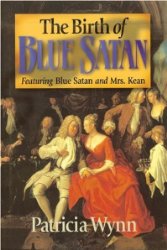
Review: The Birth of Blue Satan

The Birth of Blue SatanPatricia Wynn, The Birth of Blue Satan

Set in England during the reign of George I, this book follows the turbulent fortunes of Gideon St. Mars. Gideon is a handsome and rich aristocrat who hopes to marry Isabella Mayfield, the most sought-after beauty in London. His father, however, disapproves of the match, so Gideon visits him in hopes of persuading him to change his mind. Unfortunately, they have a violent quarrel, which becomes a damning piece of evidence against Gideon when his father is murdered later that day. Although Gideon is innocent, his so-called friends in London society immediately begin to suspect and shun him, including Isabella. Only Isabella’s companion, Hester Kean, believes in Gideon’s innocence; with her help, Gideon must hide from the law until he can bring his father’s real murderer to justice.

This is one of those books whose plot seems custom-made for me: a murder mystery, a wrongly accused hero, an interesting period setting, and a slowly developing romance. So perhaps it’s needless to say that I really enjoyed it! The early 18th century is a period I don’t know much about, but it seems fascinating and ripe for dramatic conflict. George I, the first Hanoverian monarch, is on the throne of England, but there are plenty of dissenters who would like to restore the Stuart line to power. This larger conflict is woven into Gideon’s story, and I’m interested to see how events will unfold in future installments of the series. The only jarring aspect of this book, for me, was that all the women were addressed as “Mrs.” regardless of their marital status. An author’s note explains that this was apparently the custom at that time, but it definitely confused me at first! Otherwise, though, I liked this book a lot and will definitely seek out the sequels.