Review: The Last Enchantment

The Last EnchantmentMary Stewart, The Last Enchantment

This third book in Stewart’s Merlin saga picks up right where The Hollow Hills left off: Arthur has just been crowned High King of Britain, and now he must confront the various threats to his kingdom. He immediately engages in battle with the Saxons and attains victory after victory, but the more serious dangers to Arthur’s kingship come from within. First, Morgause has managed to hide away Mordred, the son she conceived during her incestuous liaison with Arthur, who will ultimately be Arthur’s doom. There’s also the necessity of ensuring the succession, which means Arthur must find a bride. And finally, some of the northern kings are chafing under Arthur’s rule, so he faces internal rebellions as well as external threats. Through all of this, Merlin remains by Arthur’s side to give him advice, friendship, and the occasional prophecy.

My biggest feeling on finishing this book is one of relief — I’m finally done with this trilogy! (Yes, there is a fourth book, The Wicked Day, but I don’t own that one and have no intention of reading it.) It’s not badly written at all, but it moves so slowly that I couldn’t wait to be done! I think the pitfall of telling Arthur’s story from Merlin’s point of view is that (at least in this version of events) Merlin likes to go off by himself to read or tend his garden or visit foreign lands, so he’s not by Arthur’s side during all the interesting parts. There’s almost nothing in this book about Arthur’s knights, or his relationship with Guinevere, or most of the famous legends of Camelot. In short, I found this book — and the series as a whole — pretty boring, although maybe Arthur enthusiasts would enjoy it more. Personally, it’s not something I ever need to read again.
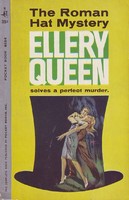
Review: The Roman Hat Mystery

The Roman Hat MysteryEllery Queen, The Roman Hat Mystery

In 1920s New York City, crowds have been thronging to see the latest Broadway hit, a sensationalist gangster play complete with flashing lights and gunfire. But little did the audience members of the Roman theater suspect that a real murder would be committed during the second act! Inspector Richard Queen of the local police is on the scene almost immediately, with his curious son Ellery in tow. In examining the victim’s body, they soon discover an interesting anomaly: despite being dressed in full evening clothes, the dead man wasn’t wearing a top hat. The police scour the Roman theater from top to bottom and search all the audience members as they leave the premises, but the hat is nowhere to be found. While Inspector Queen and his fellow police detectives identify the corpse and discover his involvement in a blackmailing scheme, Ellery applies himself to the mystery of the missing hat — and deduces the identity of the murderer as a result.

I really enjoy classic mysteries from the early 20th century, so I was excited to read this first Ellery Queen novel. Overall, I was very impressed with the mystery plot itself; the solution is tight and hangs together well, although part of the motive is concealed from readers until the very end. (Historical racism is also an aspect of the solution, which can certainly be offputting for contemporary readers.) I also liked the way in which the police were depicted as they investigated the murder: far from being bumbling idiots, they approach their job intelligently and methodically. I was especially tickled by the introduction of the district attorney as a character. Most mystery novels focus solely on catching the killer — never mind if s/he can actually be convicted in a court of law! I wasn’t as impressed with the characterization of the detectives, however. Inspector Queen was more central to this book than Ellery, but he didn’t seem to be consistently depicted, and Ellery was barely fleshed out at all. Presumably, though, more character development occurs in subsequent books, and I’d certainly be willing to read more Ellery Queen novels.

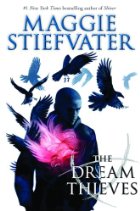
Review: The Dream Thieves

The Dream ThievesMaggie Stiefvater, The Dream Thieves

***Warning: SPOILERS for The Raven Boys!***

Ronan Lynch has the unusual ability to steal objects from his dreams. This doesn’t seem very strange to his group of friends, but then, they’re not exactly normal either. Gansey is obsessed with finding the medieval Welsh king Owen Glendower, Adam has made a strange bargain with a magical forest, Noah is a ghost, and Blue lives in a house full of psychics. Although they’re all working together on the Glendower quest, Ronan is more preoccupied with his own talent and how it might be linked to his family’s past. He’s also being drawn into the orbit of another Raven Boy with a bad reputation and a reckless thirst for danger. But the greatest threat of all seems to come from the sinister Grey Man, who is hunting for something — or someone — that can bridge the gap between dreams and reality. Only Ronan’s friends stand between him and the darkness that awaits…who will prevail?

While I enjoyed The Raven Boys when I first read it, I wasn’t completely sure that I cared enough about the story or characters to continue with the series. This book, however, sold me; I’m now committed to reading the entire series as it comes out. Stiefvater is an excellent writer, with a sparse yet poetic way of describing things that I really admire. Also, since this is book #2 in the series, the characters and world have already been established, so there’s an opportunity to dig deeper into Ronan’s and his friends’ backstories. It doesn’t hurt that this book features Ronan heavily; he’s definitely my favorite of the Raven Boys, and his story arc in this book is compelling. I can’t wait to see what happens to him and the other characters as the series continues!

Review: Chimes at Midnight

Chimes at MidnightSeanan McGuire, Chimes at Midnight

October Daye, faerie knight and private detective, is making it her mission to get goblin fruit off the streets of San Francisco. More potent than any human drug, goblin fruit will cause a human or changeling to become addicted with just one taste; its victims will become swallowed up in their dreams, wasting away and eventually dying. When Toby discovers the corpse of yet another changeling addict, she decides to petition the Queen of the Mists for help. But instead of listening to Toby’s arguments, the queen promptly exiles her, giving her only three days to get out of town forever. Reeling from shock, Toby nonetheless decides to fight back — and soon discovers some interesting details about the queen’s accession to her throne.

This book is yet another wonderful installment of the Toby Daye series. I don’t actually read a lot of urban fantasy, but I was hooked on these books from the beginning. I love Toby’s hard-boiled, self-deprecating voice, and it’s easy to root for her even when she’s getting herself into ever more dangerous situations. I think this book in particular was an excellent showcase for all the secondary characters: from Tybalt and May to Quentin and the Luidaeg, everyone seems to have a moment to shine. Also, the mystery of Quentin’s background is finally revealed! This is definitely more of a “plot” book than a “character” book, though; it’s Toby’s race against time to avoid banishment that drives the story forward. Overall, this is another strong installment of a great series — can’t wait for the next one!

Review: The Hollow Hills

The Hollow HillsMary Stewart, The Hollow Hills

Picking up right after The Crystal Cave left off, this book follows Merlin from the day Arthur was conceived to the day he became high king of Britain. Although Merlin helped Uther Pendragon to marry Ygraine, he is currently out of favor with the king. Yet when Uther needs advice about what to do with his unborn child, Merlin is still the first person he consults. If the child is a boy, Uther must recognize him as the king’s son, just in case he is unable to produce a legitimate heir. At the same time, however, he must keep the boy far away from his court, both to protect him and to get him out of the way in case there should be another son with a better claim to the throne. Merlin suggests sending the child to one of Uther’s loyal knights, where he will be raised as a foster child ignorant of his true parentage. Meanwhile, Merlin becomes Arthur’s friend and protector, teaching him all he needs to know in order eventually to take his rightful place as the king’s heir.

I wasn’t terribly impressed with the first book in this series, The Crystal Cave, but I actually liked this book more. It starts off slowly, but once Arthur is born, the book picks up and gets significantly more interesting. Unsurprisingly, I enjoyed the political machinations aspect of the book more than the mystical aspect; I found Merlin’s visions and prophecies a little boring! I did like watching the relationship between Merlin and Arthur unfold, though, and I look forward to seeing how it continues in the next book. Overall, I’m glad I decided not to give up after The Crystal Cave, and I’m a little more excited about The Last Enchantment than I was before.

Review: Royal Blood

Royal BloodRhys Bowen, Royal Blood

Lady Georgiana Rannoch, still both royal and impoverished, is desperately searching for a way to make ends meet — especially when her brother Binky and his odious wife Fig come to London expecting her to feed and house them. So when the queen suggests that Georgie represent the British crown at a royal wedding in Romania, she jumps at the chance for a taste of adventure and temporary freedom from her financial woes. When Georgie arrives at the royal palace — which is inevitably located in Transylvania — she is impressed by its suitably gloomy and gothic atmosphere. But when one of the wedding guests, an unpopular Bulgarian dignitary, is poisoned during the house party, it’s up to Georgie to discover the murderer before the tragedy escalates into an international incident.

I started this series a few years ago but lost track of it somewhere along the way, so I’m glad I finally decided to pick up the next book! I really enjoy the light, breezy tone of this series. Georgie is an extremely likable protagonist, a bit silly sometimes, but also full of spunk. I also love the 1930s setting, which allows for glamorous evening parties but also hints at the international strife that will soon erupt into World War II. The mystery plot itself is very slight, with a solution that basically comes out of nowhere; but since I enjoy the setting and characters, I can forgive a relatively weak plot. I definitely wouldn’t recommend the book as a stand-alone novel, but fans of historical mysteries and cozies should give this series a try!

Review: Devil’s Brood

Devil's BroodSharon Kay Penman, Devil’s Brood

Henry II, with the help of his wife, Eleanor of Aquitaine, has created one of the vastest empires known to Europe, and the time has come to parcel it out among his sons. As the oldest, Hal will succeed his father as king of England and will also rule over the French duchies of Normandy and Anjou. Richard, Eleanor’s favorite son, will inherit her lands as Duke of Aquitaine. Geoffrey will become Duke of Brittany through marriage to a prominent heiress. But even though all three boys have grown up, Henry still holds onto the reins of power, convinced that none of them are truly ready to rule in their own right. His sons’ lack of independence soon breeds resentment, and Henry is shocked by its consequence: with the help of their mother, they openly rebel against him. This novel is the story of the conflict between Henry and his sons, between Henry and Eleanor, and between the boys themselves, as their struggle for power leads to almost constant warfare throughout Europe.

I’ve been enjoying Penman’s Plantagenet series, and I think this is my favorite installment so far. It’s hard to believe that the major events in this novel actually happened…there’s just so much drama! I also found the portrayal of Henry and Eleanor’s (adult) sons to be fascinating. Geoffrey was my favorite, which will probably surprise any fans of “The Lion in Winter”; but based on Penman’s depiction, I think he would have made the best king. Sure, he was self-serving and manipulative, but so was everyone else in the book! At least he had a good strategic mind with an ability to make long-term plans, and he managed to win over the Breton nobles so that he could rule Brittany competently. The overarching conflict between Henry and his sons was both sad and frustrating. It seemed to come down to a total lack of communication skills and an inability to see the other side’s point of view. (Hmm, sounds familiar….) I’m glad I finally read this book, and I look forward to reading Lionheart in the future.

Review: The Passion of the Purple Plumeria

The Passion of the Purple PlumeriaLauren Willig, The Passion of the Purple Plumeria

In the eyes of the world, Miss Gwendolyn Meadows is the fiercely protective chaperone of Miss Jane Wooliston, who is currently one of the belles of Parisian society. But since Jane is also the elite British spy known as the Pink Carnation, Miss Gwen’s duties also include strategy, swordsmanship, and a taste for the dangerous work of espionage. Miss Gwen thrives upon the excitement of her double life, but she is forced to return to England when Jane’s younger sister goes missing from her prestigious boarding school. A second girl has also disappeared: the youngest daughter of Colonel William Reid, an officer of the British East India Company who has recently returned to England to reunite with his daughters. Now Miss Gwen and Colonel Reid must work together to find the missing girls — and fight their increasing attraction to one another, because Miss Gwen is all too aware that her clandestine activities are the probable reason for the girls’ disappearance.

This is the 10th book in Lauren Willig’s Pink Carnation series, and as I expected, it was a fun Regency romp complete with legendary Indian treasure, a meeting of the Hellfire Club, and a sinister French master spy. I like the fact that Willig chose a more mature hero and heroine for this installment of the series; it lent a bit of substance to the story, although the book still retains the series’ trademark light and fluffy tone. Miss Gwen is in her 40s and has long despaired of ever finding romance, so the relationship between her and Colonel Reid is particularly sweet and satisfying. I also liked how Willig is starting to gather the loose threads from some of her earlier books; for example, Colonel Reid is the father of Alex Reid from The Betrayal of the Blood Lily, and some of the events of that novel are relevant to this story. I am really hoping that Jack Reid, the black sheep of the family, is a hero in one of the future Pink Carnation books! All in all, I’m still enjoying this series and will continue to read more by Willig.

Review: In the Shadow of Gotham

In the Shadow of GothamStefanie Pintoff, In the Shadow of Gotham

After the tragic death of his fiancée, Detective Simon Ziele needs to get out of New York City. He joins the police force of a small town north of the metropolis, hoping that the work will be a respite from the suffering he’s left behind. But when a well-to-do young woman is brutally murdered — in her own house, in broad daylight — Ziele discovers that he can’t fully escape the violence and tragedy of his past. He receives the help of a criminal psychologist at Columbia University who believes that one of his own research subjects may be responsible for crime. Ziele is skeptical about the psychologist’s methods but accepts his help in hunting for the main suspect. But as they search for the man, Ziele is forced to return to New York City and confront some of the memories of his past.

This book had been sitting on my shelf for years, so I’m very glad I finally took the time to read it! I haven’t read many books set in turn-of-the-century America, but it’s certainly a fascinating setting for a murder mystery. This book takes full advantage of the setting, frequently mentioning the Tammany Hall political machine and exploring the gap between rich and poor. The mystery itself was fine but not particularly surprising; I didn’t guess “whodunit,” but I came up with a solution that, frankly, I would have enjoyed more than the actual answer! Nonetheless, I liked Simon Ziele and plan to continue with the series. I would definitely recommend this book to fans of historical mysteries.

Review: A Death in the Small Hours

A Death in the Small HoursCharles Finch, A Death in the Small Hours

Victorian gentleman and amateur detective Charles Lenox has largely given up sleuthing in the pursuit of other interests. A rising member of Parliament, he’s just been asked to give the opening speech for the next session — a very great honor that fills him with both pride and anxiety. But when his uncle, a well-to-do country squire, writes him a letter describing some recent acts of vandalism, Charles is tempted to return to his previous life of detection. He eventually accepts his uncle’s invitation, reasoning that a little time away from London will give him the peace and quiet necessary to work on his speech. When petty vandalism escalates to murder, however, Charles must use all his former skills to uncover the sinister secrets lurking within his uncle’s village.

I always enjoy the Charles Lenox mysteries, but I think this one is a bit of a weak link. My biggest complaint is that the mystery is very perfunctory and almost uninteresting. Although the solution was creative, with the appropriate number of red herrings and so forth, I just didn’t seem to care about it very much! To be fair, the main purpose of the book seems to be Charles’ internal development rather than the external mystery: he is beginning to learn that being a member of Parliament isn’t the dream career he thought it would be. I do love Charles’ character and am interested to see what will happen to him next; I was also very glad to see more of Dallington and would love to see him take a central role in upcoming books! Overall, I definitely plan to continue the series, but this is not one of the strongest installments.