Review: Murder Most Malicious

Murder Most MaliciousAlyssa Maxwell, Murder Most Malicious

It’s Christmas 1918, and England is ready for a little peace on earth after the end of the Great War. But the house party at Foxwood Hall is anything but peaceful: on Christmas night, Lady Phoebe Renshaw hears her older sister Julia arguing with her would-be fiancé, Lord Allerton. The argument ends with Julia breaking off their relationship — and the next day, Lord Allerton is nowhere to be found. Then some of the Foxwood servants receive a gruesome surprise in their Boxing Day gifts, indicating that Allerton is dead. The police believe one of the footmen is responsible, but Lady Phoebe and her maid, Eva Huntford, are convinced of his innocence. In an effort to prove it, Phoebe and Eva do some investigating of their own, and they soon discover that many of Foxwood’s current inhabitants — both above and below stairs — had a reason to want Allerton dead. And if they don’t stop sleuthing, they may be the next to die.

This book has strong Downton Abbey vibes, and I think anyone who enjoyed that show will like this book too. It gives that same upstairs-downstairs picture of English country house life at a time when social mores were beginning to shift dramatically. Phoebe and Eva are both likable protagonists, and despite their class differences, it’s obvious that they truly care for one another. At times they feel a little too much like stock characters, though . . . like every other heroine in historical fiction, they’re intelligent women who seek to transcend their social roles, but they don’t have many other personality traits. The same is true for most of the other characters: there’s the eccentric older relative, the faithful butler, the autocratic matriarch, the handsome lord who’s more than he seems, and so on. Nevertheless, it’s an enjoyable formula, so I didn’t mind too much. The mystery plot was interesting, and while I did guess the culprit, it was fun to follow along. Overall, I’m definitely interested in continuing with the series, and I hope that Phoebe and Eva’s characters will be more fleshed out in subsequent books.

2019 Vintage Mystery Challenge Wrap-Up

2018 Vintage Mysteries

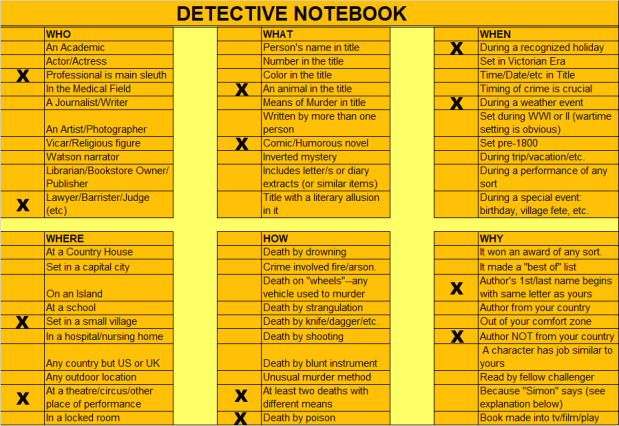
A new year means an all-new vintage mystery challenge! But before I can move on to 2020, I need to post my wrap-up for the 2019 “Just the Facts” vintage mystery challenge! Participants were asked to read at least six books, one from each category on the detective notebook.

Just the Facts Golden 2019

As you can see, I managed to read 12 books, two from each category! Here’s what I read for the challenge, with links to my reviews of each book:

1. Stuart Palmer, The Penguin Pool Murder (what: animal in the title)
2. Alan Melville, Death of Anton (where: theater/circus/place of performance)
3. Ngaio Marsh, Enter a Murderer (who: professional is main sleuth)
4. Raymond Postgate, Verdict of Twelve (how: death by poison)
5. Georgette Heyer, Duplicate Death (why: author not from my country)
6. John Bude, The Cornish Coast Murder (when: during a weather event)
7. Edward Grierson, The Second Man (who: lawyer/barrister/judge)
8. Leo Bruce, Dead Man’s Shoes (why: author’s last name starts with same initial as mine)
9. Francis Duncan, Murder Has a Motive (where: set in a small village)
10. Alice Tilton, The Cut Direct (what: comic/humorous novel)
11. Edmund Crispin, The Moving Toyshop (how: two deaths by different means)
12. J. Jefferson Farjeon, Mystery in White (when: during a recognized holiday)

Of these, I really enjoyed The Penguin Pool MurderEnter a MurdererThe Second Man, and The Cut Direct. Least favorites were Dead Man’s ShoesThe Moving Toyshop, and Mystery in White. Looking forward to reading more vintage mysteries in the coming year!

Review: Mystery in White

Mystery in WhiteJ. Jefferson Farjeon, Mystery in White

Six passengers in a third-class train compartment become entangled in a sinister mystery when the train is trapped in a snowdrift on Christmas Eve. The group includes a lively young brother and sister, a chorus girl, an elderly bore, a shy clerk, and a professor with an interest in the supernatural. They all decide to leave the train and seek shelter at a nearby station, but they become lost in the snow and end up at an isolated country house. Desperate for shelter, they enter the house, but no one seems to be home. Yet the teakettle is on, and the table is set for a meal. As the characters try to make sense of these events, one of them reveals that a man was murdered in the train — and when the group is later joined by another “lost” individual, they suspect that he may be the murderer. This chain of events later converges with another mystery concerning the house itself and a murder that happened 20 years ago.

I enjoy Farjeon’s light and humorous writing style, and his characters are well rounded and sympathetic. But plot-wise, I was quite disappointed in this novel. The six characters introduced in the opening chapters of the book are the ones we follow for about two-thirds of the novel, so naturally I assumed that they would be the most important people in the story. But in fact, aside from the professor, who acts as the detective and orchestrates the denouement, none of these six people have any relevance to either of the mysteries in the novel! They provide some humor and some human interest, but they have no actual function in the plot. Instead, two new characters come in late in the game, and they turn out to be central to the story. I can’t understand why Farjeon would structure his story in such a way that it’s totally disconnected from the characters we’ve been following all along. I also felt sorry for several of the characters, who deserved a happier ending than what they got. All in all, this might be entertaining for people who enjoy a witty period piece, but I definitely wouldn’t recommend it for people who want a good mystery!

Review: Discerning Religious Life

Discerning Religious LifeSr. Clare Matthiass, CFR, Discerning Religious Life

This short book, written by a religious sister, is a guide for Catholic women that describes the process of discerning a religious vocation (that is, a call to become a religious sister or nun). It describes various “steps” of this process in detail, from a woman’s first inkling that she might be called to religious life, to the attitudes and habits she should possess before beginning to discern seriously, to what will happen when she starts researching specific convents and communities. The book is peppered with anecdotes from the author and many other religious sisters who share their experiences of being called and of living out their vocations. The book doesn’t spend a lot of time digging into the theological and historical background of religious life, assuming that the reader will already be familiar with the basics. But it does provide very practical advice and reassurance to women who are questioning whether the religious life might be for them.

Obviously this book is going to be useful only for a very small audience: unmarried Catholic women who are still trying to discover God’s plan for their lives. I fall into this category, and while I’ve never particularly felt called to religious life, I found a lot to think about in this book. My favorite aspect of the book is that it spends a lot of time discussing the sacrifices of religious life — particularly the vows of poverty, chastity, and obedience — and the various obstacles and doubts that many women confront as they consider this vocation. It frankly acknowledges that the religious life is difficult and that the sacrifices it requires are significant. At the same time, the personal stories from the author and the other religious sisters clearly demonstrate the joy they find in their calling. I also really appreciated the book’s discussion of prayer and will definitely be applying some of those lessons to my own prayer life. Overall, I got a lot out of this book and would definitely recommend it to any woman in a similar stage of life.

Review: Mrs. Drew Plays Her Hand

Mrs. Drew Plays Her Hand:Miss Grimsley's Oxford CareerCarla Kelly, Mrs. Drew Plays Her Hand

Roxanna Drew is at the end of her rope. After the death of her husband the vicar, she must find a new home for herself and her two young daughters. Her late husband’s brother is willing to provide this home, but only if she agrees to become his mistress. Revolted by the suggestion, Roxanna decides to rent the dower house of a nearby estate instead, but her brother-in-law’s nefarious schemes are far from over. Meanwhile, the estate’s owner, Fletcher Rand, Lord Winn, has problems of his own. He is shunned by most of society because he publicly divorced his wife after discovering her many infidelities. His family urges him to marry again and produce an heir, but Winn is reluctant to trust another woman — that is, until he meets Roxanna while on a tour of his estates. Winn is immediately attracted to her and quickly befriends both herself and her children. But when circumstances force them into a marriage of convenience, they must learn whether they can truly rely on each other.

As I’ve become more familiar with the romance genre, I’ve encountered Carla Kelly’s name multiple times as a respected author of traditional Regencies, and this particular novel is often praised as one of her best. I wasn’t quite as impressed as I wanted to be, but I did enjoy this book very much and have already begun another of Kelly’s novels. Both Roxanna and Winn struck me as mature adults who are doing their best in their respective difficult situations. I especially liked Winn because, while he’s slightly curmudgeonly at first, he’s not brooding or selfish like many other romance heroes. He shows his love for Roxanna by always putting her and her family’s needs before his own, but his sense of humor keeps him from being annoyingly perfect. There’s not much plot beyond the initial setup, and I found the writing style a bit clunky and some of the dialogue anachronistic. I also wasn’t convinced by the evil brother-in-law’s repentance in the end. But overall, I did like this one and will definitely read more by the author.

Top Ten Tuesday: Favorite books of 2019

TTT Christmas

Somehow it’s New Year’s Eve already, and the year 2019 is coming to an end. So it’s only fitting that this week’s Top Ten Tuesday topic asks us to list our 10 favorite books of the year. I’ve had a really good reading year overall, so it was hard for me to narrow down my list! But here, in the order in which I read them, are my 10 favorite books of 2019:

1. McKelle George, Speak Easy, Speak Love — I loved this 1920s-era retelling of Much Ado about Nothing. It was the first book I read in 2019, and it just might be my number-one book of the year!

2. Meagan Spooner, Hunted — I never thought I’d love a Beauty and the Beast retelling as much as Robin McKinley’s Beauty, but this one comes pretty darn close!

3. AJ Pearce, Dear Mrs. Bird — This poignant World War II novel hit the same sweet spot as The Guernsey Literary and Potato Peel Pie Society, for me. I believe Pearce has a sequel planned, and I’m dying to read it!

4. Gail Honeyman, Eleanor Oliphant Is Completely Fine — I liked this book more than I was expecting to; its portrayal of loneliness is moving and sad, but the ending still manages to be uplifting.

5. Lucy Parker, The Austen Playbook — I adore Parker’s contemporary romances set in London’s theater world. This one involves a grumpy hero and an Austen-themed murder mystery TV show, so what’s not to love?

6. Mary Balogh, The Notorious Rake — I’m not really a fan of the “reformed rake” trope, but the hero of this book totally sold me on it. He’s awful at the beginning, but he truly does grow and change throughout the book — and he’s able to repair many relationships in his life, not just the one between him and the heroine.

7. Beth O’Leary, The Flatshare — It seems that romantic comedies are making a comeback (yay!), and this one is so well written and charming! I look forward to O’Leary’s next book, which is coming out sometime in 2020.

8. Ann Patchett, Bel Canto — This was my first Patchett novel, but it probably won’t be my last. A hostage situation turns into something quite different as guards and prisoners come together through the power of music.

9. Margaret Rogerson, Sorcery of Thorns — Just when I was getting sick of YA fantasy novels, this one came along and reminded me of how creative, intriguing, and fun they can be! I loved the witty banter, the slow-burn romance, and the world of the novel, in which books of magic can literally come alive.

10. Alix E. Harrow, The Ten Thousand Doors of January — Some books are written so well that you sink into them immediately and fall under their spell. This was one of those books, for me — it just felt like magic. If you don’t mind a slower-paced, more character-driven novel, you should definitely give this one a try.

Happy New Year, everyone, and may you read only wonderful books in 2020! 🙂

Review: Snowspelled

SnowspelledStephanie Burgis, Snowspelled

In a fantasy world analogous to 19th-century England, upper-class men are expected to be magicians, while upper-class women are destined to be politicians. But Cassandra Harwood has always had a thirst for magic, and her passionate determination got her all the way to the Great Library, the premier training ground for young magicians. She even found love there with the equally passionate and hardworking Wrexham. But a spell gone horribly wrong has deprived Cassandra of her ability to cast magic, not to mention her social standing and her fiancé. Now, four months after this tragic incident, Cassandra is snowed in at a house party with the high-society people she’s been trying to avoid, including her ex-fiancé. To make matters worse, the snowstorm seems to be magical in origin, and Cassandra is tricked into making a bargain with an arrogant elf-lord to discover who is causing it. If she fails, the consequences will be dire for both herself and her nation, as the age-old treaty between humans and elves will be broken. Can Cassandra discover the culprit and sort out her personal life before it’s too late?

I’ve read and enjoyed books by Stephanie Burgis before, and I’m a sucker for anything that can be described as “Jane Austen plus magic,” so this novella seemed right up my alley. And I did enjoy it overall, but now I find myself remembering more of its flaws. I think the main problem, for me, was the heroine. Cassandra is one of those protagonists who is incredibly stubborn, convinced of her own rightness, and unwilling to compromise. All of her problems in the story are of her own making, particularly the mess of her relationship with Wrexham. I did like Wrexham, and I enjoyed the banter between them, but it frustrated me that they’re both such poor communicators, especially since they were once engaged to each other. Cassandra does grow and change in the course of the story, but it was too little, too late for me. Also, as with many novellas, the short length doesn’t leave much room for nuance in the plot or characters. The world of the story is interesting, and I actually wouldn’t mind reading a full-length novel in this setting, but I feel like I didn’t get to see enough of the world. All in all, I’m not giving up on this author, but I think I’ll stick to her full-length novels instead.

Top Ten Tuesday: Winter (reading) is coming

TTT Christmas

It’s been a while since I’ve done a Top Ten Tuesday, but I always like to check in for the seasonal TBR posts! So below, in no particular order, are 10 books I’m looking forward to reading this winter.

1. J. Jefferson Farjeon, Mystery in White — What is it about Christmas that makes it the perfect season for (fictional) murder and mayhem? I’m excited to read this vintage mystery about a group of people who get snowed in on Christmas Eve with a killer.

2. Erica Ridley, The Viscount’s Christmas Temptation — I got this for free on my Nook some time ago, but I never got around to reading it! The setup sounds fun: the hero wants to cancel his Christmas party, while the heroine insists that he go through with it. I love a “managing female” in a historical romance! (It looks like this may also be published as The Viscount’s Tempting Minx, but I prefer my title!)

3. Rachel Winters, Would Like to Meet — This one has an adorable premise for rom-com fans. The heroine, Evie, works for a film agency whose star screenwriter has a bad case of writer’s block. He’s supposed to write a rom-com, so in an effort to inspire him, Evie sets out to meet a man using the meet-cute techniques of various romantic comedies. Obviously, this book is already on hold at my library!

4. Kate Milford, Greenglass House — I still love a good middle-grade novel, and this one seems to have great reviews. Plus, it’s set in winter, and it involves a mysterious old house and smugglers and possibly ghosts. Also, the cover is incredible!

5. Cecilia Grant, A Christmas Gone Perfectly Wrong — Honestly, just give me all the holiday-themed historical romance novellas. This one has an exuberant heroine and a stuffy, uptight hero (my favorite!) who get stranded in a carriage alone together. Gee, I wonder if they’ll fall in love!

6. Katherine Arden, The Winter of the Witch — Since I loved the first two books in the Winternight trilogy, I’m surprised I haven’t gotten around to the third and final installment yet! But winter is definitely the perfect time to immerse myself in the setting of this book, a fantastical version of medieval Russia.

7. Laura Wood, Under a Dancing Star — I’m a sucker for a Much Ado about Nothing retelling, and Emma at The Terror of Knowing gave this one a wonderful review, so I’m excited to read it! A bit nervous, too, because I loved Speak Easy, Speak Love so much when I read it at the beginning of this year. Will this one measure up?

8. Kate Clayborn, Love Lettering — I’m excited for this romantic comedy to come out on December 31. The heroine has a hand-lettering business, and the hero comes looking for her when he finds a secret she thought she’d hidden in her calligraphy patterns. As someone who can spend hours in a stationery store, I’m very intrigued!

9. Alan Rusbridger, Play It Again: An Amateur against the Impossible — Rusbridger is a former editor of the Guardian, but he’s also an amateur pianist. This book details his quest to learn Chopin’s Ballade No. 1 in G Minor, an extremely difficult piano piece, in the course of one year. As an amateur pianist myself, I’m really interested in his process, and I may even decide to follow in his footsteps! (I actually own the music already, but I’ve never read past the first couple of pages.) Maybe this will be one of my New Year’s Resolutions!

10. Lucy Parker, Headliners — Parker is an auto-buy author for me, so naturally I’m chomping at the bit to read her next London Celebrities book, due out on January 28. This one features Sabrina, Freddy’s sister from The Austen Playbook, and her professional rival. When they’re forced to work together, they’re also forced to confront their true feelings. Enemies-to-lovers is one of my favorite tropes, and again, it’s Lucy Parker . . . of course I preordered it months ago!

Perhaps unsurprisingly, I’ve listed a lot of romance and a lot of books set during winter/Christmas. What about you — have you noticed any trends in your winter reading? What books are on your list?

Review: A Summer to Remember

Summer to RememberMary Balogh, A Summer to Remember

Kit Butler, Viscount Ravensberg, was once a respectable army officer, but now he’s one of London’s most notorious rakes. His father wants him to come home, accept his responsibilities as heir, and marry the woman his family has chosen for him. Kit rebels from this fate and decides to choose his own wife; but she must be so thoroughly respectable that his family couldn’t possibly object to her. Lauren Edgeworth fits the bill nicely: she’s not only beautiful but a perfectly proper lady. She finds Kit’s behavior shocking, yet she’s also intrigued by his mischievous attempts to provoke her. She won’t consent to a real marriage — ever since she was left at the altar a year ago, she’s been determined to remain a spinster — but eventually she agrees to a fake engagement. She’ll accompany Kit to his home and help to heal the estrangement between him and his family. But in return, she wants a summer to remember. Of course, the longer Kit and Lauren spend together, the fonder they grow of each other. But their love may not be enough to overcome past wounds and present insecurities.

Mary Balogh has quickly become one of my go-to historical romance authors, but I must confess that I didn’t love this book quite as much as some of her others. I think it’s largely because I didn’t find Kit remotely charming or fun in the beginning; rather, I thought he was pushing Lauren out of her comfort zone far too aggressively, almost to the point of harassing her. Balogh does course-correct fairly early in the novel, making Kit realize that he’s been treating Lauren as an object rather than as a fellow human being, but I felt that the transition was abrupt and the motivation for the change was unclear. The premise of the book is a bit thin as well — I didn’t understand what Lauren was actually hoping to get out of her summer with Kit, given that she was planning to live in Bath as a spinster afterwards. However, I liked that both characters are dealing with a lot of emotional pain, but they react in completely opposite ways, Lauren by adhering strictly to society’s rules and Kit by breaking them altogether. So I did warm up to both main characters eventually, and I ended up enjoying this opposites-attract romance quite a bit. I’ll definitely continue to read more by Balogh!

Review: The Moving Toyshop

Moving ToyshopEdmund Crispin, The Moving Toyshop

On holiday in Oxford, poet Richard Cadogan stumbles upon a perplexing mystery. Arriving in town late at night, he blunders into a toyshop (the front door being mysteriously unlocked) and discovers a corpse in the flat upstairs. Before he can do much more than ascertain that the old woman is really dead, someone hits him from behind and knocks him out. When he comes to, Cadogan escapes and rushes to tell the police about the murder. But when he leads the policemen back to the scene of the crime, the toyshop is gone. In its place is a grocer that has obviously been there for years. Of course, the police think that Cadogan is crazy, and they won’t investigate a murder without a body. Luckily, Cadogan is acquainted with Gervase Fen, an Oxford don who moonlights as an amateur detective. Together, Fen and Cadogan investigate the mystery and uncover a murderous conspiracy, as well as discovering what happened to the moving toyshop.

This is a fun romp of an English Golden Age mystery, with just enough Oxford detail to please fans of academic mysteries. But despite the fact that it’s probably Crispin’s most famous novel, several aspects of it didn’t work for me. First, I can’t figure out Gervase Fen as a character: he’s supposed to be about 40 and lean, but his dialogue (especially the constant exclamations of “Oh, my dear paws!” and “Oh, my fur and whiskers!”) makes me picture a much older and larger man. Also, he’s rude about Jane Austen, which is an automatic strike against him in my book! Then there’s the issue of pacing. The story starts off strong, but it seems like most of the mystery is solved with about one-third of the book still to go. Finally, it seemed like the novel was setting up a romance for Cadogan, but nothing ever came of it, which I found confusing and disappointing. Still, I did enjoy the novel’s light tone overall, as well as the Oxford setting. I’d consider reading more by Crispin, but I think I’ll have to go in with moderate expectations.